 Society
Craft village turns to technology to adapt to changing markets
1.
|
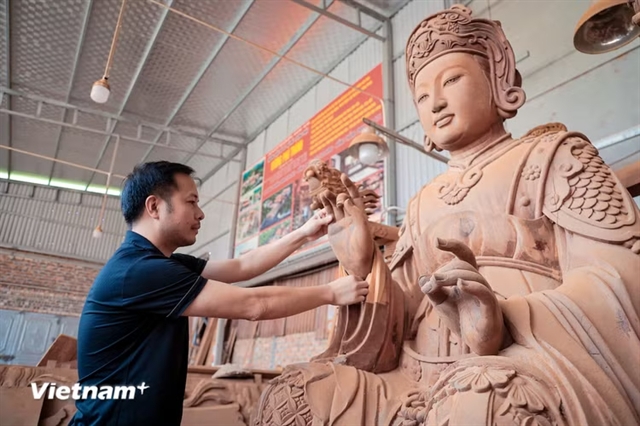
| Artisan Nguyễn Xuân Thắng with a large statue. — VNA/VNS Photos Hoài Nam |
SƠN ĐỒNG — For centuries, artisans in Sơn Đồng Village on the outskirts of Hà Nội have carved wooden statues and religious ornaments for temples and pagodas across the country.
Their work can be seen at some of the capital's best-known heritage sites, including Văn Miếu (the Temple of Literature), Ngọc Sơn Temple and Một Cột (One Pillar) Pagoda.
But as markets change and demand for traditional products becomes less predictable, the village's craftspeople are turning to digital technology and modern machinery to keep their trade alive.
In workshops where the smell of freshly cut wood still fills the air, artisans are experimenting with 3D scanning, artificial intelligence (AI), digital modelling and computer-controlled carving machines.
The technology is helping them shorten production times, reduce manual labour and develop new products, while leaving the finer details of traditional craftsmanship in human hands.
Technology transforms production
Nguyễn Xuân Thắng, a third-generation woodcarver from Hoài Đức Commune, grew up watching his grandfather and father practise the family trade.
After graduating in interior design from the University of Industrial Fine Arts, he began looking for ways to expand beyond the traditional products made at his family's workshop.
For generations, the business had focused largely on religious items for communal houses, temples and pagodas, including worship altars, carved panels, parallel couplets and large Buddha statues.
Thắng recalled that international visitors who came to Sơn Đồng 10 to 15 years ago often admired the intricate craftsmanship but found it difficult to take home large statues and bulky religious objects.
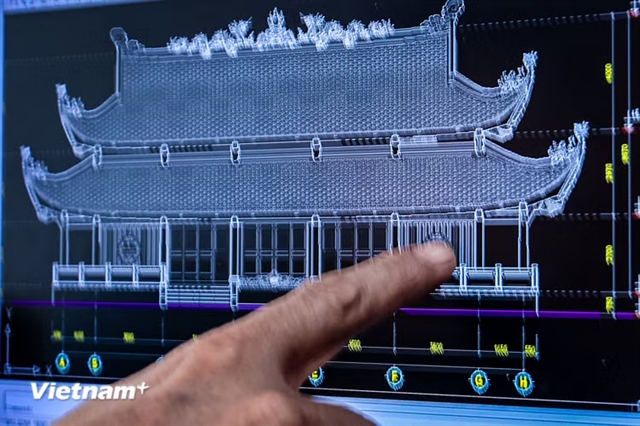 |
| Digital designs allow Sơn Đồng artisans to refine dimensions and details before carving begins. |
The lack of smaller souvenirs reflecting the village's identity prompted him to explore new designs that combine traditional motifs with modern production techniques.
His workshop now uses 3D scanning to digitise antique objects, while AI tools help generate initial designs that he estimates are 60-70 per cent accurate before being refined into complete 3D models.
CNC machines equipped with four carving heads can work on several pieces simultaneously, producing consistent results.
A machine running for 10 hours can produce as much as about three skilled hand carvers, Thắng said, adding that the technology can cut production time for large orders by at least 50 per cent.
Another artisan, Nguyễn Trung Kiên, has also embraced digital design. After graduating from the University of Fine Arts, he returned to Sơn Đồng to support local workshops by creating technical drawings and 3D models for their products.
He now spends much of his working day at a computer rather than at a carving bench.
Kiên said 3D printing allows artisans to create miniature prototypes, helping them assess proportions and details and make adjustments before production begins.
The digital process has reduced design and modelling time to around one-fifth of that required by traditional methods, he said. Designs that once took nearly a month can now be completed in just a few days.
New markets, traditional values
The drive to modernise comes as the village seeks to reach customers beyond its traditional market.
Reflecting on his 25 years in the trade, Thắng said the period after the COVID-19 pandemic was particularly difficult, as households cut spending and demand for large religious construction and renovation projects declined.
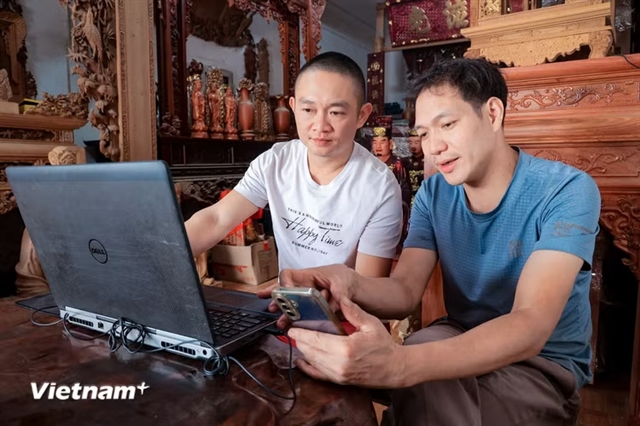 |
| Nguyen Trung Kien discusses 3D designs with artisans before submitting them to clients. |
The village's dependence on a relatively narrow customer base had become increasingly apparent.
Thắng responded by developing smaller products and diversifying the workshop's designs.
Traditional motifs such as the nghê, a mythical guardian creature, ornamental figures and dragons inspired by the Lý Dynasty have been adapted into desk decorations, paperweights and pen holders.
These smaller items are easier for foreign visitors and younger consumers to buy and take home as souvenirs.
Thắng is also experimenting with alternative materials as natural timber becomes increasingly scarce and expensive.
He said the move was not intended to replace traditional wooden products but to give the workshop greater flexibility in controlling costs and meeting market demand.
Wooden objects, while popular, can warp, shrink or crack when exported to countries with different and sometimes extreme climatic conditions.
Alternative materials can improve durability and reduce product weight, making storage and international transport easier while offering customers more choice.
Yet the growing use of machinery has raised concerns that mechanisation could weaken the traditional skills for which Sơn Đồng is known.
Thắng dismisses those concerns, saying CNC machines and 3D printers are tools to reduce physically demanding work and produce basic shapes, rather than substitutes for skilled artisans.
Machines can complete about 80 per cent of the basic shaping, he said, but the finishing work still relies on skilled human hands.
Nguyễn Trung Thành, a descendant of local artisan Nguyễn Văn Hồng, also believes craftsmanship involves more than technical precision.
He said creating distinctive religious sculptures requires not only skill but also what he described as tâm, a combination of conscience, dedication and spiritual devotion.
Artisans carving Buddha and deity statues, sacred cranes and horses, decorative panels and traditional couplets must understand the cultural and spiritual significance of the figures they create, he said.
That understanding, he added, helps shape both the character of the artisan and the quality of the finished work.
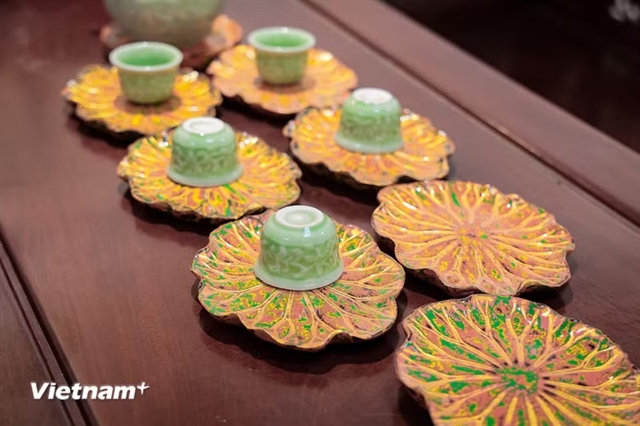 |
| New compact products designed for everyday use. |
From the expressions on statues' faces to the intricate details of ornamental figures and the application of more than a dozen layers of lacquer and gold leaf, the finishing process still requires patience, precision and an experienced eye.
For Sơn Đồng's artisans, the challenge is not choosing between tradition and technology, but finding ways to combine the two.
As workshops modernise their production methods and develop products for new markets, the village is striving to preserve the skills and cultural identity that have sustained its craft for generations.
By embracing change without abandoning its roots, Sơn Đồng hopes to secure a place for its traditional handicrafts in an increasingly competitive international market. — VNS
Society
 Society
 Society
 Society
 Society
 Society
 Society
 Society
 Society
 Society
 Society
 Society
 Society
 Society
 Society