 Society
Experts call for stronger dengue fever prevention measures
1.
|
|
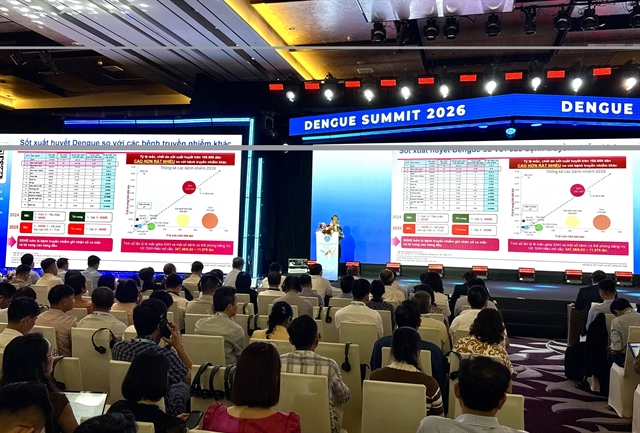
| In Việt Nam, dengue has remained a persistent burden for more than four decades. — VNS Photo Thanh Hải |
HÀ NỘI — Health experts called for stronger preventive measures to tackle dengue fever in Việt Nam at the 2026 Dengue Summit in Hà Nội on November 6.
The event was organised by the Việt Nam Administration of Disease Prevention under the Ministry of Health, in collaboration with Hà Nội Medical University, the Centre for Community Health Research and Injury Prevention and Takeda Pharmaceuticals Vietnam.
A forum for experts to share the latest data, scientific evidence and international experience in dengue treatment and prevention, the forum helped translate scientific knowledge into practice in Việt Nam.
At the summit, experts said that dengue is one of the world's fastest-growing mosquito-borne infectious diseases, with an estimated 100-400 million infections annually.
In Việt Nam, dengue has remained a persistent burden for more than four decades. Since 1980, the country has recorded hundreds of thousands of cases each year, with deaths reported annually. The dengue incidence rate per 100,000 people is significantly higher than that of other infectious diseases, ranking first in incidence and second in mortality among infectious diseases in Việt Nam.
Commenting on these challenges, Dr Hoàng Minh Đức, director general of the health ministry's Vietnam Administration of Disease Prevention, said: “Việt Nam needs decisive, proactive and evidence-based disease prevention strategies.
"At the same time, adapting relevant international experience to local conditions, alongside vector control and greater public awareness, is essential for improving prevention outcomes and reducing the burden of dengue."
In 2025, Việt Nam recorded 184,903 cases, the highest in the Asia-Pacific region, surpassing the Philippines, Indonesia and Bangladesh. In the first 10 months of 2026, Viet Nam recorded 170,684 dengue cases and 21 deaths. The disease circulates year-round across all provinces and cities, and is spreading to mountainous northern provinces such as Tuyên Quang and Sơn La, areas that previously reported few cases.
All four dengue virus serotypes (DENV-1, DENV-2, DENV-3 and DENV-4) are circulating in Việt Nam, with dominant serotypes varying over time and by region. Cyclical shifts in circulating serotypes, combined with climate change, rapid urbanisation and insecticide-resistant mosquito populations, have made dengue outbreaks increasingly difficult to predict.
Under the theme 'Dengue in ACTion: Translating Science into Practice Toward Comprehensive Dengue Management', the summit featured four thematic sessions, more than 15 in-depth presentations and more than 60 scientific research posters, covering epidemiology, clinical practice, communication, prevention, digital technology and health policy.
During the plenary session, experts presented evidence showing how vaccination programmes have contributed to measurable progress in several countries.
Brazil has implemented dengue vaccination in its public health system since 2024, starting in 521 municipalities and expanding to all 2,752 municipalities, with 24 million doses distributed. Real-world data from São Paulo during 2024–2025 shows that a two-dose schedule reduced the risk of symptomatic dengue by 73.1 per cent and the risk of hospitalisation by 87.9 per cent. Protection was sustained despite the re-emergence of DENV-39.
Indonesia is also carrying out dengue vaccination alongside health technology solutions to strengthen prevention in high-risk areas.
The draft 2026 National Guidelines for Dengue Diagnosis and Treatment also underscores the importance of dengue prevention, especially since no specific antiviral treatment exists. It recommends a comprehensive approach that combines dengue vaccination in accordance with current regulations with surveillance activities, Ministry of Health-recommended preventive measures and vector control interventions such as bite prevention and elimination of mosquito breeding sites.
The coordinated use of prevention measures is seen as a policy signal aligned with WHO recommendations for an integrated dengue control strategy.
Benjamin Ping, country head at Takeda Vietnam, said: "While the awareness of dengue in Việt Nam is relatively high, research shows that most people in Việt Nam do not fully understand the risks, severity and urgency associated with dengue to themselves and their families. More proactive preventive action is needed to reduce the burden of Dengue in Việt Nam."
With dengue occurring year-round, experts at the summit called for coordinated implementation of prevention measures at all levels — from strengthening epidemiological surveillance and treatment capacity to behaviour change communication and encouraging appropriate vaccination. — VNS
Society
 Society
 Society
 Society
 Society
 Society
 Society
 Society
 Society
 Society
 Society
 Society
 Society
 Society
 Society