 Society
Symposium discusses strategic technology in the development of modern medicine
1.
|
|
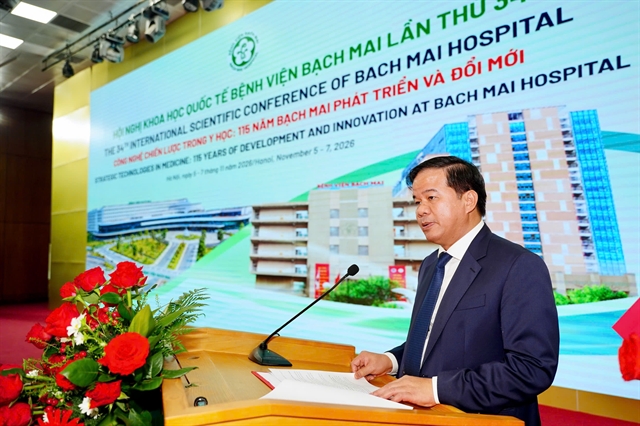
| Associate Professor Đào Xuân Cơ, Deputy Minister of Health, speaks at the 34th International Scientific Conference of Bach Mai Hospital on November 5. — VNS Photos Thanh Hải |
HÀ NỘI — Strategic technology in the development of modern medicine is the main topic of discussion at the 34th International Scientific Conference of Bach Mai Hospital from November 5-7.
The conference features 38 specialised scientific sessions, pre-conference sessions, satellite symposia and nearly 400 scientific presentations.
Topics under discussion cover a wide range of advanced medical fields, including organ transplantation, precision medicine, robotic surgery, stem cell therapy, fertility preservation, artificial intelligence and digital transformation in healthcare.
Speaking at the conference, Deputy Minister of Health and Associate Professor Đào Xuân Cơ said that the hospital should aim for a modern academic hospital model, in which scientific research, innovation and the application of technology become core competencies.
“Bach Mai is not only a place for treating the most severe and complex cases, but must also be a place for finding solutions to difficult challenges in medicine and hospital management in Việt Nam,” said Cơ.
The deputy minister also asked that Bach Mai Hospital focus on development across several areas: in-depth medical research, the application of advanced technologies, the modernisation of hospital management and the cultivation of a new generation of young scientific talent.
|
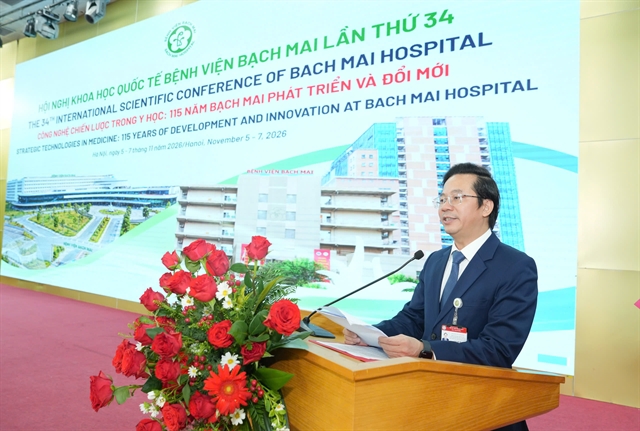
| Associate Professor Vũ Văn Giáp, deputy director of Bạch Mai Hospital, speaks at the 34th International Scientific Conference of Bach Mai Hospital on November 5. |
At the event, Associate Professor Vũ Văn Giáp, deputy director of Bach Mai Hospital, said that the hospital has identified six strategic technological pillars, remaining steadfast in its AI-first and smart orientation.
At the same time, the hospital is advancing regenerative medicine, stem cell therapy, gene therapy and precision medicine, with the goal of personalising patient treatment.
Bach Mai is shifting its approach, moving beyond just adopting and applying existing technologies towards proactively researching and developing solutions derived from actual clinical needs. Key research areas include laparoscopic surgery for colon cancer, the application of artificial intelligence in lung cancer screening, clinical decision support and the monitoring of drug interactions, according to Giáp.
In the context of digital transformation, experts said that artificial intelligence, biotechnology and precision medicine are driving profound changes in the healthcare sector. The research, mastery and application of these strategic technologies have thus become vital catalysts for the advancement of modern medicine.
|
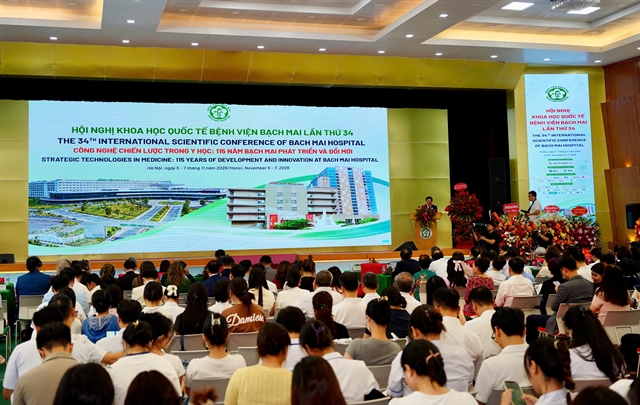
| The conference features 38 specialised scientific sessions, pre-conference sessions, satellite symposia and nearly 400 scientific presentations. |
Themed 'Strategic Technologies in Medicine: 115 Years of Development and Innovation at Bach Mai', the plenary session serves as a key highlight of the conference.
The programme focuses on showcasing achievements, professional development strategies and cutting-edge medical technologies. Notable presentations include initial outcomes from organ and multi-organ transplantation at Bach Mai Hospital, as well as discussions on precision medicine, gene therapy and cell-based therapies.
International experts also shared in-depth research on muscle and systemic ageing, the use of robotics in total knee replacement surgery, the mechanisms of stem cell-mediated regeneration for repairing brain injuries and neurological conditions, and advancements in cell biology, ovarian function and fertility preservation.
These fields represent trends in global medicine, shifting from experience-based to evidence-based treatment, personalising care according to the specific characteristics of each patient and effectively leveraging modern technology to enhance both the precision and efficacy of treatment.
The hospital also announced the establishment and inauguration of its Fertility Support Centre, while simultaneously presenting the ISO 15189 certification to its Institute of Medical Testing. These milestones represent significant steps in the hospital’s professional development, the enhancement of its service quality and the refinement of its quality management system.
Bach Mai Hospital currently has a total capacity of approximately 4,200 beds across its facilities in Hà Nội and Ninh Bình, serving around 13,000 patient visits each day. — VNS
Society
 Society
 Society
 Society
 Society
 Society
 Society
 Society
 Society
 Society
 Society
 Society
 Society
 Society
 Society