 Society

Top leader receives new foreign ambassadors
1.

|
| Nguyễn Như Toàn, a PhD student at the Department of Industrial Engineering, University of Bologna, Italy. — VNA/VNA Photos |
ROME — Việt Nam and Italy have considerable potential to strengthen cooperation in the robotics industry, drawing on their complementary strengths in technology, mechanical engineering, manufacturing and research, as well as their shared need to modernise production.
Speaking to Vietnam News Agency (VNA) correspondents in Rome, Nguyễn Như Toàn, a PhD student at the Department of Industrial Engineering, University of Bologna, Italy, said the development of humanoid robots, collaborative robots (cobots) and mobile manipulation robots is opening up new applications in manufacturing and everyday life.
This also presents an opportunity for Việt Nam to step up research, development and application of robotics technology in cooperation with Italy, a country with long-standing strengths in precision engineering, machinery manufacturing and industrial automation.
According to Toàn, the most significant change in the robotics industry today is the shift from systems that perform only pre-programmed tasks to those capable of perceiving their surroundings, learning skills and adapting to new tasks. Combining AI and machine learning with models integrating vision, language and action is making robots increasingly versatile, enabling them to interact with people and operate in more complex environments.
Notably, humanoid robots, cobots and mobile manipulation robots can improve productivity and product quality while reducing repetitive, strenuous or hazardous work.
He said experience in Europe, including Italy, shows that this trend is gradually being adopted in production. Italy is well positioned to develop robotics, thanks to its traditional strengths in mechanical engineering and machinery manufacturing, as well as its network of small and medium-sized enterprises (SMEs). Companies such as Comau in industrial robotics and qbrobotics in soft robotic hand technology, together with research projects at the Italian Institute of Technology (IIT), demonstrate the country's capabilities in robotics development. Notably, shipbuilder Fincantieri's cooperation with Generative Bionics to develop humanoid robots to assist with welding in shipbuilding, with real-world trials expected by the end of 2026, represents a promising application.
Toàn noted that high initial investment costs, a shortage of highly skilled technical personnel and limited access to technology among SMEs remain barriers to robotics development in Italy. It is therefore important to link research with industrial needs and support businesses in testing and commercialising new technologies.
For Việt Nam, he said priority should be given to robotics applications that meet practical needs and can be deployed in the short term. These include industrial robots for production lines, autonomous robots for warehouses and factories, and unmanned aerial vehicles (UAVs) for agriculture and logistics. In the longer term, the country should continue investing in AI, environmental perception technologies, advanced control systems and humanoid robotics.
One important direction is to prioritise mastery of software, algorithms and system integration, before gradually developing high-value hardware technologies and components. At the same time, cooperation among businesses, universities and the State should be promoted to bring research results to market and prevent products from remaining at the demonstration-model stage.
Toàn said Việt Nam and Italy have highly complementary strengths in this field. Italy has experience in machinery manufacturing, industrial robotics applications and an established business network, while Việt Nam has a dynamic market, strong demand for production modernisation and a promising young engineering workforce. These provide a solid basis for the two countries to expand cooperation in robotics research, development and application.
|
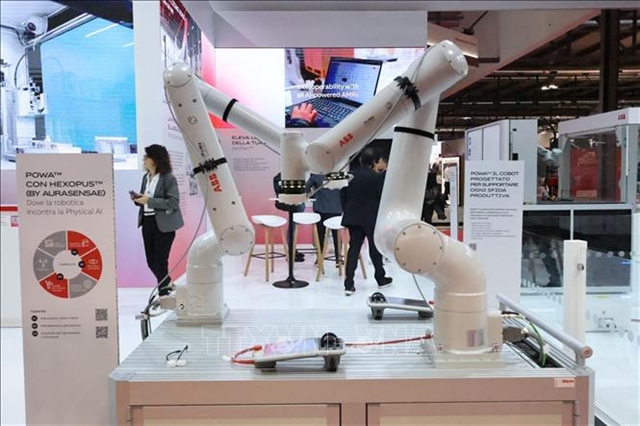
| Robotics is among the key highlights of the 35th BI-MU International Exhibition of Machine Tools, Robotics, Automation, 3D Printing and Auxiliary Technologies, held in Milan, Italy. |
Areas with immediate cooperation potential include industrial robots, cobots and mobile manipulation robots for manufacturing, assembly and logistics. In the longer term, the two sides could expand cooperation to UAVs, autonomous robotic systems for precision agriculture, infrastructure inspection and goods transportation, as well as research into intelligent robotics and human-robot interaction.
The University of Bologna doctoral candidate stressed that Việt Nam-Italy cooperation should go beyond the transfer of equipment and technology to encompass joint research, development, testing and product commercialisation.
Stepping up exchanges of students, doctoral candidates and experts, while strengthening links between universities, research institutes and businesses, will help both countries make effective use of their respective strengths and lay the foundation for long-term cooperation in robotics and automation, he stated. — VNA/VNS
Society
 Society
 Society
 Society
 Society
 Society
 Society
 Society
 Society
 Society
 Society
 Society
 Society
 Society
 Society