 Society
Lawmakers call for tighter safeguards in revised Bidding Law
1.
|
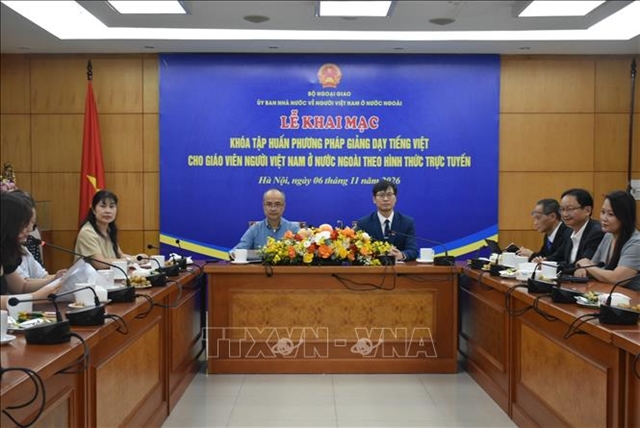
| Participants at an online training course on Vietnamese language teaching methods for overseas Vietnamese teachers on Friday. — VNA/VNS Photo |
HÀ NỘI — The State Committee for Overseas Vietnamese (SCOV) under the Ministry of Foreign Affairs, in coordination with the University of Social Sciences and Humanities under Vietnam National University, Hanoi, and the Vietnam Education Publishing House, opened an online training course on Vietnamese language teaching methods for overseas Vietnamese teachers on Friday.
According to the organising board, the 2026 course has attracted 770 participants from 40 countries and territories, reflecting both the demand for professional development and the dedication of overseas Vietnamese teachers to preserving and passing on the Vietnamese language within their communities.
Addressing the opening ceremony, SCOV Chairman Nguyễn Trung Kiên acknowledged the sustained efforts of teachers in maintaining Vietnamese language classes abroad. Many have devoted their free time and weekends to preparing lessons, mobilising parents, sourcing teaching materials and nurturing young people's love for the Vietnamese language.
He stressed that Vietnamese is not merely a means of communication but is also closely tied to family bonds, memories and national identity. For overseas Vietnamese communities, preserving the language helps strengthen connections between generations and foster their attachment to the homeland, while promoting cultural resources to introduce Vietnam and its people to international friends.
Describing the course as a practical initiative to implement the Politburo's Resolution No. 23-NQ/TW dated August 2, 2026, on overseas Vietnamese affairs, Kiên underscored the need to renew teaching methods and improve teachers' professional capacity. He also called for stronger coordination among domestic agencies, Vietnamese representative offices abroad, educational institutions, associations and families in preserving the Vietnamese language and national cultural identity.
Following an in-person training course held in August 2026, the online programme offers teachers in a wider range of locations greater access to professional training. Kiên urged the organisers to place greater emphasis on practical application and learner-centred approaches, with teaching methods tailored to students' ages, language environments and the specific conditions of each community. Stories, games, songs, cultural experiences and familiar communication scenarios should be incorporated to spark students' interest and help them use Vietnamese with confidence, he said.
On the role of digital technology and artificial intelligence in teaching, Kiên said new tools should be used selectively, with proper verification, and in support of educational objectives. However, teachers' understanding, ability to inspire and love for the Vietnamese language remained essential.
He called on the organising board and lecturers to share teaching materials and maintain professional connections after the course, while encouraging participants to exchange experience and discuss challenges in their teaching. This would help connect professional knowledge from Việt Nam with the practical realities of Vietnamese language education in overseas communities, he added.
Speaking at the ceremony, Associate Professor Dr. Đặng Hồng Sơn, Vice Rector of the University of Social Sciences and Humanities, said the course responded to overseas Vietnamese communities' desire for support in teaching and learning Vietnamese, particularly among generations born and raised abroad.
With more than a decade of cooperation with the SCOV in providing professional development for overseas Vietnamese teachers, the university had developed a scientific and practical training programme, delivered directly by experts in Vietnamese language teaching, he said.
Sơn acknowledged teachers' role in spreading a love of Vietnamese to families and communities, particularly among younger generations. He expressed confidence that the course would equip participants with modern and effective teaching methods, while providing opportunities to exchange experience and build a strong, sustainable network of Vietnamese language teachers.
The programme further demonstrates the commitment of domestic agencies and educational institutions to supporting overseas Vietnamese teachers, contributing to the preservation of national cultural identity and strengthening ties between generations of overseas Vietnamese and their homeland. — VNA/VNS
Society
 Society
 Society
 Society
 Society
 Society
 Society
 Society
 Society
 Society
 Society
 Society
 Society
 Society
 Society