 Society

Việt Nam sets four priorities for APEC Finance Ministers’ Meeting in 2027
1.
|
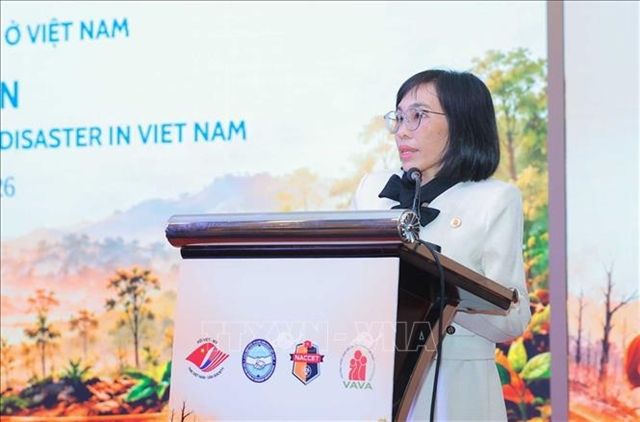
| Vương Thị Quyên, a second-generation victim of Agent Orange/dioxin from the central province of Quảng Trị, addresses an international seminar held in Hà Nội on Wednesday to mark 65 years since the toxin was first sprayed in Việt Nam. — VNA/VNS Photos Hoàng Hiếu |
HÀ NỘI — A seminar took place in Hà Nội on Wednesday to mark 65 years since the US military first sprayed toxins over Việt Nam, most of which was Agent Orange containing dioxin, and left serious consequences on the Vietnamese people and the environment.
The seminar, entitled '65 Years of the Agent Orange Disaster in Việt Nam', was co-organised by the Vietnam Association for Victims of Agent Orange/dioxin (VAVA), the Viet Nam Union of Friendship Organizations (VUFO) and the National Action Centre for Toxic Chemicals and Environmental Treatment (NACCET), in coordination with the Vietnam-USA Society (VUS).
The event aimed to call for support from the international community, asking them to 'transform sympathy into long-term commitments for cooperation' by creating sustainable livelihoods for those affected, enabling rehabilitation and cleaning up dioxin 'hotspots' in Việt Nam.
Participants had the opportunity to hear the story of Vương Thị Quyên, a second-generation victim of Agent Orange/dioxin from the central province of Quảng Trị, who currently works at the Centre for Social Justice under VAVA.
Born in 1989, from the age of nine, Quyên has suffered from physical deformities, cancer and a congenital spinal curvature as the consequences of the effects of Agent Orange passed down from her father, who fought on the battlefield in southeastern Việt Nam.
While these hardships have presented significant challenges throughout her life, Quyên said they have also driven her to overcome adversity and pursue an education.
“Our bodies may have been damaged by Agent Orange, but our will to live and our pursuit of justice remain unyielding,” she said.
She added that consequences of Agent Orange do not end with an individual but persists across generations, placing a heavy burden on their families and society.
"So support for victims must go beyond emotional solidarity or immediate, short-term aid," Quyên said.
"It requires concrete, sustained initiatives such as medical care, rehabilitation, educational support, livelihood development and efforts to ensure successful integration into the community."
It is estimated that about three million people in Việt Nam have been identified as victims of Agent Orange.
Statistics as of 2024 indicated that there are over 35,000 third-generation and 6,000 fourth-generation victims, many of whom face significant challenges in education, employment and social integration.
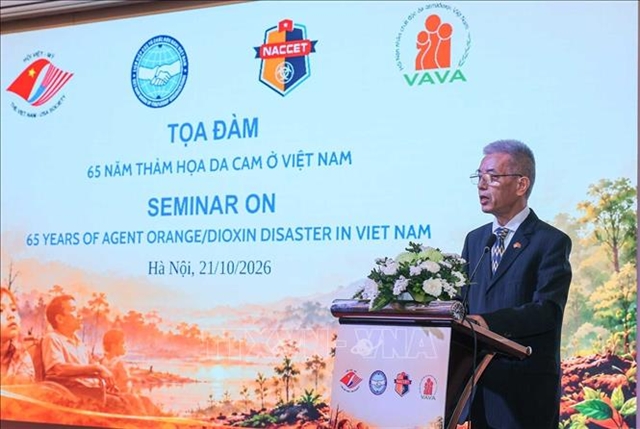
Speaking at the event, VUS President Bùi Thế Giang stressed that addressing the major legacies of the war – such as Agent Orange's consequences – is key to healing the past and building the future within the Việt Nam-US Comprehensive Strategic Partnership.
|
| Bùi Thế Giang, president of the Vietnam-USA Society (VUS) speaks at the event. |
He urged the US government, Congress, the business community and the American public, especially chemical companies that produced the toxic agents used during the war, to demonstrate social responsibility by actively participating in programmes that provide rehabilitation and livelihood support for victims and work to remediate the remaining dioxin hotspots.
“This responsibility must be translated into concrete terms through specific programmes, resources and measurable outcomes to address the essential needs of the victims, in a manner that ensures both practicality and sustainability,” Giang said.
Dr Charles R. Bailey, former head of the Ford Foundation in Việt Nam, proposed giving more resources to VAVA and NACET to enable them to update the registry of households with war-related disabilities, specifically those meeting Việt Nam's criteria for victims of Agent Orange and unexploded ordnance.
Based on this registry, priority should be given to households living below the poverty line that include individuals with severe disabilities requiring full-time care from family members, particularly in areas that were heavily sprayed with chemical agents, he said.
Bailey also suggested providing direct, sustained support to these families over a three-year period, with services tailored to their specific needs such as home improvements, vocational training, capital for small business development, rehabilitation, and access to social services.
This approach would help improve living conditions, enhance the self-reliance of these families and bring about tangible, positive changes in the lives of the victims, he said. — VNS
Society
 Society
 Society
 Society
 Society
 Society
 Society
 Society
 Society
 Society
 Society
 Society
 Society
 Society
 Society