 Society

ZOOD Real Estate launches Élevée, a $667 million project in north Riyadh
1.
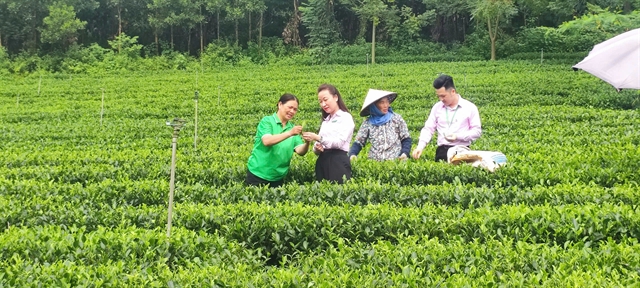 |
| Mai Thị Vân (left) earns a stable income from a tea farm that is funded with a loan offered by the Việt Nam Bank for Social Policies. VNS Photo Tố Như |
Trần Như
THÁI NGUYÊN People in the northern province of Thái Nguyên are benefiting from preferential loans to invest in expanding production that creates jobs, increases incomes and improves living standards step by step.
For poor households lacking resources, policy-based credit has served as a vital support, enabling many families to build livelihoods and achieve a stable life.
Mai Thị Vân's family in Đồng Hỷ Commune had long been classified as a poor household. She couldn't even imagine a day when her family might escape poverty. A turning point arrived when officials from the Đồng Hỷ transaction office of the Việt Nam Bank for Social Policies suggested that she access preferential credit.
Before applying for the preferential loan, Vân received assistance from Vũ Trí Long, an experienced farmer who helped her invest in agriculture.
Long shared experiences on capital management, selecting suitable investment strategies and expanding production.
The knowledge and insights he shared boosted Vân's confidence, leading her to decide to borrow VNĐ100 million (US$3,800) to improve the soil and expand her tea cultivation area.
The tea plantation produces around 100kg of dried tea a month, bringing revenue of VNĐ20 million (US$800). This stable source of income has helped Vân’s family escape poverty and build a new house.
With support from credit and the assistance of local organisations and individuals, Vân’s family has gradually established a livelihood, stabilised its income and improved its living conditions.
Aside from helping Vân take out a loan and invest in production, Long also regularly shares his experience with other households in the locality.
As head of the Club of Farmers with Excellent Production and Business Performance, which currently has around 30 members, he shares knowledge and experience in livestock farming and production and works with other households to find suitable ways to develop their local economies.
Long himself started out as a member of a poor household, taking out a loan of only VNĐ3 million ($120) from the Việt Nam Bank for Social Policies to buy a pair of cattle in 2002.
The small loan marked the beginning of his family’s journey out of poverty. Just one year later, the family was no longer classified as poor. After raising cattle, Long continued to expand production.
By 2007, his herd was worth hundreds of millions of đồng. However, market fluctuations and a sharp fall in cattle prices caused the family to suffer losses.
Unwilling to give up, Long switched to raising wild boar in 2009.
A year later, after his younger brother in Bắc Ninh Province told him about raising spotted deer, he decided to explore another new direction.
In 2011, he borrowed additional money from relatives and neighbours and invested VNĐ60 million ($2,300) in buying two female and one male spotted deer from Thanh Hóa Province.
“At first, I had no experience in raising deer,” Long said.
“I only thought I would give it a try and did not dare to expand the herd. After one or two years, when I saw that the model was effective, and with advice and encouragement from officials at the bank, I borrowed another VNĐ100 million ($3,800) to expand."
He now maintains a herd of up to 80 breeding deer in two enclosures, with annual revenue from the model reaching around VNĐ650 million ($25,000).
Long’s story also illustrates a meaningful cycle created by policy credit: from someone who once needed support to escape poverty, he has gone on to become someone who shares experience, encourages and supports other households.
When capital becomes a livelihood
Vân and Long's stories show that the effectiveness of policy credit lies not only in the amount of money disbursed, but more importantly in its ability to turn capital into livelihoods, jobs, income and assets for local residents.
According to a report by the Đồng Hỷ Transaction Office of the Việt Nam Bank for Social Policies, as of August this year, total capital stood at VNĐ761.8 billion ($29 million), up VNĐ49.8 billion ($1.9 million) from the end of 2025, equivalent to a growth rate of 7 per cent.
Đoàn Lệ Thủy, director of the bank’s Đồng Hỷ Transaction Office, said this funding continues to provide policy credit to households and other eligible beneficiaries.
In August alone, over 80 households were provided credit.
The timely recovery of loans allows the capital to continue moving, creating opportunities for households in need and meeting eligibility requirements to access policy loans.
Since the beginning of the year, nearly 8,000 poor and near-poor households, production and business households in ethnic communities, have received loans to develop production and businesses.
According to Hoàng Văn Hậu, deputy director of the bank’s Thái Nguyên branch, what matters is not simply disbursing capital but ensuring that the funds create jobs, income and stable livelihoods for local people.
“The ultimate effectiveness of policy credit does not lie in the amount of capital disbursed or the number of people receiving loans, but in whether that capital can genuinely become a livelihood, income and capacity for people to become self-reliant,” Hậu said.
To ensure that capital generates sustainable results, policy credit needs to be combined with production advice, technical transfer, vocational training, job creation, market connections and guidance on the proper use of funds, Hậu said. VNS
Society
 Society
 Society
 Society
 Society
 Society
 Society
 Society
 Society
 Society
 Society
 Society
 Society
 Society
 Society