 Society
LOAN Foundation awards scholarships to disadvantaged students on 10th anniversary
1.
 |
| ISYA 2026 opens on September 28 with the participation of 32 students and 14 lecturers from 15 countries and territories around the world. |
GIA LAI — The International School for Young Astronomers (ISYA 2026) officially opened in Quy Nhơn, Gia Lai Province on September 28 with the participation of 32 students and 14 lecturers from 15 countries and territories around the world.
ISYA 2026 is jointly organised by Rencontres du Vietnam and the International Centre for Interdisciplinary Science and Education (ICISE), in collaboration with the International Astronomical Union (IAU) and the Norwegian Academy of Science and Letters (NASL).
ISYA is a long-standing training programme of the IAU, established in 1967 to support the training and development of the next generation of young astronomers around the world. The programme is also co-funded by the NASL through the Office for Young Astronomers (OYA). The 48th edition of the school takes place from September 28 to October 16.
ISYA 2026 takes place during the period when Việt Nam is hosting the 19th International Olympiad on Astronomy and Astrophysics (IOAA 2026), which is the largest edition of the IOAA to date.
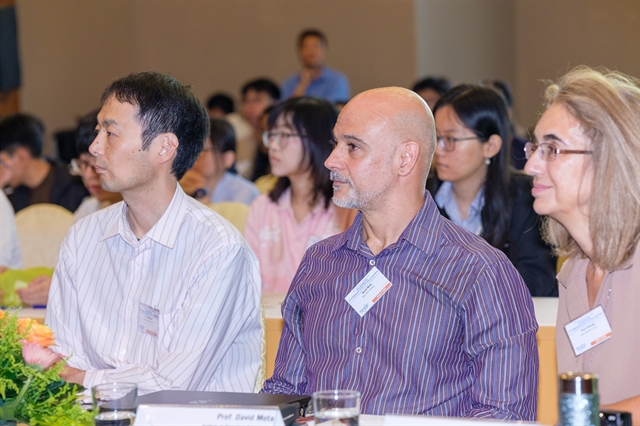
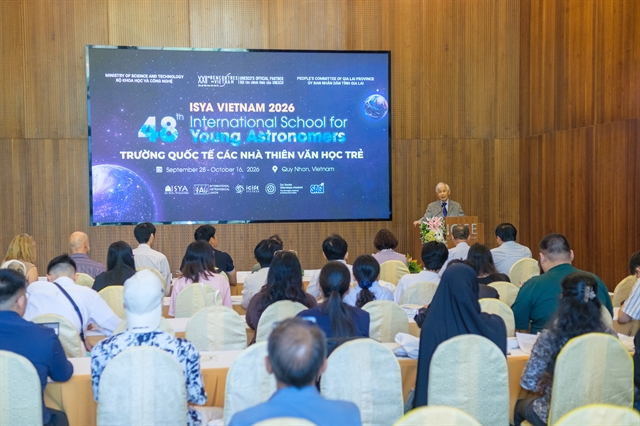 |
| The International School for Young Astronomers (ISYA 2026) officially opened in Quy Nhơn, Gia Lai Province on September 28. |
ISYA 2026 witnessed the participation of scientists in the field, including: Prof. David Mota, University of Oslo, Norway; Prof. Itziar Aretxaga, CAB CSIC-INTA, Spain; Prof. Wen-Ping Chen, National Central University, Taiwan (China); Prof. Jun Takahashi, Nishi-Harima Astronomical Observatory, University of Hyogo, Japan; Assoc. Prof. Dr. Yasunori Hori, Okayama University, Japan; Assoc. Prof. Dr. Priya Hasan Shah, Maulana Azad National Urdu University, India; Dr. Sara Webb, Swinburne University of Technology, Australia; Dr. Nguyen Trong Hien, California Institute of Technology–Caltech, USA - Head of the SAGI Astrophysics Research Group, IFIRSE, ICISE; Prof. Thiem Hoang, Korea Astronomy and Space Science Institute [KASI], Korea University of Science and Technology, Member of the SAGI Astrophysics Research Group, IFIRSE, ICISE; Assoc. Prof. Dr. Phạm Ngọc Điệp, Vietnam National Space Center–VNSC; and Dr. Nguyễn Lương Quang, Vietnam Quantum Network–VNQuantum.
Over the course of three weeks, the training programme focuses on a wide range of topics in modern astronomy and astrophysics, including: galaxies, cosmology, virtual observatories and databases, stars and stellar evolution, exoplanets, machine learning, visible astronomy, and radio astronomy. The curriculum combines lectures, hands-on workshops, and data analysis sessions, enabling participants to gain practical access to modern research methodologies and computational tools in astronomy and astrophysics.
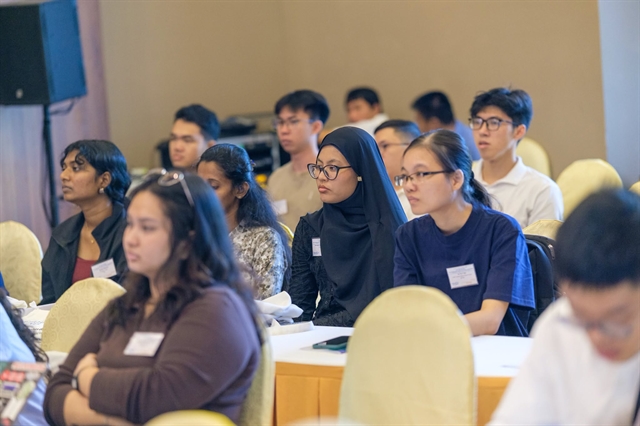 |
| One of ISYA's core objectives is to provide training opportunities for early-career astronomers. Photos courtesy of ICISE |
ISYA 2026 is organised to broaden the knowledge, technical skills, and scientific perspectives of early-career astronomers. The curriculum features up-to-date lectures on theoretical and observational astrophysics delivered by international experts, complemented by hands-on practical sessions and academic exchanges. Participants have the opportunity to engage with various branches of astronomy—ranging from stellar physics and galactic astronomy to cosmology—while simultaneously developing specialised proficiencies in data analysis, modeling, and modern research methodologies.
One of ISYA's core objectives is to provide training opportunities for early-career astronomers, particularly those from regions with limited local research infrastructure and training capacities across diverse astronomical disciplines. By fostering an international academic environment, the programme strengthens connections between participants, leading experts, and international peers, thereby facilitating the development of enduring scientific collaborations.
According to organisers, in addition to formal training, ISYA 2026 encourages participants to take an active role in scientific exchange and research. Attendees are invited to submit scientific posters showcasing their research findings, proposed directions, or ongoing projects, providing a forum for direct dialogue with international experts and fellow young astronomers. Through that, the programme not only imparts specialised academic knowledge, but also nurtures scientific initiative, curiosity, and professional growth among the next generation of astronomers. VNS
Society
 Society
 Society
 Society
 Society
 Society
 Society
 Society
 Society
 Society
 Society
 Society
 Society
 Society
 Society
.jpg)