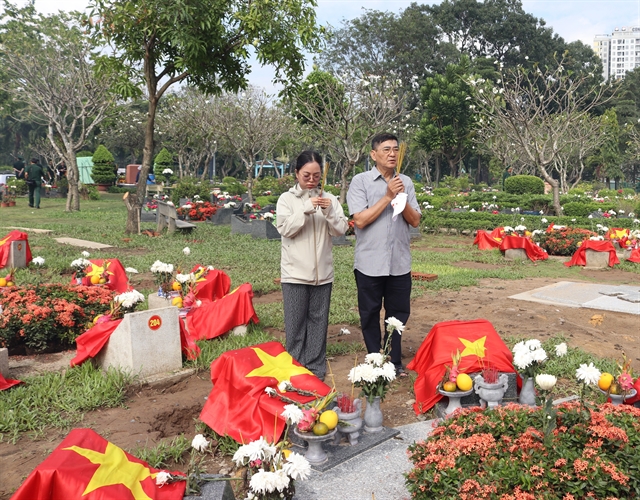
Incense for the fallen: Visitors honour fallen soldiers at the HCM City Martyrs’ Cemetery
1.
|
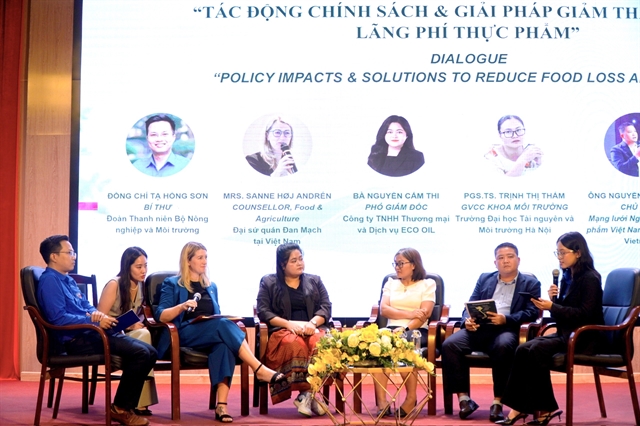
| Experts discuss policy impacts and solutions to reduce food loss and waste at the Hà Nội University of Natural Resources and Environment on September 25. — Photos Courtesy of the organisers |
HÀ NỘI — Cross-sector collaboration, strong legal frameworks and circular economy models are essential to reducing food loss and waste in Việt Nam, experts said at a dialogue in Hà Nội on September 25.
The dialogue, organised at the Hà Nội University of Natural Resources and Environment, focused on policy impacts and practical solutions to address organic waste and cut greenhouse gas emissions.
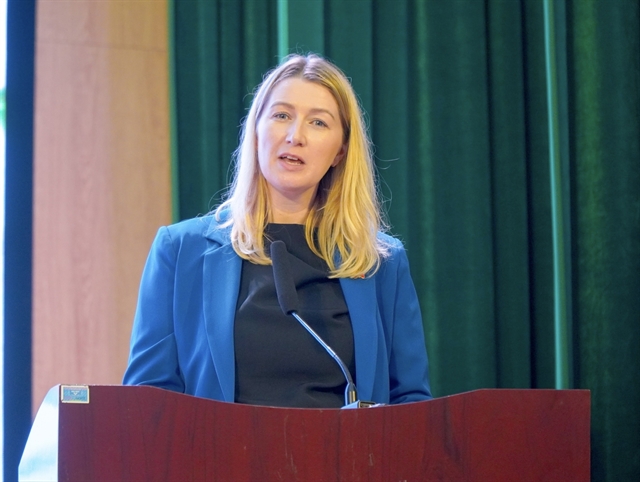
Speaking at the event, Sanne Høj Andrén, counsellor for Food, Agriculture and Fisheries at the Embassy of Denmark in Việt Nam, highlighted the critical role of multi-stakeholder partnerships across the entire food system.
Denmark views reducing food loss and waste as a priority that must be driven through collaboration among all actors in the food chain, she said.
“Meaningful change stems not only from policy, but also from the active engagement of businesses, research institutions, universities, social organisations and citizens.”
Việt Nam and Denmark have significant opportunities to share expertise and co-develop solutions tailored to local conditions.
“Engaging students and youth on food, environment and circular economy topics is also a key strategy to raise awareness and foster sustainable innovations,” she added.
According to experts at the dialogue, Việt Nam discards more than eight million tonnes of edible food annually, causing an estimated economic loss of US$3.9 billion per year — equivalent to nearly 2 per cent of the country’s Gross Domestic Product.
On average, a Vietnamese citizen generates approximately 76 kg of food waste per year, closely mirroring the global average of 74 kg.
In major urban centres like HCM City, organic waste accounts for up to 60 per cent of daily municipal solid waste, reaching roughly 7,800 tonnes per day.
However, between 83 per cent and 88.9 per cent of this waste is currently sent directly to landfills without specialized treatment or recycling.
Experts warned that uncollected and untreated organic waste decomposing in landfills is a primary source of methane, a potent greenhouse gas that significantly accelerates global warming. Globally, food loss and waste contribute between 8 and 10 per cent of total emissions.
|
| Sanne Høj Andrén, counsellor for Food, Agriculture and Fisheries at the Embassy of Denmark in Việt Nam, speaks at the dialogue on policy impacts and solutions to reduce food loss and waste in Hà Nội on September 25. |
Bùi Lê Thanh Khiết, lead researcher on plastic waste circular economy at the Institute for Circular Economy Development (ICED), said businesses are increasingly adapting to cleaner production trends.
“However, the implementation of sustainable practices faces bottlenecks in waste-sorting and logistics infrastructure.”
Hoàng Trung Sơn, director of Đồng Tiến Paper Company and chairman of the Việt Nam Packaging and Paper Association, said his company had partnered with Tetra Pak since 2011 to recycle beverage cartons, long before Extended Producer Responsibility (EPR) regulations were enacted.
When EPR regulations came into effect, they created substantial opportunities by gradually improving the waste collection and sorting ecosystem, Sơn said.
"A streamlined collection network lowers input costs and improves raw material quality, proving that the paper sector is inherently well-suited for a circular economy."
From the perspective of packaging producers and brand owners, Chu Thị Kim Thanh, Chief Operating Officer of Packaging Recycling Organisation Việt Nam, highlighted the importance of eco-design prior to recycling.
Member companies are actively sharing solutions to reduce plastic usage and standardise materials, such as transitioning to uniform PET labels on beverage bottles to enable seamless processing.
She called on regulators to refine legal frameworks and provide incentives for processing technologies to handle low-value, hard-to-recycle multi-material packaging.
To bridge the gap between policy and practice, social enterprises and non-governmental networks are stepping up operational models.
The Food Bank Việt Nam network, through campaigns such as Food For Change and the Green Hero Initiative, is reframing food waste as a valuable organic resource.
By redistributing surplus, wholesome food from farms, retailers and manufacturers to vulnerable communities, the network addresses food insecurity while preventing organic waste from reaching landfills.
Furthermore, initiatives connecting agriculture and waste management are converting non-edible organic waste into bio-fertilisers and feeds to support regenerative agriculture.
Experts agreed that curbing food loss and waste is vital for Việt Nam’s 2050 net-zero ambition.
Achieving this requires a synchronised effort encompassing robust EPR enforcement, financial support for sustainable materials, enhanced urban sorting systems, and heightened environmental awareness among the public. — VNS
Society
 Society
 Society
 Society
 Society
 Society
 Society
 Society
 Society
 Society
 Society
 Society
 Society
 Society