 Society

2026 Swiss-Viet Economic Forum ties poised for growth as EFTA trade deal opens new opportunities
1.

|
| Residents scan QR codes to report suspected crimes to border guards. — VNA/VNS Photo |
NGHỆ AN — From QR codes installed at community houses and public gathering places, the border guard of a small commune in the central province of Nghệ An is creating an additional channel for local residents in border areas to provide information quickly, conveniently and confidentially.
The unit's anonymous electronic mailbox system both encourages people to report suspected crimes and helps border guards gain a better understanding of local conditions, respond promptly to incidents and contribute to maintaining security and social order along the border.
Môn Sơn Commune lies in the buffer zone of Pù Mát National Park, where tourism has been developing and visitors come from increasingly diverse backgrounds.
The commune’s border guard station is responsible for nearly 30km of the border, adjacent to Nậm Chăm Commune in Laos’ Bolikhamxay province.
Alongside agriculture, forestry and tourism activities, the area still faces violations, such as illegal logging and exploitation of forest products, the use of electric fishing equipment and illegal hunting of wildlife.
Against this backdrop, the guard has introduced an electronic mailbox accessible through a QR code at community locations.
The system provides an additional channel for receiving information while encouraging residents to take a more active role in maintaining security and social order.
Its effectiveness was demonstrated recently, when the station received a report through the QR system concerning suspected illegal exploitation of forest products.
After receiving the information, officers and soldiers verified the report and discovered and detained two people involved in illegal logging. A case file was subsequently completed for handling in accordance with the law.
Lieutenant Colonel Hoàng Ngọc Bình, political commissar of the Môn Sơn Commune’s border guard station, said the QR mailbox has provided the unit with an additional channel for receiving information from residents. The initiative has gradually raised public awareness and responsibility for crime prevention, border protection, natural resource conservation and the maintenance of security and order.
|
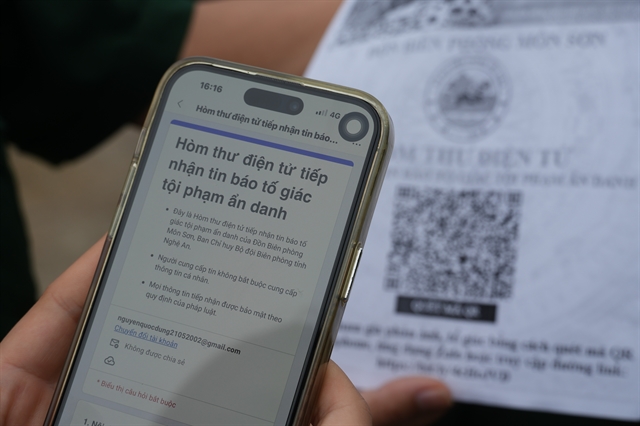
| Using a smartphone, residents can scan the code and send information to border guards without having to visit the station in person. — VNA/VNS Photo |
Following cases detected through information supplied by residents, the station has continued to disseminate legal regulations on forest management and protection, natural resource conservation and activities in border areas.
The outreach helps residents better understand prohibited acts and their legal consequences, while encouraging them to report suspicious activities to the authorities.
Vi Thị Thùy, secretary of the Party cell of Xiềng Village, said the QR mailbox gives residents a quick and convenient way to report information.
When authorities receive, verify and deal with cases, residents gain a clearer understanding of their responsibilities in complying with the law, protecting forests and maintaining security and order in their communities, she said.
Previously, when people noticed suspicious activities such as the suspected illegal transportation of goods, illegal exploitation of forest products, illegal border crossings or other violations, not everyone was willing to report them directly to authorities. Concerns about revealing their identities, affecting relations with neighbours or facing retaliation from violators could prevent some information from being reported promptly, she said.
With the anonymous electronic mailbox, residents can use their phones to scan a QR code and submit information, photographs or other details relating to an incident. The information is then transmitted to the authorities for receipt, classification, verification and handling in accordance with regulations.
Lương Thị Mai, a resident of Bu Nà Village in Châu Khê Commune, said that previously, when residents noticed strangers appearing at night or saw suspicious activities, they would often inform the village head or someone they knew who worked with authorities. However, many people were still reluctant to make a direct report.
“With the QR code, people can report information directly from their phones without having to meet anyone in person, which is more convenient,” she said, adding that residents also feel more secure when their personal information is kept confidential.
Improving digital skills
The electronic mailbox accessed through QR codes is not only creating another channel for reporting crimes, but also represents a new approach to applying digital technology at the local level.
By scanning QR codes to submit information, residents are gradually becoming familiar with digital tools and services, helping improve their awareness and digital skills in everyday life.
At community houses across the area, 32 QR codes have been installed in 16 villages to make the system easily accessible.
After about three months, the system had received 17 reports, including information concerning illegal exploitation of forest and aquatic resources and security and order in the area.
According to Vi Sơn, head of Diềm Village in Châu Khê Commune, placing QR codes at locations where residents regularly gather makes technology more accessible.
By using their phones to send information to authorities, residents can gradually develop habits of using digital tools for other aspects of daily life.
Secretary of the Châu Khê Commune Party Committee Lô Xuân Thảo said the broader value of the model lies not simply in the number of reports received, but also in helping residents gain access to digital transformation through simple and practical actions.
Starting with a QR code for reporting suspected crimes, local authorities can help residents use QR codes, digital platforms and online public services to handle administrative procedures, receive information and communicate about work.
In this way, digital transformation can gradually become more practical and better suited to the circumstances of people living in border areas.
Lieutenant Colonel Chu Văn Thống, deputy political commissar of the Châu Khê Border Guard Station, said the application of technology provides the unit with an additional channel for gathering information from local communities, and also creates opportunities to educate and help residents in the digital environment.
The station will continue to make effective use of the model while linking technology applications with efforts to encourage legal compliance and public participation in maintaining security and social order, he said. — VNS
Society
 Society
 Society
 Society
 Society
 Society
 Society
 Society
 Society
 Society
 Society
 Society
 Society
 Society
 Society