 Society
VPS leads brokerage market share on HNX in Q3
1.
|
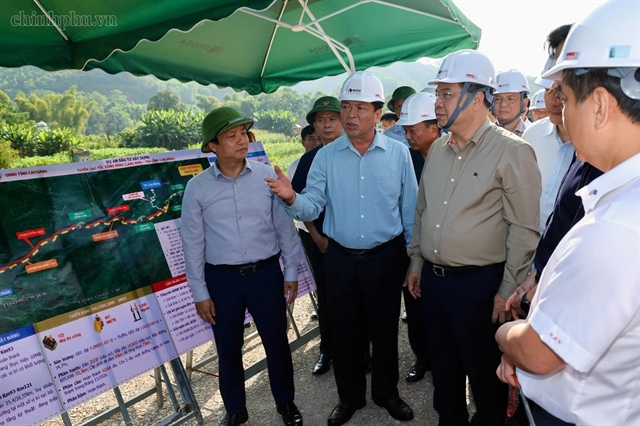
| Permanent Deputy Prime Minister Phạm Gia Túc listens to Minister of Construction Trần Hồng Minh deliver a report during his site inspection on the Đồng Đăng-Trà Lĩnh Expressway project. — VGP/VNA Photo |
HÀ NỘI — Permanent Deputy Prime Minister Phạm Gia Túc on Sunday urged relevant organisations to make every effort to complete phase one of the Đồng Đăng-Trà Lĩnh Expressway project on schedule, so that it can serve residents as soon as possible.
At the project site, the deputy PM inspected construction activities and heard reports from relevant agencies on progress, difficulties, recommendations and measures to accelerate the project.
The Đồng Đăng-Trà Lĩnh Expressway is more than 121km long. Along the Km0–Km93 section, contractors are operating 132 construction teams, using nearly 900 machines and items of equipment and more than 2,000 workers.
Under the plan, the asphalt surfacing and road safety systems on the section from Tân Thanh (Km0) to Đồng Khê (Km62) will be completed by next month.
By April next year, the entire 93.35km first-phase section will be completed, with a 22-metre-wide roadbed.
At the meeting with Túc, participants focused their discussions on the project’s progress, site clearance, construction arrangements and obstacles requiring resolution to ensure that the scheduled milestones are met.
The investor asked Cao Bằng Province to report to the PM and relevant ministries on the need to cover the shortfall in State budget funding for the 2026–2028 period.
The investor also proposed that permission be granted to temporarily open the section from Tân Thanh (Km0) to Đồng Khê (Km62) to traffic, allowing local residents to travel free of charge during the 2027 Lunar New Year holiday, even though several components of the phase-two expansion have yet to undergo integrated acceptance.
Local authorities and relevant organisations were requested to coordinate in drawing up plans for the management and operation of the section and the deployment of personnel, vehicles and equipment.
They were also asked to organise fire prevention and firefighting, search and rescue, and traffic regulation measures, particularly on sections passing through tunnels, to ensure safety when the road section opens.
Concluding the meeting, Túc praised the efforts of local authorities, the investor, enterprises, contractors and relevant agencies in carrying out the project.
He stressed that the Đồng Đăng-Trà Lĩnh Expressway was of major importance to Lạng Sơn and Cao Bằng, as well as to transport connectivity in the northeastern region.
The route is expected to help expand development space and promote trade, imports and exports through border gates.
The deputy PM asked the investor and contractors to make the most of favourable weather conditions, continue mobilising personnel, machinery and equipment, and organise construction in a coordinated manner.
He placed particular emphasis on construction quality and safety, especially the treatment of soil and rock along both sides of the route, the prevention and control of landslides and the need to ensure long-term safety during operation.
Regarding the proposal to open the section from Tân Thanh (Km0) to Đồng Khê (Km62) ahead of schedule to serve residents, he said that all necessary conditions must be fully met before the section is opened to traffic, ensuring the safety of road users.
Items including crash barriers, rest areas and search and rescue vehicles and personnel must be fully prepared, he said.
Túc noted that expressway investment should aim for a completed configuration capable of meeting long-term development requirements.
For sections initially built to a reduced scale, plans should be made for continued investment to bring them up to four lanes.
Adequate rest areas must be provided along the route to meet the needs of residents and passengers and the operational requirements of the expressway.
He also asked authorities to pay attention to improving the landscape along both sides of the route and to study ways of introducing and promoting the distinctive scenic spots and landscapes of Lạng Sơn and Cao Bằng, linking transport infrastructure development with tourism, services and socio-economic development. — VNS
Society
 Society
 Society
 Society
 Society
 Society
 Society
 Society
 Society
 Society
 Society
 Society
 Society
 Society
 Society