 Society

2026 Swiss-Viet Economic Forum ties poised for growth as EFTA trade deal opens new opportunities
1.
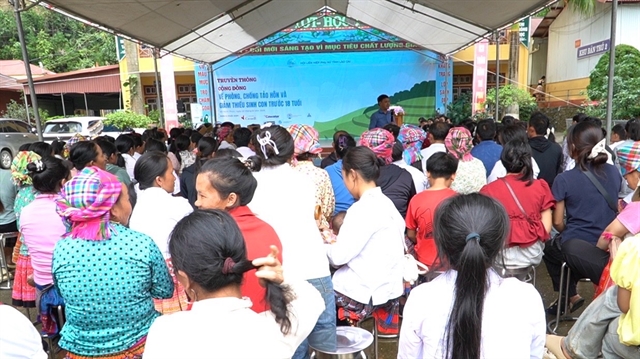 |
| Residents attend a community session on preventing child marriage and reducing births among women under 18 in Hạnh Phúc Commune, Lào Cai Province. The mountainous commune is home to a predominantly H’Mông population, which accounts for 53 per cent of residents. — Photo baochinhphu.vn |
LÀO CAI — At 14, while many of her peers were still studying in the classroom, Mùa Thị Linh had already left school.
She dropped out of ninth grade in Tà Xủa, the northern mountainous province of Sơn La, and moved to Hạnh Phúc Commune in neighbouring Lào Cai Province to live with Hờ A Vênh as his wife.
Instead of schoolwork, her days were filled with farm labour and household chores. Work that can be demanding even for adults became the teenage girl's daily routine.
“I miss my school and classmates. I also miss home very much,” Linh the Việt Nam Government Portal.
Her story is not unique.
Giàng Thị Máy, 14, lives in Sáng Pao Village in Hạnh Phúc with Chớ A Phổng, a fellow villager.
After her parents divorced, Máy was left without a stable source of support. Her relationship with Phổng, who is also a teenager, gradually led to the two living together.
“Actually, I did not want to get married. I just wanted to go to school,” Máy said.
Life outside school quickly showed her what she had given up.
Her days are now spent working in rice fields and upland farms, while good meals and new clothes have become luxuries.
Phổng, now 19 and regarded locally as Máy’s husband, has also left school. He has to support himself and shoulder family responsibilities.
“I once wanted to attend vocational training, hoping to find a less demanding job. Now that dream has been left unfinished,” he said.
“I hope others do not get married as young as I did. They should try to stay in school. Because I married early, I could no longer continue my education.”
A persistent problem
Despite years of awareness campaigns, child marriage remains a challenge in parts of Lào Cai, particularly in disadvantaged ethnic communities.
The latest report from the Lào Cai Department of Health recorded about 56 cases of child marriage in the province. No cases of consanguineous marriage were reported, although officials said the risk remained in some areas.
More than 440 girls under 18 also gave birth, accounting for 6.9 per cent of all newborns recorded.
Mông women accounted for 315 of those cases, or 70.9 per cent, followed by Dao women at 14 per cent and Tày women at 5 per cent.
Nguyễn Quang Hải, chairman of the Hạnh Phúc Commune People’s Committee, said child marriage and births among women under 18 remain persistent social problems.
Hạnh Phúc is an extremely disadvantaged mountain commune where Mông people make up 53 per cent of the population.
But Hải said poverty and social customs are only part of the picture.
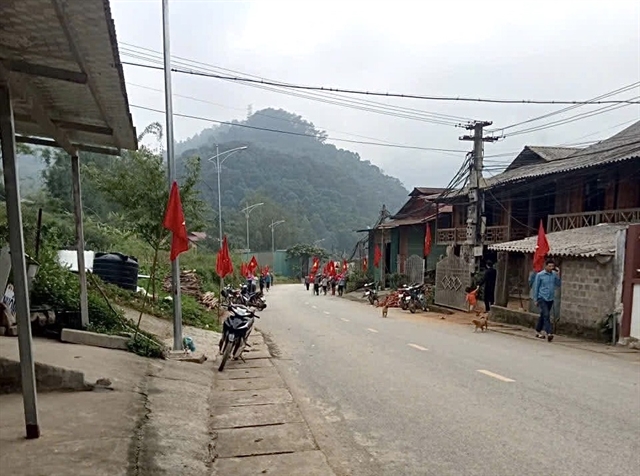 |
| A corner of Hạnh Phúc Commune. The mountain commune has a large Mông population, which accounts for 53 per cent of residents. |
Parents leaving home for work, limited supervision of teenagers, school dropouts, a lack of career guidance and limited access to sex education and adolescent reproductive health information can all leave young people vulnerable.
The commune aims to eliminate child marriage and births among girls under 18 before 2030, in line with its local development plan, Hải said.
Authorities are changing how they communicate with local residents, including producing information materials in Vietnamese, Mông and Thái and tailoring them to individual villages.
Loudspeakers, social media, community Zalo groups and mobile information teams will be used to reach residents. Campaigns will be intensified before wedding seasons, festivals and Tết (Lunar New Year), when officials say the risk of child marriage often increases.
Schools will also play a larger role. All students will receive information on marriage and family law, reproductive health, gender equality and life skills. Teachers will pay closer attention to students who are frequently absent or appear to be preparing for an early marriage.
When a risk is identified, schools are expected to work with families and local authorities to intervene early, he said.
At the village level, officials will identify adolescents approaching marriageable age and households considered at higher risk. All villages will be encouraged to maintain models aimed at preventing child marriage and births among girls under 18.
Village elders, clan leaders, respected figures, religious leaders and local Party working groups are expected to identify risks and persuade families before marriages take place.
However, changing attitudes alone is not enough, according to Hải.
The commune plans to link efforts against child marriage with vocational training, preferential loans and technical support for poor and near-poor households, particularly those with teenage children.
Improving livelihoods could give families more options for their children and reduce the pressure to arrange marriages at an early age, Hải said.
The commune also plans to include the prevention of child marriage in annual assessments of officials and village leaders in areas where such cases occur. — VNS
Society
 Society
 Society
 Society
 Society
 Society
 Society
 Society
 Society
 Society
 Society
 Society
 Society
 Society
 Society