 Society
LOAN Foundation awards scholarships to disadvantaged students on 10th anniversary
1.
|
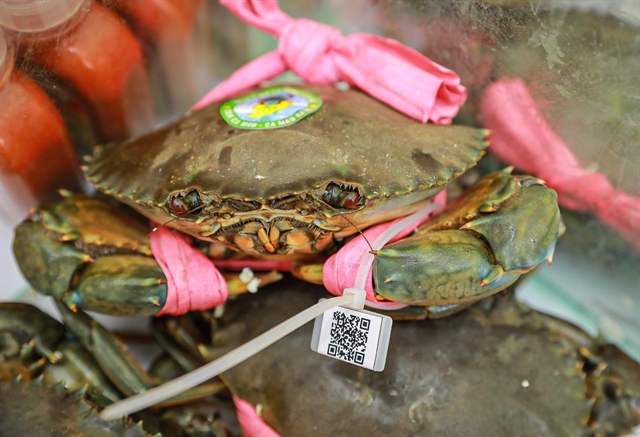
| Cà Mau crabs are tagged with QR codes to enhance traceability and strengthen consumer confidence in the product’s origin. — VNA/VNS Photo |
CÀ MAU— Cà Mau Province's agriculture sector benefits from extensive mangrove forests, coastal ecosystems, and integrated shrimp-crab farming models in developing crab production.
Cà Mau crab, particularly from Năm Căn and Ngọc Hiển, has long been prized for its firm, flavourful meat, rich roe, and nutritional value.
Crab farming has also become an important source of income for locals and a growing part of the province’s aquaculture sector.
Phạm Văn Mười, deputy director of the provincial Department of Agriculture and Environment, said Cà Mau has about 365,000ha under crab farming that produce 36,500 tonnes a year.
The province has identified 120 key marine crab farming areas for export production covering approximately 50,000ha.
It is also developing food-safe production zones, strengthening links between producers and buyers, and promoting circular farming models.
Most farmers raise crabs alongside shrimp in extensive farming ponds.
The model requires relatively little investment and relies mainly on natural food sources, making it accessible to large numbers of farming households.
In Phước Long Commune, Đinh Hoàng Quân has incorporated crab into his shrimp-rice farming system after previously focusing mainly on shrimp-rice rotation.
After about four months, the crabs reach marketable size and can be harvested.
Prices generally range from VNĐ200,000 to VNĐ450,000 per kilogram (US$7.80–$17.55), depending on the type of crab and market conditions.
During holidays – especially Tết (Lunar New Year), prices can exceed VNĐ500,000 per kilogram ($19.50).
Quân said the integrated model enables his family to earn more than VNĐ200 million ($7,800) a year.
In Vĩnh Phước Commune, nearly half of the 9,000ha under shrimp-rice production has been integrated with crab farming.
Nguyễn Thanh Hoàng, chairman of the commune People’s Committee, said the area has expanded rapidly over the past two to three years, with local authorities providing technical training to help farmers improve production efficiency.
Alongside expanding production, Cà Mau is also developing concentrated crab growing zones and strengthening links between farmers, cooperatives, and businesses.
Nguyễn Hoàng Xuân, deputy director of the provincial Sub-Department of Fisheries, said production and consumption chains had gradually been established, while raw material zones covering about 30,000ha had been identified to support the granting of farming-area codes to a number of enterprises.
Several large raw material zones have been developed, including a 9,560ha area associated with Thanh Hằng International Import-Export Trading Investment and 10,000ha with Gia Thành Trading Business.
The province has also adopted food-safe and VietGAP farming models, shrimp-crab systems, and circular farming models.
Research is under way to develop high-quality crab sources for soft-shell, roe-filled, and premium products, and conserve and develop the genetic resources of marine crab.
|
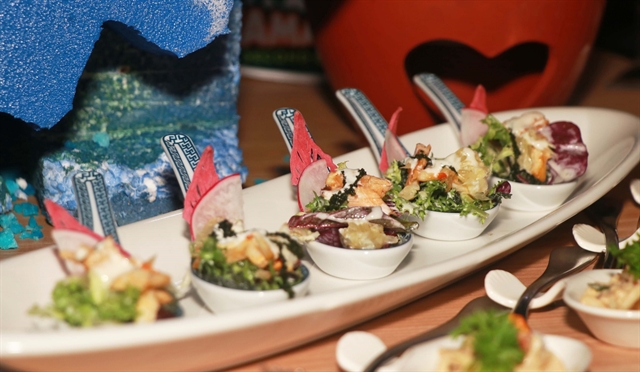
| Cà Mau crab products are processed into a wide range of products, an enormous advantage while exporting to international markets.— VNA/VNS Photo |
Digital passport for crabs
The rapid expansion of the sector has also exposed challenges, particularly in product standardisation, traceability, and food safety.
Most crab farming remains part of extensive shrimp-crab systems, while household production is fragmented and farming techniques and product quality vary.
Production organised through cooperatives and value-chain partnerships remains limited.
Links between farmers, cooperatives, and businesses are not yet strong enough.
When prices fluctuate, some farmers sell outside contractual arrangements, disrupting supply chains and making businesses less willing to invest in raw material zones over the long term.
Meanwhile, Cà Mau crab is still mainly sold live or after basic processing.
Deep-processed, convenient, and higher-value products remain limited, restricting efforts to increase value and enter demanding international markets.
Food safety and traceability requirements are becoming increasingly stringent globally, requiring the sector to move from traditional production towards a more modern, transparent, and professional system.
Dư Thái Bình, deputy director of Dư Thái Bình Co., Ltd., said market requirements for product quality and origin are becoming increasingly demanding.
“When trust is no longer enough, crabs need a clear identity.”
QR-based traceability would help improve competitiveness and strengthen consumer confidence, he added.
Developing a “digital passport” for Cà Mau crab is therefore expected to be an important step in transforming the sector, allowing consumers and businesses to access information about farming areas, production processes, and product origins.
To address traceability and food safety challenges facing crab exports, the province People’s Committee has instructed relevant departments and agencies to take coordinated measures.
Lê Văn Sử, vice chairman of the People’s Committee, said the Department of Agriculture and Environment has been tasked with reviewing the purchase, packaging, and traceability of crabs and export certification activities, while providing timely guidance to businesses and farming communities.
The department is working with local authorities to strengthen management and guide farmers and businesses in applying safe food production and trading practices.
Working teams have also been sent to crab-producing areas supplying export markets to provide technical guidance and help farmers comply with regulations.
The department is also reviewing and proposing procedures for managing raw material zones and traceability, and researching technologies for product identification, traceability, and protection of the Cà Mau crab brand.
The Department of Industry and Trade is monitoring markets, circulation, customs clearance and crab exports, particularly to China, while maintaining contact with businesses and border authorities to address possible problems.
The province’s strategy is expected to shift the sector away from simply expanding crab farming areas and output towards improving quality, added value, branding, and competitiveness.
The development of food-safe raw material zones with farming-area codes, stronger traceability, ecological farming, soft-shell and premium crab products, and deeper processing will be important steps towards increasing the value of Cà Mau crab.
Building transparent and sustainable value chains can help farmers increase their incomes while strengthening the Cà Mau crab brand and providing a stronger foundation for expansion into international markets. —VNS
Society
 Society
 Society
 Society
 Society
 Society
 Society
 Society
 Society
 Society
 Society
 Society
 Society
 Society
 Society

.jpg)