 Society
Top Vietnamese leader highlights new horizon for Việt Nam–Denmark cooperation
1.
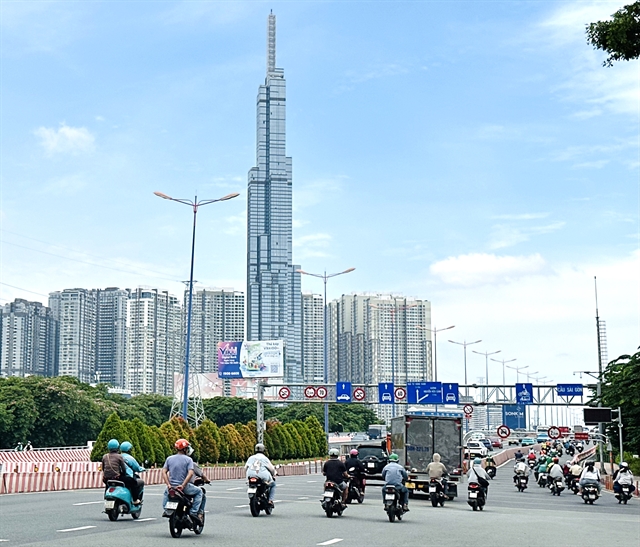 |
| Motorbikes make up nearly 90 per cent of all vehicles in HCM City, and are the primary mode of daily transport for millions of its people. — VNA/VNS Photos Nguyễn Diệp |
HCM CITY — Infrastructure synchronisation and calibrated support policies must precede strict vehicle restrictions to ensure a smooth transition towards green urban transport, experts and officials said as HCM City finalises its ambitious low-emissions roadmap.
According to a draft scheme on controlling vehicle emissions, road transport accounts for some 88 per cent of NOx emissions, 99 per cent of CO, 79 per cent of SO2, and 88 per cent of fine particulate matter across the city's transport sector.
Air pollution causes economic losses estimated at over VNĐ3 trillion (US$122 million) annually, or roughly 0.25 per cent of the city’s gross regional domestic product.
Without decisive interventions, transport-related greenhouse gas emissions are projected to exceed 18.4 million tonnes of CO2 equivalent by 2030.
The draft categorises the municipal territory into four operational zones: Côn Đảo Special Zone; the rural communes of Bình Khánh, An Thới Đông, Cần Giờ, and Thạnh An; a central low emission zone (LEZ); and the remaining areas.
The central LEZ is split into two tiers.
Tier 1 covers 16.6 square kilometres, encompassing the existing central core (930-ha zone) and the Thủ Thiêm New Urban Area.
Tier 2 spans 280 sq.km, covering the broader urban region within Ring Road No. 2.
To enter the LEZ, public buses must run on electricity or green energy by 2027.
Taxis must meet Euro 5 emission standards by 2028 before full electrification by 2030, while two-wheeled ride-hailing and delivery services must switch to green energy starting in 2028.
Passenger coaches, contract vehicles, and light trucks will undergo phased upgrades before complete electrification between 2032 and 2035.
Private motorbikes will have to meet Euro 3 standards by 2029 and Euro 4 by 2030, and private cars must conform to Euro 4 by 2028 and Euro 5 by 2030.
Both are slated for complete electrification by 2035.
As of May, the city managed nearly 12.8 million vehicles, including 11.5 million motorbikes and 1.28 million cars.
To offset upcoming restrictions, public transit must expand rapidly.
Since 2025, all new or replacement buses have been mandated to run on green power, bringing the current fleet to 88 electric bus routes with 1,404 vehicles, or over half of active public buses.
Experts point out that removing millions of personal vehicles will lead to a sharp surge in public transport demand, particularly in LEZs.
Therefore, public transit capacity must be expanded in parallel with vehicle restriction roadmaps to ensure alternative commuting options for residents once the new regulations take effect.
Charging networks present another critical hurdle: the scheme projects a minimum need for 19,000 charging stations and 33,000 battery-swapping cabinets for electric motorbikes.
Ung Thị Xuân Hương, chairwoman of the city Lawyers Association, said charging infrastructure in existing residential areas and older apartment blocks remains unsynchronised with urban power grids.
Furthermore, establishing 88 inspection centres and acquiring 1,606 exhaust-measuring devices by 2027 poses enormous operational and budgetary challenges, she warned.
She added that LEZ restrictions should be launched only when local public transit meets at least 60-70 per cent of commuting demand.
Trần Văn, former deputy chairman of the National Assembly's Finance and Budget Committee, warned against expanding the LEZ too quickly from the 16.6 sq km core to the 280 sq km Tier 2, which has over 6.1 million residents and sees 11.5 million daily vehicle trips.
"Restrictions should be applied strictly on the principle of infrastructure readiness—restricting fossil-fuel transport only after public transit and charging infrastructure reach required benchmarks rather than relying on rigid calendar deadlines."
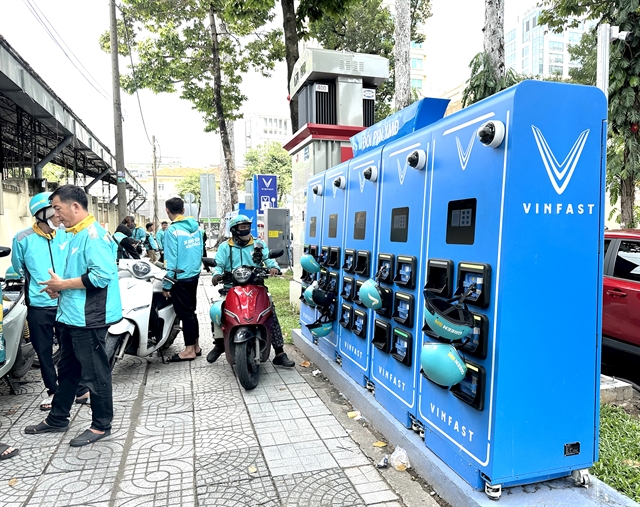 |
| A battery-swapping cabinet for electric motorbikes on Huyền Trân Công Chúa Street in central HCM City. The city plans to install 33,000 of them to support its green transition. |
Protecting livelihoods and vulnerable groups
Motorbikes represent the primary source of livelihood for millions of low-income workers, including traditional taxi drivers, ride-hailing drivers, couriers, and street vendors.
Under the draft, non-commercial private motorbikes failing to meet Euro 3 emission standards will be banned from entering the LEZ from January 1, 2029.
“This deadline puts a heavy strain on low-income groups,” Hương said.
Although the scheme includes a VNĐ10.27 trillion ($416.7 million) vehicle conversion fund, subsidy amounts and access procedures require further clarification, she added.
Surveys indicate that 60 per cent of the public requires financial support to switch vehicles, with nearly 28 per cent unable to afford the purchase of a green vehicle within three to five years.
The proposed subsidies of VNĐ800,000 to VNĐ1.77 million ($30–70) remain minuscule compared to the VNĐ18.5 million ($710) to VNĐ26 million ($1,000) price tag for a standard electric motorbike.
Legal expert Nguyễn Văn Hậu advocated for an approach centred on "support and infrastructure readiness first, restriction and enforcement later."
Tomoki Yanagawa of the Vietnam Automobile Manufacturers Association advised extending the 18-month LEZ Tier 1 trial to avoid sudden disruptions to automotive supply chains and employment.
Võ Khánh Hưng, deputy director of the city’s Department of Construction, said: “Emission control requires a comprehensive framework with expansion of public transit, charging networks, and inspection capacity and targeted socio-economic support.”
Recent legal developments, including the amended Law on Urban Development, provide a strong legal foundation for the city People’s Council to create policies for green transport infrastructure, vehicle conversion subsidies, and emission control measures. — VNS
Society
 Society
 Society
 Society
 Society
 Society
 Society
 Society
 Society
 Society
 Society
 Society
 Society
 Society
 Society