 Society
Việt Nam to revise food safety law with risk-based, supply-chain approach
1.
|
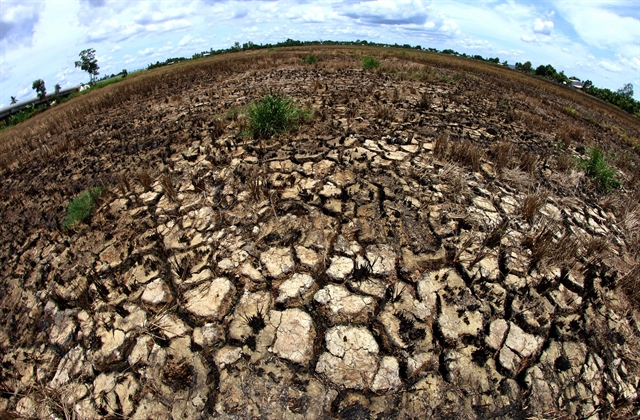
| Rice fields in Cần Thơ City are drying up after prolonged hot and dry weather. — VNA/VNS Photos |
HÀ NỘI — El Niño has reached strong levels and is likely to remain strong to very strong through the end of 2026, the Ministry of Agriculture and Environment said, warning of higher temperatures, rainfall deficits and drought.
Around 60 per cent of Việt Nam’s surface water comes from outside its borders, compounding the risk.
Authorities and experts urge provinces to shift from reacting to shortages to proactive planning, with basin-by-basin scenarios and tailored water allocations by region and use.
Việt Nam’s water resources face three major challenges, intensifying drought, more extreme rainfall and sea-levels rising, according to the National Centre for Hydro-Meteorological Forecasting.
Việt Nam has relatively abundant surface water, with 3,450 rivers and streams at least 10km long and about 844 billion cubic metres of annual runoff, mainly across 13 major basins, said Ngô Mạnh Hà, Deputy Director General of the Department of Water Resources Management.
Distribution is uneven across space and time, and five of the 13 basins depend on cross-border flows. Since May 2026, most rivers and streams have shown El Niño impacts, with flows trending below long-term averages.
A recent report by the Ministry of Agriculture and Environment warns El Niño 2026–2027 could trigger severe drought and saltwater intrusion in the South Central Coast, Central Highlands and Mekong Delta as early as the coming dry season.
Nguyễn Xuân Hiển, deputy director of the National Centre for Hydro-Meteorological Forecasting, Department of Meteorology and Hydrology, said the challenge was the uneven distribution of water between regions and seasons, along with substantial reliance on transboundary flows.
The Red River basin’s relatively complete reservoir system allows more proactive regulation, while the Mekong Delta depends heavily on upstream inflows. Dry-season rain accounts for only about 28 per cent of annual precipitation, heightening shortage risks.
Transboundary factors further complicate management, given roughly 60 per cent of Việt Nam’s surface water comes from outside the country.
“When climate change alters rainfall regimes and runoff or increases extreme weather upstream, these shifts can rapidly impact domestic water resources,” Hiển said.
He said Việt Nam must move from crisis response to preparedness, with early forecasting, warning and allocation planning based on each basin’s evolving conditions.
“We also need to reassess the load-bearing capacity and design standards of reservoirs, storage works, drainage systems and related infrastructure. Design parameters must be updated to reflect new climate realities, rather than relying solely on historical hydro-meteorological data,” he said.
Water management should run as a connected chain, from forecasting, storage, regulation and allocation to abstraction, drainage and water quality protection, so changes are detected earlier and responses prepared.
For agriculture, Associate Professor Mai Văn Khiêm, Director of the National Centre for Hydro-Meteorological Forecasting, urged provinces to review and balance water by area, infrastructure and crop season; assess storage in reservoirs, ponds, dams and canals; identify high-risk zones; and set allocation plans.
“Where water is limited, plan early for crop switching or adjusting cultivated area to avoid expanding beyond supply capacity," Khiêm said.
"In high-risk areas, consider cropping calendars, select varieties and crops with suitable water needs, adopt water-saving irrigation and limit production in zones where supply is not assured.”
For perennial crops such as coffee, pepper and fruit trees, proactive water management is critical. For rice, prioritise water at yield-determining stages.
|
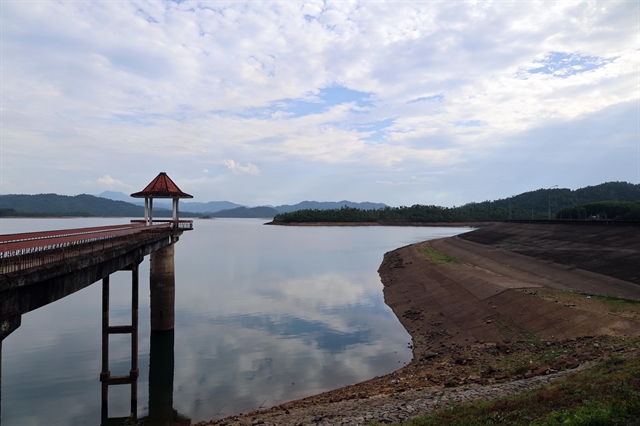
| Drought has caused a sharp decline in water levels at Phú Ninh Reservoir in Đà Nẵng City. |
Sharing this view, Hà called for stronger forecasting and early warning in drought-prone areas, especially the Central Region, Central Highlands and Mekong Delta.
He urged early water storage in irrigation and hydropower reservoirs during the flood season to secure supplies for the 2027 dry season, prioritising domestic use. Reservoirs should be operated flexibly, including coordinated multi-reservoir operations, to aid flood control and downstream safety while maximising storage.
Hà also called for early publication of river-basin water scenarios to underpin drought, shortage and salinity-response plans, and for regulation and distribution plans in basins where scenarios show deficits or severe deficits.
Provinces should prepare crop restructuring, adjust planting seasons and reduce cultivated area where needed; revise water abstraction downstream of hydropower reservoirs to optimise available supply when power plants must prioritise grid security; and adjust tasks at irrigation reservoirs that have yet to maximise storage, prioritising production and daily needs.
Hà said: “Particularly, we must develop proactive plans to address potential water shortfalls at hydropower reservoirs in late 2026 and early 2027, to regulate downstream supplies through the 2027 dry season, especially for domestic water in the Central and Southeast regions.” — VNS
Society
 Society
 Society
 Society
 Society
 Society
 Society
 Society
 Society
 Society
 Society
 Society
 Society
 Society
 Society