 Society

ZOOD Real Estate launches Élevée, a $667 million project in north Riyadh
1.
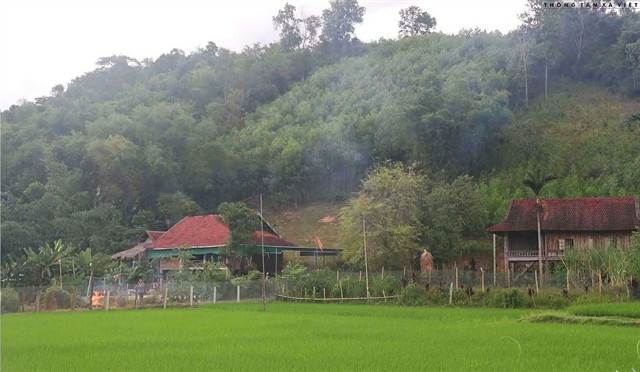 |
| A Thái village in Môn Sơn Commune, Nghệ An Province. — VNA/VNS Photo Viết Tôn |
NGHỆ AN — Nestled beside the vast Pù Mát National Park, Môn Sơn border commune in Nghệ An Province is working to transform its economy following the merger carried out as part of the two-tier local government model.
Lương Văn Tuấn, deputy chairman of the Môn Sơn Commune People’s Committee, said that more than 98 per cent of the commune’s population are Thái people, alongside the Kinh and Đan Lai ethnic groups.
Following the merging of 25 hamlets into 13, the Môn Sơn Party Committee has embarked on a new term with determination, setting a target of achieving double-digit growth in average per capita income and gradually lifting the commune out of the list of extremely disadvantaged poor communes in the country’s border areas.
Tuấn said Môn Sơn’s advantages are closely associated with its rich historical tradition. The commune is proud to preserve the Vi Văn Khang House, a special national historical relic and the birthplace of the first Party cell in western Nghệ An in 1931.
“To fully realise the value of this heritage, the commune is developing a plan to digitise tourism and heritage data and promote the locality’s image on digital platforms to attract domestic and international visitors,” Tuấn said.
In agriculture, the locality has drawn a number of practical lessons from its experiments with new models. Môn Sơn once attempted to cultivate orange trees, but the effort failed because the crop was not suited to the local soil. Learning from that experience, the commune has shifted towards focused investment in crops and livestock that are resilient and have stable markets.
Following the strategic orientation suggested by provincial leaders, Môn Sơn is actively expanding pineapple, tea and spotted deer farming to create sustainable livelihoods for local residents.
“With the advantages it possesses, Môn Sơn is shaping its tourism development strategy to increase incomes for both the locality and its people,” said Tuấn.
Poverty reduction
Despite achieving a number of encouraging results, Môn Sơn’s socio-economic picture still contains areas of deep concern.
Nearly 17 per cent of households in the commune remain poor. The situation is particularly difficult in Cò Phạt and Khe Búng hamlets, which are isolated deep within the core zone of Pù Mát National Park, where the poverty rate is close to 100 per cent.
Lieutenant Colonel Hoàng Ngọc Bình, political commissar of the Môn Sơn Border Guard Station, said that the rugged and fragmented terrain has become the biggest barrier separating the core zone from opportunities for development.
The most distant hamlet is approximately 20km from the commune centre by forest track. During the rainy season, the only access route is frequently hit by landslides, while rising floodwaters completely cut off the hamlets.
Poor transport infrastructure means that residents' goods and farm produce are often bought at low prices by traders and makes it extremely difficult for local officials to reach the area and hear about their concerns and aspirations.
The Môn Sơn Border Guard Station has served as a strong pillar of support for the Party committee, local authorities and residents. The soldiers stay close to the hamlets day and night and work alongside commune officials to provide hands-on guidance for residents applying scientific and technical advances to production. They also support Đan Lai ethnic pupils through the Border Guard Station’s foster child programme.
Gradual improvement
As it carries out Politburo Resolution 57 on developing science, technology, innovation and digital transformation, alongside the two-tier local government model, Môn Sơn has made clear progress in modernising its administration. Directives sent from the provincial level to the commune are processed promptly in the digital environment, reducing the time required to handle official business.
However, as digital transformation has progressed in the mountain commune, a number of shortcomings have emerged.
Tuấn said telecommunications infrastructure is the first major bottleneck. The commune’s internet connection is frequently congested and unstable, interrupting online public services.
At the same time, a digital literacy gap remains. Most residents in the highlands are not accustomed to using smartphones or remembering passwords, so using the VNeID electronic identification app is extremely difficult for them.
A heavy schedule of online meetings means that officials may be sitting in meeting rooms, but spend 99 per cent of the time working on their computers to process documents to meet deadlines.
For digital transformation to genuinely become a driver of development, Môn Sơn authorities have proposed that electronic administrative procedures be simplified into a genuinely integrated one-stop mechanism.
This should involve a single point of receipt and the integration of one digital signature account for commune-level leaders, while eliminating duplicate signing stages on paper and electronically.
In terms of infrastructure, residents are eagerly awaiting the early completion of a project to upgrade and pave the road linking Khe Búng and Cò Phạt hamlets. Once completed, the road will break the economic isolation of the area, facilitate the movement of goods and bring knowledge and technology to every local household. — VNS
Society
 Society
 Society
 Society
 Society
 Society
 Society
 Society
 Society
 Society
 Society
 Society
 Society
 Society
 Society