 Economy

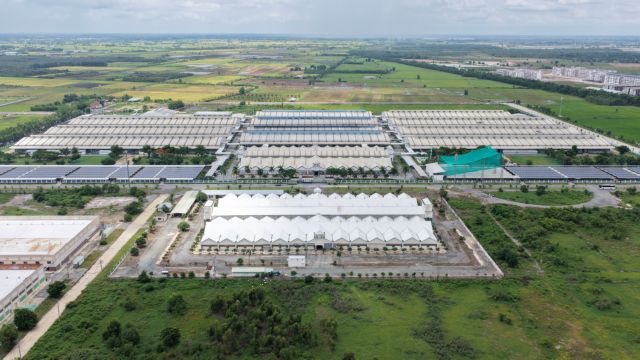
HCM City attracts US$5.7 billion into export processing and industrial zones
1.
|
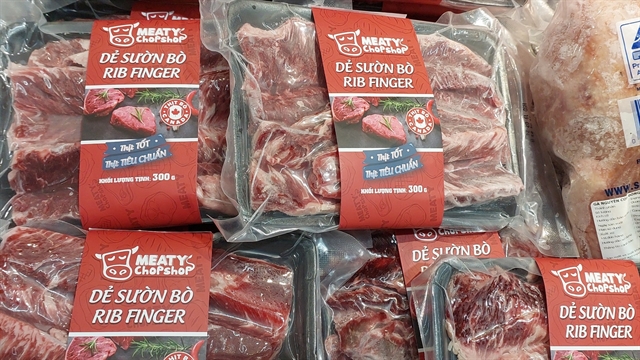
| Imported beef are sold at a supermarket in Hà Nội. — Photo laodong.vn |
HÀ NỘI — Imported beef is moving beyond restaurants and into homes, as consumers pay greater attention to the origin, quality and specific cuts of meat, intensifying competition among exporting countries and shifting the focus toward supply-chain reliability.
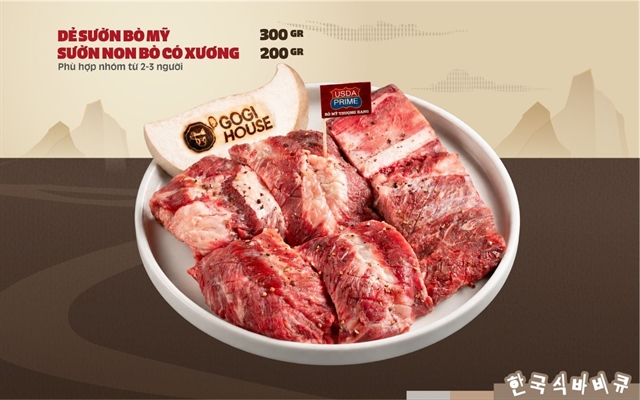
Trần Thế Quang from Golden Gate, which operates a chain of restaurants, said GoGi House mainly sources beef from the US and Australia, using both frozen meat transported by sea and chilled meat transported by air.
Frozen beef is suited to large-volume demand and generally offers lower costs, while chilled beef is kept at between zero and five degrees Celsius and requires a period of storage after arrival to maintain tenderness and juiciness, Quang said.
The choice depends on the restaurant's menu, target customers and price range, while consistent quality and supply are key considerations for importers, he told mekongasean.vn.
According to Quang, when his company began importing its first containers of beef around 2010-12, the market was still relatively new in Việt Nam and consumers were more familiar with beef in traditional dishes such as phở, while individual cuts were less widely known.
That has changed, with consumers now able to choose from dozens of cuts, including tenderloin, shank, brisket, short ribs, sirloin and flank steak.
Korean and Japanese hotpot and barbecue chains, along with steak restaurants, have helped introduce these products. Consumers may first encounter a particular cut at a restaurant before looking for similar products in supermarkets or grocery stores.
Australia's beef exports to Việt Nam reflect the growing demand for specific cuts. Australia exported 18,221 tonnes of beef to Việt Nam in 2025, with exports increasingly shifting toward individual cuts, while tenderloin shipments have risen significantly over time.
Standardisation becomes a competitive factor
|
| A GoGi beef dish. —Photo courtesy of GoGi |
As consumers begin choosing individual cuts, consistency becomes increasingly important for restaurants and retailers.
Chefs need to know how a cut will perform during cooking, while restaurant chains need confidence that the same products can be supplied consistently over an extended period.
Industrial suppliers can benefit from systems designed to standardise meat quality.
Trần Thị Lan Hương, a representative of Meat & Livestock Australia (MLA), an Australian non-profit organisation supporting the red meat and livestock industry, in Việt Nam, said the AUS-MEAT system has been used for about five decades to classify and assess beef carcasses.
Australia's Meat Standards Australia (MSA) system has since incorporated additional data and technology to assess the quality of individual cuts, Hương said, adding that more than 50 exporters are using the system.
When data is entered for all the carcasses of a cow, the system immediately gives a score for each cut, Huong told mekongasean.vn.
The data helps producers match individual cuts with particular dishes and consumer groups, allowing the value of an animal to be distributed across multiple market segments rather than treating the carcass as a single product.
Việt Nam's cattle industry, meanwhile, remains heavily reliant on small-scale farms. The fragmented production base can make traceability, quality control and consistent supply more difficult.
A March 2026 report by MLA found that Southeast Asian consumers buying imported beef for home consumption place importance on quality, freshness, country of origin, intended use and price.
The report also found that consumers were willing to pay up to 30 per cent more for meat they trusted, with trust linked to a combination of quality and traceability.
According to MLA, 54 per cent of consumers in the Asia-Pacific region eat out several times a week or daily, while Southeast Asia's food-service industry is projected to grow by about 4 per cent annually over the long term.
More suppliers enter the supply chain
Growing demand is also attracting new suppliers. Brazil, one of the world's largest beef producers and exporters, returned to Việt Nam's market in 2025.
JBS, the Brazilian meat processor, announced plans to invest US$100 million to build two factories in Việt Nam, mainly importing raw materials from Brazil and processing them locally for the domestic market and other Southeast Asian countries.
Such investments would place Việt Nam further along the regional beef supply chain, with imported meat processed, packaged and distributed to other markets rather than simply sold to Vietnamese consumers.
For domestic producers, competition therefore extends across multiple stages of the supply chain. Vietnamese cattle farmers operate within a system that includes farms, slaughterhouses, grading, data management, cold storage and transportation, while international suppliers can deliver specific cuts to targeted market segments and build demand through restaurant and retail channels, industry insiders said. — VNS
Economy
 Economy
 Economy
 Economy
 Economy
 Economy
 Economy
 Economy
 Economy
 Economy
 Economy
 Economy
 Economy
 Economy