 Economy


Việt Nam, Liechtenstein agree to soon ratify free trade deal
1.
|
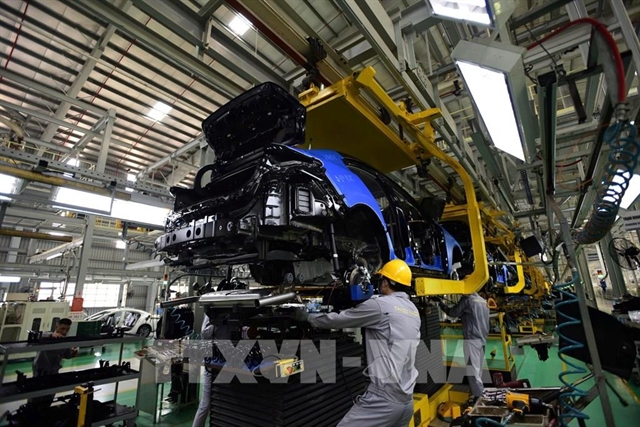
| Technology applied in the production and assembly process at a plant of THACO Group. — VNA/VNS Photo |
HÀ NỘI — Việt Nam is moving its digital transformation agenda beyond policy frameworks and individual technology platforms towards practical applications that address everyday needs, as authorities seek measurable outcomes from science, technology and innovation.
Under Politburo Resolution No. 57-NQ/TW issued on December 22, 2024, the implementation is increasingly shifting from simply completing assigned tasks towards developing concrete products and services for citizens and businesses.
A major step came on August 28, when Deputy Prime Minister Hồ Quốc Dũng signed Decision No. 1671/QĐ-TTg approving the National Artificial Intelligence Strategy to 2030, with a vision to 2045.
While Resolution 57 identifies artificial intelligence as a strategic technology and targets placing Việt Nam among Southeast Asia's three leading countries in AI research and development by 2030, the strategy establishes a more detailed framework for research, development, application and the creation of a domestic AI ecosystem.
Under the strategy, AI is envisaged not merely as a field of technological research but as a core capability supporting how the State, economy and society identify problems, design solutions and organise operations.
Human resources, infrastructure and data are defined as foundations, while AI institutions and governance are considered a breakthrough area.
Implementation will follow a human-centred approach while expanding AI skills among the population and developing infrastructure, data, models and platforms with requirements for safety, security and technological sovereignty.
Nguyễn Khắc Lịch, director general of the Department of Digital Technology and Artificial Intelligence under the Ministry of Science and Technology, said implementation would focus on six groups of breakthrough solutions, including institutions and legislation, national coordination, resource mobilisation, international cooperation and standards, responsible AI awareness and monitoring and evaluation.
Implementation will follow the six clear principles: clear people, tasks, timelines, responsibilities, products and authority. Results and the level of AI transformation will be used to adjust tasks, policies and resource allocation.
The ministry has also launched a one-stop AI portal at ai.dda.gov.vn to support implementation of the Law on Artificial Intelligence and related regulations.
The platform provides a single online point where businesses, developers, government agencies, experts and citizens can complete procedures, submit information, search data and interact with regulators.
Businesses can reduce administrative time and compliance costs, while citizens can monitor systems, submit feedback and receive warnings.
Meanwhile, the National Technology Innovation Fund, or NATIF, has announced its first 2026 round of interest-rate support for loans financing technology transfer, application, innovation and digital transformation projects.
The funding package is expected to total VNĐ50 billion (roughly US$2 million), with applications accepted until September 20. Eligible spending includes acquiring technology ownership or usage rights, technology information, design documents, technical standards, software, research results and digital transformation solutions.
At the local level, digital transformation is increasingly being linked with practical public services and administrative management.
Nghi Lộc in Nghệ An has become the province's first commune to establish an Intelligent Operations Centre, or IOC. Built around the local Party Committee, People's Council, People's Committee and Fatherland Front, the centre also covers major socio-economic and State management functions.
The IOC is designed to reduce manual reporting, improve transparency in task progress and enable local leaders to make decisions using data while strengthening accountability in public administration.
Hải Phòng, meanwhile, has launched a new version of its Smart Hải Phòng application under the message 'one touch, multiple services'.
Developed around the needs of residents, businesses and visitors, the platform is intended to bring information, public services and essential utilities into a single access point instead of requiring separate applications and accounts for individual services.
Technology adoption is also extending into manufacturing and logistics.
Robotics and automation are among Việt Nam's 10 national strategic technology groups.
In HCM City, a technology connection programme focusing on automated guided vehicles, or AGVs, robots and factory and warehouse automation has brought together business demand, research capabilities and technology suppliers.
The programme showcased AGVs, robotics, AI and automation solutions for factories, warehouses and logistics operations, giving companies additional information to evaluate technologies suited to their operational requirements. — BIZHUB/VNS
Economy
 Economy
 Economy
 Economy
 Economy
 Economy
 Economy
 Economy
 Economy
 Economy
 Economy
 Economy
 Economy
 Economy
.jfif) Economy
Economy