 Society
.jpg)
SHB unveils sustainable finance framework to expand green and social lending
1.
|
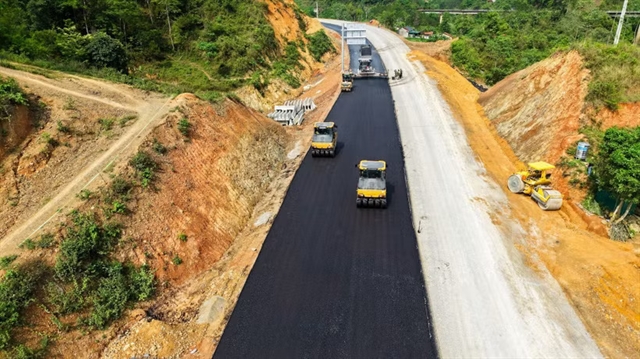
| A contractor lays asphalt on the Hữu Nghị-Chi Lăng Expressway. — Photos vietnamplus.vn |
HÀ NỘI — Transport infrastructure can attract substantial investment when backed by appropriate policies and mechanisms, the Ministry of Construction said as it outlined plans to mobilise private capital for expressway development.
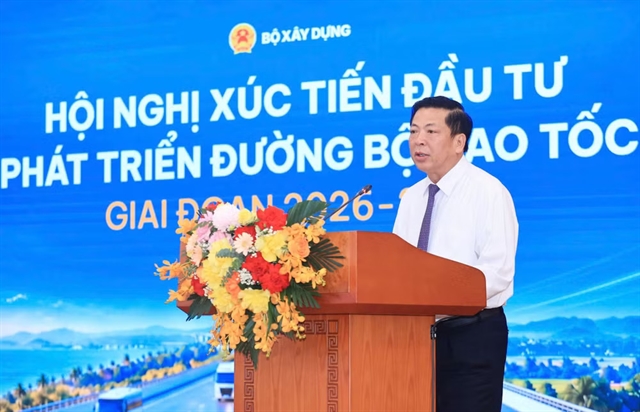
Việt Nam aims to expand its expressway network to more than 5,000km by 2030, requiring an estimated VNĐ1.27 quadrillion (US$48.9 billion) in investment, Minister of Construction Trần Hồng Minh told an investment promotion conference yesterday.
The country has already put 3,345km of expressways into operation, exceeding the 3,000km target set for 2021-2025, while another 1,252km is under construction.
Stretching from Lạng Sơn to Cà Mau, the more than 2,000km eastern North-South Expressway has also been largely connected, creating a continuous backbone for the country's transport network.
Over the next five years, Việt Nam needs to build 2,829km of new expressways and upgrade 1,187km of existing routes, according to the ministry.
Priority projects include expanding sections of the eastern North-South Expressway, such as Mai Sơn-Cam Lộ and Quảng Ngãi-Dầu Giây, widening HCM City's Ring Road 3 from four restricted lanes to six to eight full lanes, and completing major ring roads including Ring Road 5 in the Hà Nội Capital Region.
The Government also plans to develop routes linking the East-West economic corridors, the Central Highlands and the Mekong Delta.
“State budget resources are expected to cover only around VNĐ423 trillion,” Minh said. “We therefore need to mobilise around VNĐ846 trillion from non-State sources.”
He said the funding shortfall would be a major challenge, but also offer significant opportunities for businesses and lenders.
The minister called on investors to study and register for 29 priority projects to be developed under the public-private partnership (PPP) model, with preliminary total investment estimated at around VNĐ923 trillion.
Major banks including BIDV, VietinBank, Vietcombank, Agribank, MB and Techcombank are expected to develop long-term credit packages at reasonable interest rates to support PPP investors.
Minh also called on central agencies and local authorities to ensure timely site clearance and simplify administrative procedures, saying difficulties faced by investors should be addressed jointly.
He acknowledged challenges including arranging credit, land clearance and fluctuations in the prices of raw materials, fuel and construction materials.
The Ministry of Construction would work with investors from project preparation through operation and take steps to ensure projects are carried out quickly, correctly, effectively and safely, he said.
The ministry would also continue to refine policies to improve transparency and balance the interests of the State, investors and the public.
|
| Minister of Construction Trần Hồng Minh calls on investors and businesses to invest in transport infrastructure projects. |
Diversifying funding sources
Lê Văn Đạt, deputy director of the Academy of Strategy and Leadership Development under the Ministry of Construction, said Việt Nam's expressway network remained relatively underdeveloped, making the 5,000km target a major investment challenge.
Priority would be given to restricted two- and four-lane expressways needing expansion, routes along economic corridors and in key growth areas, and projects with strong transport demand and potential to connect regions, economic centres, seaports and economic zones.
Việt Nam's expressway network is planned to comprise 46 routes totalling about 10,106km by 2030. Đạt said funding sources needed to be diversified, with private investment playing a key role alongside public spending.
“The State plays a facilitating and leading role and invests in essential, strategic infrastructure, while creating conditions for the private sector to participate in infrastructure investment, management and operation,” he said.
Nguyễn Thị Thu Hà, deputy head of the PPP Office under the Ministry of Finance's Department of Public Procurement Management, said mobilising private resources was essential to meeting the expressway development target.
She called for continued improvements to the legal framework for PPP projects, including clearer risk-sharing mechanisms to ensure a fair balance of interests.
Project preparation procedures should also be streamlined and post-inspection measures strengthened during implementation, she said.
“Continued policy improvements, better project selection, diversified funding sources and stronger implementation capacity” would help mobilise private capital for transport infrastructure, Hà said. — VNS
Society
 Society
 Society
 Society
 Society
 Society
 Society
 Society
 Society
 Society
 Society
 Society
 Society
 Society
 Society