 Society

Triton Crown launch draws more than 400 prospective buyers
1.
 |
| A perspective rendering of the Cát Lái Bridge, which will replace the existing Cát Lái Ferry, between HCM City and Đồng Nai City. — Photo courtesy of TEDI |
ĐỒNG NAI — Construction of the two long-awaited bridges linking the two southern centres HCM City and Đồng Nai City – Cát Lái and Long Hưng – began on Tuesday.
A groundbreaking ceremony was organised by the two administrations.
Both bridges will span the Đồng Nai River and serve as key transport links that connect the two major economic hubs and provide crucial access to the under-construction Long Thành International Airport.
The Cát Lái Bridge, which will replace the existing Cát Lái Ferry, is budgeted at over VNĐ24 trillion (US$970 million).
It spans 11.6km in all, with the main bridge section measuring 3km.
Designed for a maximum vehicle speed of 80km per hour, it will have eight lanes with six dedicated to motor vehicles and two to non-motorised traffic.
It starts on Nguyễn Thị Định Street in HCM City’s Cát Lái Ward, about 400 metres from the Mỹ Thủy Intersection, and terminates at the junction of DT769D Road and the Bến Lức–Long Thành Expressway in Đồng Nai City’s Đại Phước Commune.
The winning consortium for the construction is led by Construction Joint Stock Company No. 1 (CC1) and has CC1 Asset Management and Services LLC and CC1 Investment JSC.
The bridge was first mooted by Đồng Nai authorities in 2003 to connect HCM City with the Nhơn Trạch urban area. In 2017, the Government approved adding the bridge to HCM City’s transport master plan, and in 2019, Đồng Nai was designated to implement the project under a public-private partnership model.
The Long Hưng Bridge, also known as Đồng Nai 2 Bridge, spans nearly 9.8km.
It is designed with six motor vehicle lanes and two mixed lanes, and will cost over VNĐ12.7 trillion ($508 million).
It begins in HCM City’s Long Phước Ward, and ends at its intersection with the Biên Hòa - Vũng Tàu Expressway in Đồng Nai.
At the groundbreaking ceremony, Trần Trọng Thuỷ, Director of the Đồng Nai Transport Construction Investment Project Management Board, urged participating entities to uphold the highest sense of responsibility, proactively coordinate, concentrate resources, and strictly adhere to all technical, quality, environmental, and safety requirements during construction.
He also called for close collaboration with relevant authorities to promptly resolve any obstacles and accelerate project progress.
The Board is intensifying coordination with relevant units to expedite compensation and site clearance for the two bridge projects.
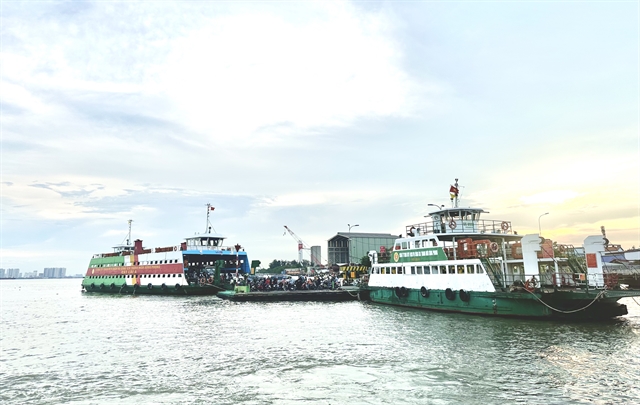 |
| Once completed, the Cát Lái Bridge will replace the busy ferry service, eliminating severe congestion during holidays and peak periods, which has become a regular phenomenon. — VNS Photo Nguyễn Diệp |
The two administrations agreed that the main bridge structures will be built under a PPP model with build-transfer contracts.
Meanwhile, site clearance and access roads in each jurisdiction will be funded and managed with their respective public funds.
Both bridges are expected to open to traffic in 2029.
Seven bridges are planned in all over the section of the Đồng Nai River between Đồng Nai Bridge and HCM City’s Cần Giờ.
Only three currently exist, the other two being Long Thành Bridge on the HCM City-Dầu Giây Expressway and Nhơn Trạch Bridge on HCM City Ring Road 3.
The Phước Khánh Bridge on the Bến Lức–Long Thành Expressway is currently under construction.
Experts note that completing these key river crossings will remove long-standing traffic bottlenecks, alleviate severe congestion at the Cát Lái ferry Terminal by replacing the ferry operation altogether, and reduce heavy reliance on the overloaded HCM City–Long Thành–Dầu Giây Expressway, thus unlocking the full economic potential of the region. — VNS
Society
 Society
 Society
 Society
 Society
 Society
 Society
 Society
 Society
 Society
 Society
 Society
 Society
 Society
 Society


.jpg)




