.jpg) Economy
Economy



Triton Crown launch draws more than 400 prospective buyers
1.
|
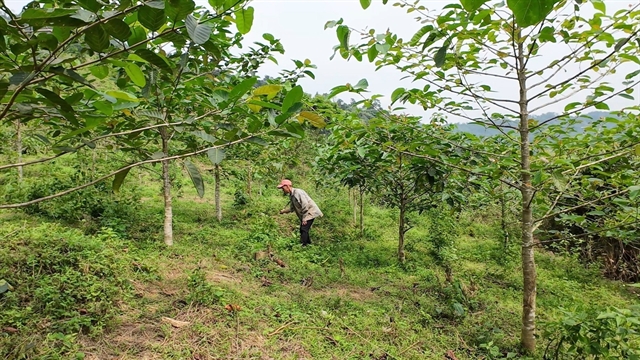
| A forest in Quảng Trị Province being restored. The long-term goal of post-mining restoration should be to restore ecological functions and establish stable forest ecosystems suited to local conditions. — VNA/VNS Photo Tá Chuyên |
HÀ NỘI — Restoring forests and ecosystems on land damaged by mining could help rehabilitate degraded landscapes while creating opportunities to develop forest carbon credits, experts said at a workshop in Hà Nội on Tuesday.
The workshop, organised by the Vietnam Academy of Forest Sciences and Forest Trends, examined nature-based solutions (NbS) for restoring forests after mining and their potential role in future carbon markets.
Experts said mining can cause significant damage to forests and ecosystems through vegetation loss, soil disturbance, habitat fragmentation, erosion and water pollution.
Still, mining supply chains have generally faced less stringent forest-risk requirements than commodities such as timber, coffee, rubber, soy and palm oil.
Mineral commodities are rarely viewed as commodities with deforestation risks, which creates a policy gap with mineral supply chains not yet subject to equivalent requirements on forest protection and restoration, said Tô Xuân Phúc, an expert at Forest Trend.
Phúc said that the energy transition is increasing demand for minerals used in batteries, solar and wind power, electric vehicles and energy storage systems, which makes it increasingly important to balance resource extraction with forest and ecosystem protection.
Việt Nam has regulations covering the conversion of forest land and environmental restoration obligations for mining projects, but implementation remains uneven, experts said.
Nature-based solutions
Trần Lâm Đồng, deputy director of the Vietnam Academy of Forest Sciences, said it’s time the impact of mining on forests be considered as an integral part of national forest protection and climate-change strategies.
Experts proposed treating minerals as a forest-risk commodity and incorporating forest-impact assessments and due-diligence requirements into mining projects.
They also called for stronger coordination between mineral-resource and forestry authorities throughout the life cycle of mining projects, from planning and licensing to mine closure and restoration.
Vũ Tấn Phương, director of the Vietnam Forest Certification Office, said NbS could help restore native vegetation and damaged ecosystems while potentially generating new economic value through participation in the carbon market.
"Post-mining areas, if restored properly using nature-based approaches, can gradually regenerate native vegetation, stabilise soils and form forest ecosystems," Phương said.
Carbon absorbed during the restoration process could, if properly measured, reported and verified (MRV) under appropriate standards, provide a basis for developing forest carbon credits, he said.
Phương said the long-term goal of post-mining restoration should be to restore ecological functions and establish stable forest ecosystems suited to local conditions.
NbS should be tailored to local soil and terrain conditions, as well as tree species and planting density, rather than applying a single model to all mining sites, experts said.
For coal and apatite waste dumps, restoration should initially focus on soil stabilisation, erosion control and environmental rehabilitation, he said. Areas affected by bauxite mining, where site conditions may be more favourable, could potentially be restored for economic forestry while also generating carbon credits.
Việt Nam has more than 5,000 mining sites and around 60 types of minerals, including bauxite, apatite, titanium, coal, rare earths and granite. Mining excluding oil and gas accounts for about 4-5 per cent of the country's gross domestic product (GDP) each year and provides significant revenue and employment. — VNS
Economy
 Economy
 Economy
 Economy
 Economy
 Economy
 Economy
 Economy
 Economy
.JPG) Economy
Economy
 Economy
 Economy
 Economy
.jpg) Economy
Economy
 Economy