 Economy


HCM City attracts US$5.7 billion into export processing and industrial zones
1.
|
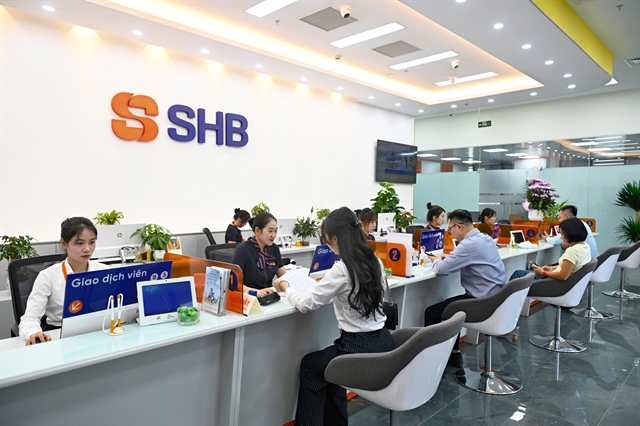
| Customers conduct transactions at SHB. — Photos courtesy of the bank |
HÀ NỘI — Saigon-Hanoi Commercial Joint Stock Bank (SHB) is expanding its ecosystem of financial solutions for import-export businesses, helping companies secure working capital, optimise cash flow, reduce transaction costs and manage foreign exchange risks throughout the international trade cycle.
As cross-border trade becomes increasingly dependent on speed, financial flexibility and cost control, businesses need more than individual banking products to support their operations. From securing an export contract and purchasing raw materials to production, shipment, documentation and payment collection, each stage creates different financial needs.
SHB has therefore developed an integrated suite combining pre- and post-shipment export financing, international payment services, preferential fees and foreign exchange solutions.
For exporters, working capital needs often arise at the beginning of the production cycle, when businesses purchase raw materials, process goods and prepare orders for shipment.
SHB offers pre-shipment export financing of up to 90 per cent of an export contract’s value, with loan terms of up to 12 months. Export receivables can be used as collateral, reducing reliance on traditional secured lending and giving businesses greater flexibility in planning production.
The bank also offers unsecured credit limits of up to 20 per cent, helping businesses with limited collateral expand production capacity and take on new export orders.
Access to funding from the time an export contract is secured can ease cash-flow pressure during the early stages of production and help businesses respond more quickly to international orders.
SHB’s support continues after goods have been shipped through its post-shipment export financing solutions.
Once export documents have been completed, businesses can access financing for up to 12 months. SHB can purchase documents with recourse, providing financing of up to 98 per cent of their value, or purchase them without recourse for up to 100 per cent of the document value.
These arrangements allow businesses to convert export receivables into cash more quickly, enabling them to fund new orders, cover production costs, purchase materials or expand operations.
The solutions support common international payment methods, including letters of credit (LCs), documentary collections, cash against documents (CAD) and telegraphic transfers.
For businesses with regular export activity, faster access to post-shipment funding can shorten the cash conversion cycle and reduce the need to wait for overseas buyers to settle invoices before financing the next order.
International payments and lower transaction costs
.jpg)
|
| The bank has introduced preferential fee packages covering up to 66 types of service fees. |
Alongside trade financing, SHB provides international payment services, including outward and inward remittances, import and export collections, CAD, import and export LCs, border trade payments and international guarantees.
The bank has also introduced preferential fee packages covering up to 66 types of service fees, including account and international payment services.
For exporters, SHB offers fee waivers for online transactions, tax payments, foreign currency transfers, SMS services and various account-related services. Other waived fees include international incoming transfers, export LC notifications, import-export collections, receipt and processing of export documents, and inquiries and amendments related to export LCs and collections.
SHB also offers discounts of up to 70 per cent on selected services, including LC issuance and amendments, documentary payments, collections, fund transfers and over-the-counter transactions.
For businesses making frequent international payments or expanding into new markets, lower transaction costs can help improve margins and strengthen competitiveness.
To support foreign exchange transactions, SHB offers preferential buying and selling rates of up to 150 points against listed rates for major currencies, including USD, EUR, GBP, JPY and KRW.
The bank also provides foreign exchange products such as forward transactions and currency swaps, enabling businesses to plan cash flows with greater certainty and mitigate the impact of exchange rate fluctuations.
For import-export companies, currency movements can directly affect input costs, foreign currency revenues and profit margins. Combining preferential exchange rates with hedging tools can therefore give businesses greater control over their financial planning, particularly those with significant foreign currency revenues or payment obligations.
SHB’s solutions are designed around the different stages of customers’ international trade activities. By combining financing, international payments, preferential fees and foreign exchange services, the bank aims to address four key financial needs: funding, cash flow, transaction costs and currency risk.
A SHB representative said: “Import-export businesses need financial solutions that are flexible, fast and integrated throughout the international trade cycle. Through our specialised product ecosystem, SHB aims to support customers from the moment they secure an order and begin production through to shipment and payment collection, helping them manage capital, optimise costs, mitigate risks and pursue sustainable growth.”
The expansion of solutions for import-export businesses forms part of SHB’s broader ecosystem banking strategy, which focuses on customer needs and connects corporate lending, international payments, foreign exchange, guarantees and digital banking.
SHB said it would continue to enhance its trade finance, international payment, foreign exchange and digital banking products as it strengthens its support for businesses operating in an increasingly interconnected global trading environment. — VNS
Economy
 Economy
 Economy
 Economy
 Economy
 Economy
 Economy
 Economy
 Economy
 Economy
 Economy
 Economy
 Economy
 Economy