 Society

Triton Crown launch draws more than 400 prospective buyers
1.
|
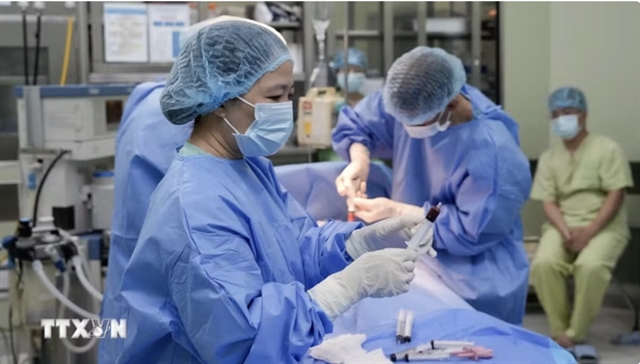
| Doctors taking marrow from the donor. VNA/VNS Photo |
HUẾ CITY — Huế Central Hospital has successfully performed a stem cell transplant from an 18-month-old donor, the youngest in Việt Nam, to save his four-year-old sibling with idiopathic aplastic anaemia.
This success marks a significant milestone, confirming the exceptional professional expertise and seamless coordination among the specialised departments at Huế Central Hospital and opening up a lifeline for many paediatric patients suffering from haematological disorders – particularly idiopathic bone marrow failure – across the central and Central Highlands regions and the entire country.
The young paediatric patient from Đà Nẵng City first showed symptoms in February, presenting with anaemia and haemorrhaging that required continuous blood and platelet transfusions.
The child also suffered from recurrent infections due to a low granulocyte count.
After undergoing comprehensive testing, the child was diagnosed with idiopathic bone marrow failure.
This is a critical condition occurring when bone marrow suddenly ceases to produce sufficient quantities of vital blood cells (red blood cells, white blood cells and platelets).
Affected children face risks of severe infections, serious haemorrhaging and prolonged, severe anaemia.
According to doctors, relying solely on conservative treatment carries a very high risk of recurrence and life-threatening complications.
Haematopoietic stem cell transplantation is the only method offering a chance for a complete cure, enabling the regeneration of a healthy haematopoietic and immune system.
Doctors conducted a clinical consultation and devised a treatment plan for the child.
Human leukocyte antigen (HLA) blood testing revealed a perfect bone marrow match with the patient's 1.5-year-old 10kg brother, although they had incompatible blood types.
Performing an allogeneic stem cell transplant involving such a young donor with blood type incompatibility presented a significant challenge requiring careful consideration.
Consequently, the doctors decided to employ an immunomodulatory approach that transfuses the donor's blood type into the patient to lower antibody titers.
This strategy eliminated the need to deplete red blood cells from the stem cell product on the day of harvest, thus preserving the full count of stem cells for the child.
Thanks to the seamless coordination between departments, the bone marrow harvest from the donor was successfully completed.
During the transplantation process, the paediatric patient experienced some complications.
However, thanks to the medical team's meticulous preparation, dedicated care and timely treatment, the child's health has fully stabilised.
Blood cell counts are recovering well, and the child no longer requires blood transfusions.
The patient was released from the hospital on Monday.
On the same day, the hospital also celebrated the success of three allogeneic stem cell transplants for Beta-Thalassaemia.
All the children received bone marrow from HLA-matched siblings.
The patients have recovered their blood cell counts, their health is stable and they are completely free from the need for regular blood transfusions.
To date, the hospital has successfully performed 88 paediatric stem cell transplants.
Specifically for Thalassaemia patients, the hospital has carried out 23 allogeneic stem cell transplants within just 24 months – the highest number in the country for this period.
To meet growing demand, the hospital has expanded its transplantation facilities, increasing capacity to perform transplants for four paediatric patients simultaneously.
The hospital has begun implementing haploidentical (half-matched) transplantation techniques for Thalassaemia patients who lack a full HLA match with their parents or siblings. — VNS
Society
 Society
 Society
 Society
 Society
 Society
 Society
 Society
 Society
 Society
 Society
 Society
 Society
 Society
 Society

.jpg)




