 Society
Việt Nam promotes hot spring tourism at Algerian forum
1.
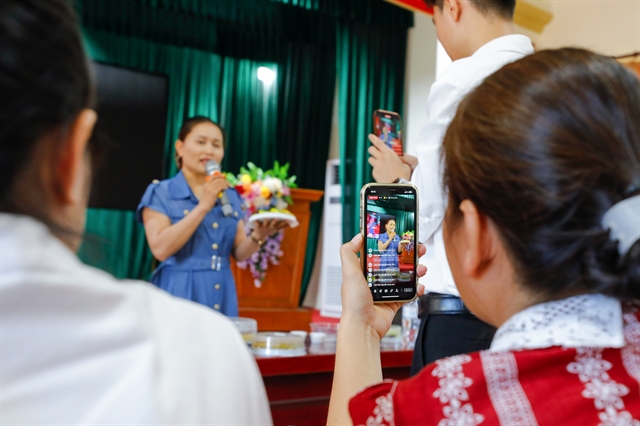 |
| Trainees practise livestreaming techniques with an instructor in Phượng Dực. — Photo courtesy |
HÀ NỘI — From livestreaming classes that teach villagers how to sell their products online to 'Digital Village' and 'Digital Cultural House' models, Hà Nội is bringing digital technology deeper into rural life.
As local residents learn to market traditional craft products online, access public services from home and connect with local authorities via smartphones, digital transformation is emerging as a new driver for building modern, connected rural communities centered on the people.
Technology expands development opportunities for rural communities
At 6.30am on a Saturday, as Hà Nội was waking up to sweltering heat, 51-year-old Nguyễn Thị Thiếc and her son travelled more than 6km from their small home at the end of Lưu Thượng Village to the cultural house of Phượng Dực Commune.
Their destination was a special training class: learning how to sell products through livestreaming.
For residents of an area known for its many traditional craft villages, online commerce is no longer unfamiliar. Yet enabling a middle-aged woman to confidently introduce her family's products on digital platforms requires more than just a smartphone. That is why training courses like the one in Phượng Dực have been regularly organised by local authorities.
In Phú Xuyên Commune, e-commerce has grown rapidly in recent years. Total e-commerce revenue in the former district rose from VNĐ147 billion (US$5.7 million) in 2022 to more than VNĐ6 trillion ($231 million) in 2025. Behind this growth was a policy of viewing e-commerce as a tool to promote the development of traditional craft villages.
Since late 2023, online sales training courses have been held regularly on Saturdays, attracting thousands of participants. The training programme has continued even as the local administration has undergone organisational restructuring and commune mergers.
The class began with practical lessons. Expert Đỗ Văn Việt instructed participants on how to take well-lit product photos, shoot videos with smartphones and edit them using the CapCut application. New concepts such as artificial intelligence (AI) were also introduced in a simple, hands-on manner.
After the theoretical session, participants immediately practised with their phones. In the afternoon, the class moved on to livestreaming practice. Family products were placed in front of the camera, while instructor Vũ Kim Oanh offered continuous advice: speak more naturally, smile more, keep it brief and, above all, retain the local accent, which can itself be an advantage when selling products.
Then came the moment everyone had been waiting for.
'3, 2, 1… We’re live!'
The livestream was broadcast directly on the official fanpage of the commune People's Committee and simultaneously on two major social media platforms. Hundreds of viewers quickly joined the discussion and posted questions and comments. Even the account of a local leader appeared among the viewers.
More than 50 trainees interacted, shared the livestream and posted questions, making the session increasingly lively. During her very first livestream, Nguyễn Thị Thiếc managed to sell several baskets made of rattan – a traditional product that had previously been sold mainly in local markets but could now reach customers farther afield.
"The most valuable thing today is not how much I sold, but that I know I can do it," Thiếc said with a smile after the training session.
Her next step is already clear: she and her son will set up an account, build a following and gradually bring their family's products to e-commerce platforms.
The story illustrates that digital transformation in rural areas does not necessarily begin with sophisticated technological systems. It can start with a smartphone, a community training class and a resident taking the confidence to stand in front of a camera for the first time to sell a product made by her own family.
From 'Digital Villages' to smart community cultural houses
While e-commerce creates new economic opportunities, digital platforms are also providing local authorities with new ways to connect with residents.
In Hồng Kỳ Village, Trung Giã Commune, Nguyễn Duy Câu previously had to cycle to the commune People's Committee whenever he needed to raise an issue or deal with administrative procedures.
Now, after being guided by local officials to install the iHà Nội application, he can handle a number of tasks from home using his smartphone.
This is also how Trung Giã Commune is implementing its 'Digital Village' model, establishing community groups on the iHà Nội platform to strengthen connections between local authorities and residents.
To date, 16 'Digital Village' community groups have been established across the commune. The model is not simply about putting information online. It is also intended to change how residents access information and participate in common community affairs.
Notices of meetings and working schedules, fundraising campaigns, environmental clean-up activities, village and alley improvements, and community movements can all be communicated more quickly and conveniently.
According to Lê Anh Trường, Head of Hồng Kỳ Village, the 'Digital Village' model has helped renew grassroots management and administration, enabling information to reach residents more quickly and conveniently.
More importantly, digital platforms provide residents with an additional channel to report local issues, contribute opinions and participate in community affairs. Greater transparency and interaction between village officials and residents also help build consensus and mobilise community participation in shared projects and activities.
Alongside the 'Digital Village' model, Trung Giã is developing a plan to establish 'Digital Cultural Houses' in all villages.
In rural Việt Nam, cultural houses have traditionally served as venues for community meetings and cultural, artistic and sporting activities. Under the new model, these familiar spaces are being equipped with digital facilities so that they can also become community hubs for digital access and learning.
Under the plan, all cultural houses in Trung Giã will be provided with free Wi-Fi, security cameras, computers, printers and scanners, as well as QR codes for information lookup. The commune is also gradually developing digital libraries, with at least 200 e-book titles planned for each location.
 |
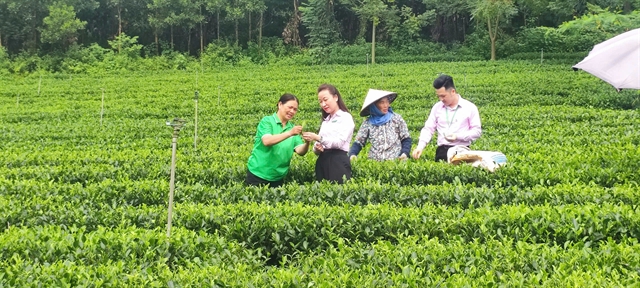
| Women in Phượng Dực Commune practise how to hold and present products. — Photo courtesy |
Each month, the 'Digital Cultural Houses' aim to organise at least four sessions to support residents in becoming digitally capable citizens. At these sessions, people can receive hands-on guidance on using VNeID and iHà Nội, accessing online public services, making digital payments and protecting their information and security on the Internet.
From 'Digital Villages' to 'Digital Cultural Houses', Trung Giã's longer-term goal is to establish 'smart villages', where technology is used to support local administration, economic development, quality of life and stronger connections between residents and authorities.
The stories from Phượng Dực and Trung Giã reflect a notable direction in Hà Nội's new rural development efforts. In the past, new rural development was often associated with wider roads, improved infrastructure and upgraded public facilities.
Today, digital transformation is becoming an increasingly important component.
According to Ngô Văn Ngôn, Deputy Chief of Hà Nội's Office for Coordination of the New Rural Development Programme, Hà Nội aims by 2030 to have around 80 per cent of its communes meeting new rural development standards and around 20 per cent meeting advanced new rural development standards.
The city also aims to raise average annual income in rural areas to at least VNĐ135 million ($5,200) per person and achieve 100 per cent health insurance coverage among residents.
From a livestream selling baskets made of rattan to a 'Digital Village' group connecting residents; from traditional village cultural houses to digital libraries, change is taking place in spaces that are deeply familiar to rural communities in Hà Nội.
Here, technology is no longer a distant concept. It is becoming a practical tool that helps residents sell their products, access services more conveniently, participate in community affairs and take a more active role in developing their own communities.
This is how Hà Nội is gradually bringing digital platforms to its villages, creating new momentum for building rural areas that are modern, civilised and connected. — VNS
*The article was produced in coordination with Hà Nội's Office for Coordination of the New Rural Development Programme.
Society
 Society
 Society
 Society
 Society
 Society
 Society
 Society
 Society
 Society
 Society
 Society
 Society
 Society
 Society