 Society

Central Retail breaks ground on GO! Rạch Giá shopping centre
1.

|
| Đặng Hoa Nam, Permanent Vice Chairman of the Vietnam Association for the Protection of Child Rights, speaks at the event. — VNS Photo Thanh Hải |
HÀ NỘI — Gaps in regulations concerning new tobacco products, the effectiveness of health warnings on packaging and the rise of tobacco marketing in the digital space are among the main topics of discussion at a seminar held in Hà Nội on October 27.
Titled 'A Young Vietnamese Generation Says No to Tobacco' and organised by Nhân Dân (The People) Newspaper, the forum gathered health experts, representatives from the National Assembly (NA) and delegates from both domestic and international organisations.
Experts say that more than 13 years after the implementation of the Law on Prevention and Control of Tobacco Harms, Việt Nam has achieved significant results in raising public awareness, reducing the demand for tobacco and establishing smoke-free environments.
However, the emergence of new tobacco products, alongside increasingly diverse forms of promotion and marketing, poses significant challenges to the protection of public health, particularly that of children and adolescents.
Given this reality, experts are calling for the continued refinement of legal regulations, as well as the strengthening of measures to more effectively prevent and control the risks of young people accessing and using tobacco products.

|
| Dr Angela Pratt, World Health Organization (WHO) Representative in Việt Nam, speaks at the event. — VNS Photo Thanh Hải |
World Health Organization (WHO) Representative in Việt Nam Dr Angela Pratt emphasised that "new nicotine and tobacco products are not safe, and they are not healthy".
They contain nicotine, which is highly addictive, along with toxins linked to cancer, cardiovascular disease and respiratory illness. Far from producing harmless vapour, some produce emissions that are even more toxic than cigarette smoke.
“Nicotine is particularly harmful for children, adolescents, pregnant women and their babies. It can affect brain development, impair learning and increase the risk of anxiety disorders. Young people who use e-cigarettes are also more likely to go on to use conventional cigarettes,” Dr Pratt said.
She also expressed her concern that many new tobacco products were being designed and marketed to appeal to young people.
In Việt Nam, she said she had seen products sold in flavours such as watermelon, cotton candy and lemon tart, with colourful packaging that would make them especially attractive to children and adolescents. These were not products designed to appeal primarily to long-term smokers who are trying to quit, but to children and young people to get them hooked on nicotine.
“Young people must be protected from the harms of these products and from the aggressive industries trying to market them. WHO strongly commends Việt Nam's ban on e-cigarettes and heated tobacco products,” Dr Pratt noted.
For smokers who want to quit, WHO recommends proven measures, such as advice from health workers, quit lines, behavioural support and approved cessation medicines.
The revision of the Tobacco Control Law currently before the NA is an important opportunity to carry out the legislature's comprehensive ban on e-cigarettes and heated tobacco products in full. Young people must be protected from e-cigarettes, heated tobacco products and other new nicotine products, according to the WHO representative.
|
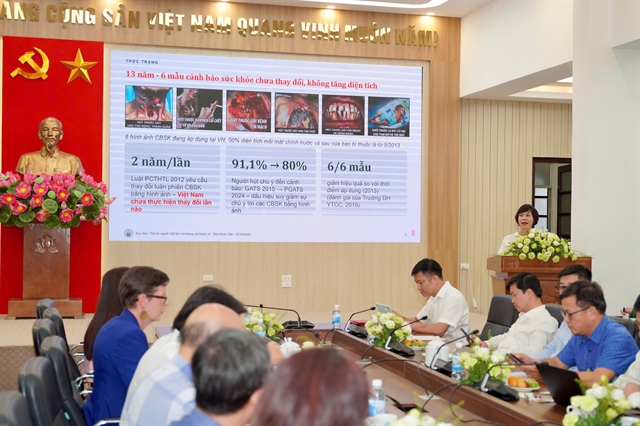
| Associate Professor Lê Thị Thanh Hương, Vice Rector of the Hà Nội University of Public Health, speaks at the event. — VNS Photo Thanh Hải |
Associate Professor Lê Thị Thanh Hương, Vice Rector of the Hà Nội University of Public Health, said at the event that 13 years after the implementation of the Law on Prevention and Control of Tobacco Harms, the system of pictorial health warnings on tobacco packaging in Việt Nam had seen no significant changes.
The six health warning images, in use in Việt Nam since May 2013, continue to occupy 50 per cent of the surface area on both the front and back of each tobacco pack. The 2012 Law on Prevention and Control of Tobacco Harms stipulates that health warnings must be updated every two years. However, the set of six images in use since 2013 has yet to be changed.
Survey results indicate that the proportion of smokers who pay attention to health warnings has declined from 91.1 per cent in 2015 to 80 per cent in 2024. The long-term use of warning images causes smokers to become desensitised, which diminishes the effectiveness of the intended message, according to Hương.
Hương proposed increasing the size of health warnings to at least 85 per cent of the package area, periodically updating the images used, including the phone number for a free smoking-cessation counselling hotline on the packaging, and exploring a roadmap for the implementation of standardised plain packaging.
Đặng Hoa Nam, Permanent Vice Chairman of the Vietnam Association for the Protection of Child Rights, argued for a shift in mindset from just addressing consequences toward proactively preventing risks.
He proposed increasing the accountability of digital platforms in detecting and blocking prohibited content, monitoring the online sale of tobacco products and equipping children with the skills to identify covert advertising and misinformation.
Experts also said that refining the legal framework must go hand in hand with effective monitoring and enforcement mechanisms.
They underscored the need for stronger coordination among regulatory authorities, families, schools, digital platforms and social organisations to limit the risks of children and adolescents accessing and using tobacco products. — VNS
Society
 Society
 Society
 Society
 Society
 Society
 Society
 Society
 Society
 Society
 Society
 Society
 Society
 Society
 Society