 Society

Look who’s at the top
1.
HÀ NỘI — Vietnamese engineers have successfully designed and manufactured a mini remotely operated underwater vehicle (ROV) capable of operating at depths of up to 100 metres, marking a significant step towards mastering strategic technologies and supporting the sustainable development of the country's marine economy.
Underwater inspections have traditionally been costly, as Việt Nam has relied heavily on expensive imported equipment. The development of a domestically designed and manufactured robot offers a potential alternative, helping reduce dependence on foreign technology while improving the country's capacity to inspect and maintain underwater infrastructure.
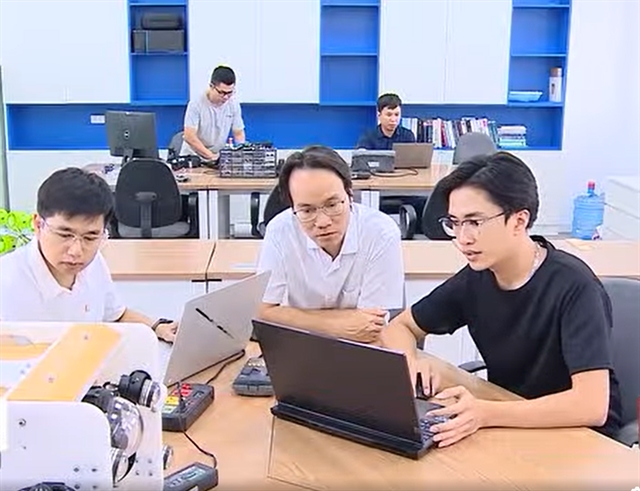
|
| The research team works on the remotely operated underwater vehicle (ROV). VNS Thế Bình |
Weighing approximately 17kg, the mini ROV is equipped with a highly light-sensitive camera and a specialised manipulator arm for exploration tasks. By mastering the hardware design, Vietnamese engineers can customise the robot's shape and configuration to suit different inspection requirements.
A central control software system enables the vehicle to collect and process data accurately in real time.
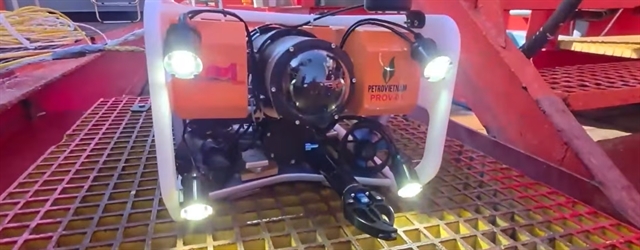
|
| The 17kg device can operate at depths of up to 100 metres. |
“Our goal is not just to develop a mini ROV, but also to produce larger systems. Mastering core technologies will enable us to independently develop such products in the future,” said Dr Ngô Lam Trung, deputy head of the Faculty of Computer Engineering at the School of Information and Communication Technology, Hà Nội University of Science and Technology.
Assoc Prof Dr Lã Thế Vinh, director of the International Centre for R&D on Satellite Navigation Technology in South East Asia at the same school, said the robot could perform basic tasks, with further software development expected to expand its capabilities.
“When deployed in real-world applications, it may require additional software functions, such as seabed reconnaissance, 3D mapping and automatic target detection,” he said.
.png)
|
| The robot could perform basic tasks, with further software development expected to expand its capabilities. |
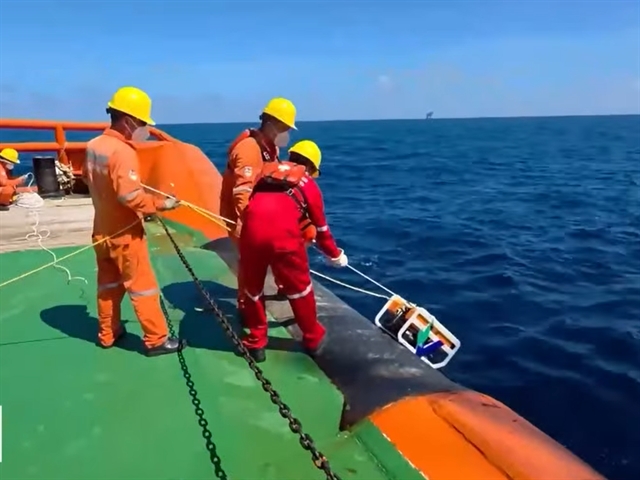
The technology has already moved beyond the laboratory, with the robot deployed to inspect the foundational structure of an offshore oil rig.
Operating tens of metres below the sea surface, the vehicle transmits high-definition images to the surface, enabling engineers to assess the condition of underwater structures more accurately.
The technology is also ready for potential applications in inspecting hydropower facilities, seaports and the hulls of large vessels, helping detect structural damage and identify problems in hard-to-reach areas.
Vũ Mai Khanh, general director of the Việt Nam-Russia joint venture Vietsovpetro, highlighted the importance of domestic production for both security and competitiveness.
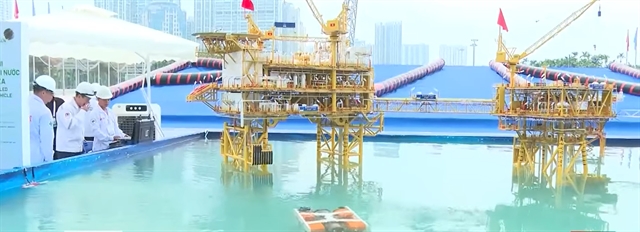
|
| Vietsovpetro researchers test the ROV in a tank. |
“The product has two important implications. First, it helps protect security because we have full control over the system, reducing the risk of cybersecurity breaches or external interference with our equipment.
“Second, mastering the technology enables us to compete with similar foreign products. Delivery times can also be shorter, while after-sales services and operational support can be more effective,” he said.
The development of the underwater robot also demonstrates the effectiveness of cooperation between research institutes, universities and businesses in bringing scientific research into practical use.
By involving businesses from the development stage, the partnership helps address the challenge of translating research results into commercially viable products, connecting laboratory innovation with real-world demand.
Assoc Prof Dr Tạ Hải Tùng, Vice President of Hà Nội University of Science and Technology, said the involvement of businesses, alongside State support and contributions from scientists, universities and research institutes, was essential to developing strategic technology products.
“This approach combines scientific and technological capabilities with State investment, practical demand, expertise in management and operations, and the production and business resources of enterprises,” he said. “These combined resources will improve the prospects for successfully developing strategic technology products.”
|
| The development of the underwater robot also demonstrates the effectiveness of cooperation between research institutes, universities and businesses in bringing scientific research into practical use. |
The mini ROV integrates several advanced technological fields, including artificial intelligence, integrated circuit design, automation and image processing.
Its successful development highlights the growing capabilities of Vietnamese engineers in mastering complex technologies, while laying the groundwork for a wider range of domestically developed products.
As Việt Nam seeks to strengthen its marine economy and modernise offshore infrastructure, home-grown underwater robotics could help improve inspection efficiency, reduce reliance on imported equipment and create new opportunities for the country's technology sector. VNS
Society
 Society
 Society
 Society
 Society
 Society
 Society
 Society
 Society
 Society
 Society
 Society
 Society
 Society
 Society