 Society

Vietnamese airlines asked to study domestic routes restoration and development
1.
|
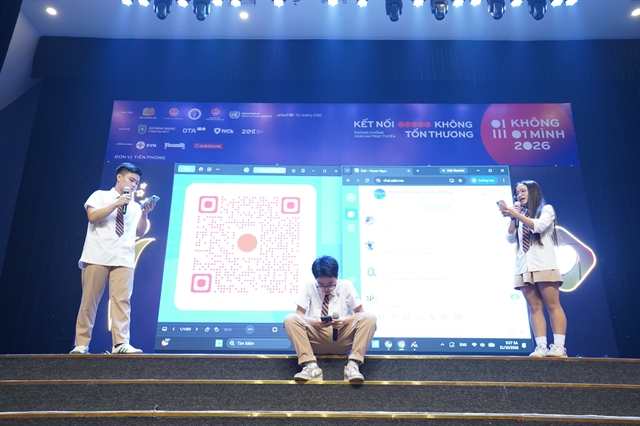
| Pupils of the Wellspring International Bilingual School in Hà Nội participate in a short play about protecting children on cyberspace. — VNS Photo Thu Trang |
Thu Trang
HÀ NỘI — Pupils are future citizens growing up alongside the rapid development of technology and the digital space.
It is essential that the community proactively equips them with knowledge, skills, resilience and reliable sources of support, so that they can connect, explore and grow without having to compromise their own safety.
Nguyễn Thuận Hải, Head of the Child Protection Hotline 111, informed that the Hotline 111 received more than 1,000 calls every day and provided counselling for between 200 and 300 of them.
“From there, we connect with the competent authorities and localities to support nearly ten cases involving children who are at risk of, or have already suffered, abuse,” she said.
In the first ten months of this year, Hotline 111 intervened in and supported nearly 2,000 cases of child abuse.
“That is a very large number, and many of the children involved faced problems in the online environment,” said Hải.
Teaching digital safety skills

|
| Senior Colonel, Dr Nguyễn Hồng Quân, Deputy Director of the Cybersecurity Department under the Ministry of Public Security, says that effective child protection requires proactive prevention, early detection and timely intervention. — Photo courtesy of the Wellspring International Bilingual School in Hà Nội |
Senior Colonel, Dr Nguyễn Hồng Quân, Deputy Director of the Cybersecurity Department under the Ministry of Public Security, affirmed that, based on cybersecurity protection practice, effective child protection required a decisive shift from addressing consequences to proactive prevention, early detection and timely intervention.
In particular, digital safety education must be provided from an early age, on a regular basis, in a manner appropriate to each age group and linked to situations that pupils may genuinely encounter.
“We need to help pupils not only understand what is dangerous, but also know what to do when danger arises; not only know how to protect themselves, but also know how to seek help and take responsibility for the safety of others,” he said.
To achieve this, no individual or organisation can act alone.
“The family must be a place where children are heard and trusted. Schools must be places where children are equipped with knowledge, skills and protection. The competent authorities, social organisations and technology companies must share responsibility for building a safe and healthy digital environment,” said Quân.
Protecting children requires not only technological and legal solutions, but also an understanding of their psychology, the ability to recognise changes in their behaviour, and timely coordination among families, schools and the relevant authorities.
“I hope that education managers and teachers will proactively study and apply digital safety content, gradually incorporating it into educational activities, pupil management and cooperation with parents at their institutions,” said Quân.
Every school needs more teachers capable of identifying risks, clearer procedures for handling incidents, and a sufficiently trustworthy environment in which pupils are willing to speak up when they need help.
Senior Colonel, Associate Professor and Dr Nguyễn Minh Hiển, Head of the Professional Affairs Faculty at the People’s Police Academy, identified three issues that teachers, parents and pupils needed to pay attention to.
“The first is recognition skills. Only when we recognise risks correctly can we defend ourselves. So how do we recognise them? Through daily activities and the mass media. We need to identify what is real and what is fake,” said Hiển.
The second is self-protection skills. In reality, parents can devote time to their children only in the evening, while teachers may have just 45 or 90 minutes in class. That means all the remaining gaps fall back on the children themselves. Children therefore need the ability to protect themselves. Of course, teachers, schools, families and the competent authorities must equip them with the methods to develop these skills and protect themselves.
“The third is that children cannot be left alone. Alongside them, there must always be teachers, families and the competent authorities, and, in particular, School Digital Safety Ambassadors are the ones who spread, communicate and provide their friends with knowledge and skills."
Protective shield
|
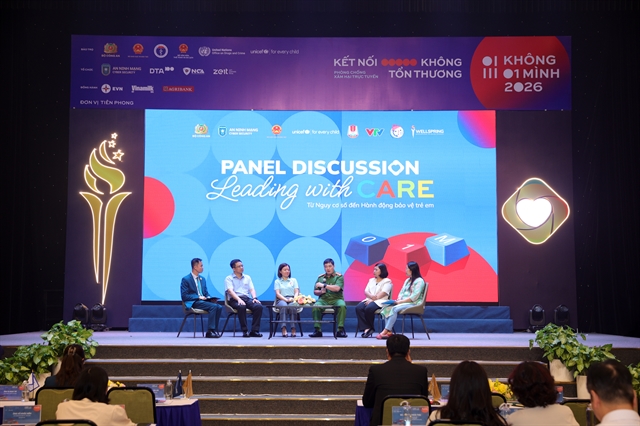
| Experts on the field give measures to protect children in the digital era as a part of the Cyber CARE Summit 2026. — VNS Photo Thu Trang |
Nguyễn Thuận Hải, Head of the Child Protection Hotline 111, said whenever children encounter any problem – whether they do not yet know how to deal with it, or they know that a friend is in difficulty – they can call 111.
“At any time. At any hour. Hotline 111 operates all day, seven days a week,” she said.
“We listen to and guide children, and we also ask whether they are safe. We help assess the risks and determine whether they are being protected,” she said.
In particular, at the third level – where children have been abused, or know that a friend has been abused – the hotline will connect them with the competent authorities.
Under the Law on Children and Decree No. 56 guiding the implementation of the Law on Children, the support process for an abused child consists of six steps. These clearly set out the functions and duties of each agency upon receiving information: how to verify it, how to assess the risks, and how to establish the extent of the harm suffered by the children.
Hotline 111 connects the parties and monitors the entire support process for the children.
Lê Anh Lan, an education specialist at the United Nations Children’s Fund (UNICEF) in Việt Nam, said that children had the right to participate in the digital environment, as well as the right to be heard and to share their views.
“Therefore, when we support and work with children, it is important to place their best interests first. Secondly, we must respect and listen to children’s opinions,” she said.
The way we act must also be verified with the children: whether they agree and whether it is appropriate for them. At all times, we must protect their information and maintain confidentiality.
“At the same time, maintaining connection with and support for children is also essential,” Lan said.
Associate Professor and Dr Nguyễn Như Hà, Deputy Director of the Legal Affairs Department under the Ministry of Education and Training (MoET), confirmed that the MoET always listened to children in order to develop regulations that create a shield to protect them, so that they are not harmed and are not left alone.
For example, the regulations require schools to have school counselling teams.
“Schools must protect children not only within the school gate, but beyond it as well. There is also the principle that children’s personal information must be kept absolutely confidential. Likewise, if a pupil unfortunately has to face disciplinary action, that discipline must be humane,” Hà said.
The MoET has issued many circulars on protecting children in cyberspace, and the supreme principle is confidentiality – from the moment an incident is received until the authorities coordinate to resolve it.
“The most important thing is that children must feel they can trust the system,” he said.
“Children should be able to choose the person to whom they first report and confide. To earn that trust, the people responsible must have the capacity to handle such information and must respect and absolutely protect children’s right to privacy. In this way, they become a trusted source of support to which children can turn,” Hà said.
|
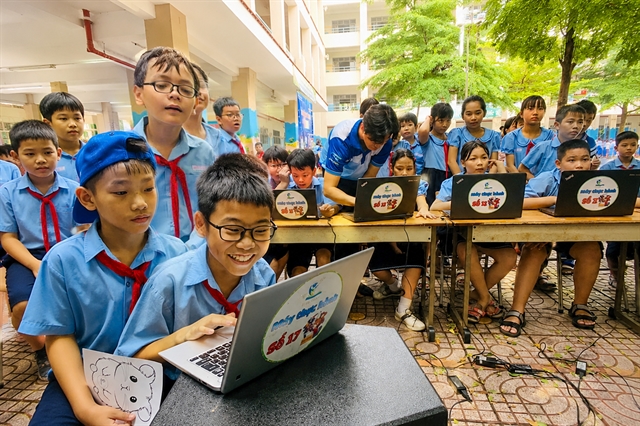
| Children study skills to grow up safely in cyberspace in Tây Ninh Province. — VNA/VNS Photo Giang Phương |
Digital safety is not the responsibility of the specialised cybersecurity forces alone, nor is it a topic to be mentioned only when an incident occurs. It must become part of the culture of education, of community responsibility, and of the process of forming informed, resilient and responsible digital citizens.
The goal is that every pupil can connect more safely, every teacher has greater capacity to protect their pupils, and every school truly becomes a trusted source of support for children, both in cyberspace and in real life. — VNS
Society
 Society
 Society
 Society
 Society
 Society
 Society
 Society
 Society
 Society
 Society
 Society
 Society
 Society
 Society