 Society

HCM City seeks US$19 billion in foreign investment in 2026
1.
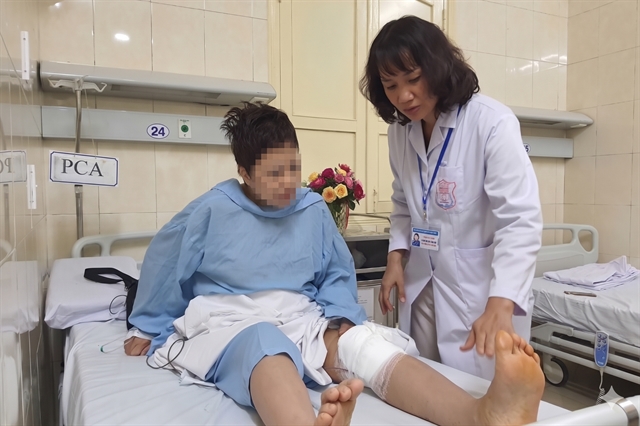 |
| Dr Nguyễn Thị Kim Liên examines a patient’s leg after a traumatic injury. — Photo benhvienvietduc.org |
HÀ NỘI — For three months after a road crash left him with a severe brain injury, a 25-year-old man lay wherever his family put him. Surgeons at Việt Đức University Hospital had saved his life, but back home in the countryside, his arms and legs curled and stiffened, his muscles wasted away and he seemed barely aware of what was around him.
When his desperate family brought him back to Việt Đức, he was placed in the care of Associate Professor Nguyễn Thị Kim Liên, head of the hospital’s rehabilitation department. For more than two decades, she has worked on what comes after the operation. At one of Việt Nam’s leading surgical hospitals, the operating theatre gets the attention. Rehabilitation is slower and quieter, but to her mind just as decisive.
“Surgery saves patients’ lives, it pulls them back from death. But it’s rehabilitation that holds the key to recovering what they’ve lost after an injury or a stroke,” Liên said.
"Surgery saves patients’ lives, it pulls them back from death. But it’s rehabilitation that holds the key to recovering what they’ve lost after an injury or a stroke," Liên said.
She came to the field almost by chance. Raised in a family of doctors, she had finished her degree at a medical university and was preparing for the residency exam when her older brother, back from training in France, suggested rehabilitation.
It was hardly an obvious choice. At the time, the specialty was young in Việt Nam and widely misunderstood. Many thought it was little more than massage or acupressure, while others, hearing its Vietnamese name, literally 'restoring function', took it for a treatment for men’s sexual problems.
The more she read, though, the more she saw the humanity in the work: getting people from a sickbed back to feeding and dressing themselves, walking and rejoining the world.
Some of the cases that trouble her most began with ordinary injuries: a wrist broken in a fall, a knee ligament torn playing sports.
Such patients should be shown early on how to move the injured limb. Instead, many keep it completely still for fear of undoing the surgeon’s work, or follow patchy advice from social media. By the time the cast comes off, the joint has stiffened almost solid. Some patients can no longer dress themselves, and some end up back on the operating table to have the joint forcibly freed, the first operation wasted.
Behind such cases lies an attitude Liên has long fought: the belief, among the public and many of her own colleagues, that rehabilitation is an optional extra, sought only once the body has already locked up.
"Rehabilitation has to start early, with advice even before surgery and immediately after it. You don’t wait until function is lost and then go scrambling for help," she said.
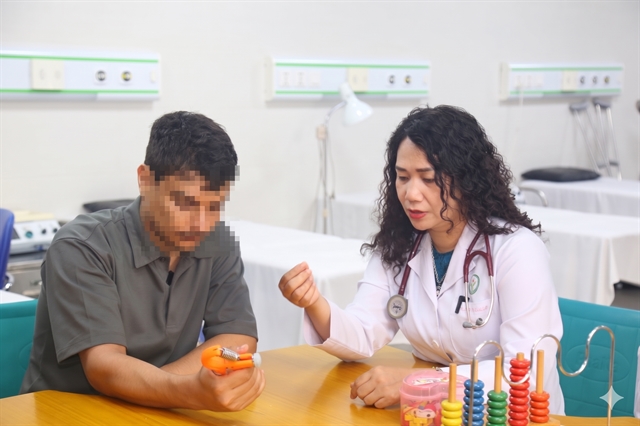 |
| Dr Liên guides a foreign patient through exercises to regain arm function. — Photo benhvienvietduc.org |
Even harder for her are the patients who make the long journey from remote areas to the big national hospitals, only to arrive with severe complications because help came too late. Cases like theirs drew her out of the capital.
Through the Vietnam Rehabilitation Association and her teaching at Hà Nội Medical University, she has taken her skills to the far north and deep into the mountains to train local medical staff.
What stays with her from those trips isn’t the shortage of equipment. It’s the hope in patients’ faces and the eagerness of local doctors to learn. One doctor in the highlands took her hand and said nobody there was dreaming of expensive, state-of-the-art machines. What they wanted was to be taught treatments that were sound, simple and effective.
The people there were too poor to travel to Hà Nội, the doctor said. But if Liên passed on what she knew, the local doctors and nurses could keep patients moving in their own villages.
Geographical gaps are wide. Decision 569, the national policy behind the push to bring rehabilitation into communities, aims for at least one rehabilitation worker for every 20,000 people by 2030. Yet further down the health system, the specialists a proper team needs, from physical and speech therapists to psychologists, are scarce and often undertrained, and many facilities borrow staff from other departments.
The only lasting answer is training, Liên believes. She folds the latest thinking from partners in Japan, the Netherlands, the Republic of Korea and Taiwan into her teaching. Students, residents and trainees from the provinces learn on Việt Nam’s most complex cases, working in multidisciplinary teams so they can build the same model back home.
In the lecture hall, she skips the slogans. Instead, she tries to instil pride in a profession devoted to giving people back their independence, and pushes students to stay the course rather than collect a certificate and move on.
Each of us is just a flickering candle, she said. Bring enough together, and they can light up the whole field.
Her message to the public is simple: "If you or someone close to you suffers a serious illness or injury, don’t hesitate, and don’t count on the body to heal itself.
"Seek out rehabilitation as early as you can, and make the most of every precious chance to get back to your life."
The young man from the countryside made the most of his. Day after day, for months, Liên’s team eased his muscle spasms, freed his stiffened joints one by one and worked to bring back his awareness. Then they taught him again how to swallow, and how to stand.
One day his father, a man of nearly 50, came running into the department, eyes brimming, barely able to speak: his son had strapped on his brace by himself and taken his first steps.
The whole department erupted with joy.
After more than a year of perseverance, his mind had cleared. He could sweep the house. He could put the rice on for his parents.
For Liên, there is no greater reward than seeing a patient return to the ordinary business of living. Surgeons had saved the young man’s life. Her team gave it back to him, one joint, one swallow, one step at a time. — VNS
Society
 Society
 Society
 Society
 Society
 Society
 Society
 Society
 Society
 Society
 Society
 Society
 Society
 Society
 Society