 Society
.jpg)
SHB unveils sustainable finance framework to expand green and social lending
1.
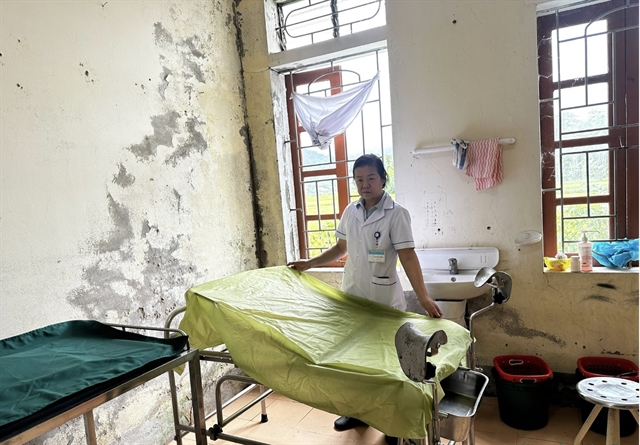 |
| Lục Dạ Health Station in Môn Sơn Commune had to close because the facility had been severely deteriorated for years. Photo suckhoedoisong.vn |
NGHỆ AN - Healthcare facilities in the central province of Nghệ An are often operating under conditions characterised by dilapidated infrastructure, a lack of functional rooms and outdated equipment, or are forced to use temporary premises.
The situation has caused difficulties not only for health workers, but also for the quality of healthcare provided to residents, especially those in mountainous and remote areas.
Repairing old healthcare facilities and building new ones in the province is a crucial and urgent measure to strengthen the primary filter within the public healthcare system.
The interior facilities of Mậu Đức Clinic in Mậu Trạch Commune have suffered significant deterioration after years of use.
Built on an area of 2,800sq.m, the clinic's exterior grounds feature a courtyard, garage, greenery and a sizeable traditional medicinal herb garden, and its three buildings have 23 rooms in total.
Nurse Nguyễn Thị Hồng said that the six staff members worked amid dilapidated facilities.
“Floors, walls and ceilings in many areas are peeling and suffering from water leaks. The delivery room lacks electricity, posing safety risks to expectant mothers and newborns,” Hồng said.
“Since March this year, the clinic has ceased accepting deliveries, and expectant mothers are directed to higher-level facilities. The waste treatment area is also dilapidated, complicating the collection and processing of medical waste. Whenever there is heavy rain, the staff work in a state of anxiety."
Lô Thị Loan, a patient from Thạch Ngàn hamlet, is undergoing treatment for high blood pressure. Loan said that the clinic’s deterioration affected patients' state of mind when seeking care and sometimes necessitated transfers to higher-level facilities, particularly when services were required but the local station was not equipped to provide.
Party Secretary of Mậu Thạch Commune Phạm Trọng Bình said Mậu Đức Clinic's degradation had caused difficulties for medical examinations and treatment.
Many people had to seek care at higher-level medical facilities, incurring additional travel time and costs, Bình said.
The situation is not limited to Mậu Đức Clinic. Lục Dạ Health Station in Môn Sơn Commune is also awaiting a new facility to stabilise its operations.
Since late May 2025, staff at the health station have had to use the Lục Dạ Primary School premises to provide medical examinations and treatment, as their old facility had deteriorated and was no longer suitable for operations.
Dr Ngân Văn Anh, head of the Lục Dạ Health Station, said that the new facility was originally scheduled for completion and handover in December 2025. However, the project remained unfinished.
“At the temporary facility, cramped conditions make it difficult to arrange and store medical equipment, and hygiene standards are not fully met,” Văn Anh said.
“The station lacks a reliable source of clean water. While water is currently piped in from a nearby school, the supply remains insufficient."
Under its current circumstances, Lục Dạ Health Station primarily focuses on dispensing health insurance medications, administering expanded immunisation programmes and carrying out preventive healthcare and national health initiatives.
Its capacity to provide on-site medical examination and treatment services remains limited.
Building new facilities
Lục Dạ Health Station is one of 63 healthcare facilities listed in a project to upgrade, repair and build local healthcare clinics in Nghệ An Province.
The health station's new facility had VNĐ6 billion (US$231,000) in investment, with construction started in May 2025 and scheduled for completion in eight months.
But over a year later, it is still not finished.
Nguyễn Đình Hoàn, from the Technical and Construction Quality Management Division under the Nghệ An Provincial Civil and Industrial Construction Investment Project Management Board, said the main reason for the project's interruption was financial difficulties faced by the original contractor, which halted construction.
Heavy rains also affected progress on the project, he said.
The project management board subsequently completed procedures to terminate the contract with the contractor and transferred the remaining work to another member of the consortium to continue construction.
Now, the new contractor had mostly completed structural and exterior work and was installing medical equipment. The project was scheduled for completion and handover by tomorrow.
According to Chairman of the Môn Sơn Commune People's Committee Phạm Mạnh Hùng, following the merger of Lục Dạ and Môn Sơn communes, the locality now has two health stations.
“Both facilities were built long ago, have limited floor space and have deteriorated, affecting medical examination and treatment as well as primary healthcare services for local residents,” Hùng said.
The commune People's Committee has submitted a document asking relevant agencies to accelerate the project and put the facility into operation.
Lục Dạ Commune Health Station's completion will provide medical staff with a stable workplace and improve the quality of healthcare services for residents.
The problem is not confined to mountainous areas, however.
Hoàng Mai Medical Centre in Hoàng Mai Ward is also operating on a cramped, deteriorating site and is frequently overcrowded.
About one kilometre from the old facility, a new Hoàng Mai Medical Centre has been built, and is expected to replace the deteriorated site.
The project was approved in 2015 and construction began in 2020.
Its first phase comprises a five-storey examination, treatment and inpatient building with 100 beds. However, after several adjustments, the facility has yet to be put into operation because some components remain unfinished and further work is still required.
The deterioration of the Mậu Đức and Lục Dạ health stations and Hoàng Mai Medical Centre highlights the challenges posed by inadequate infrastructure to the operation of Nghệ An's local healthcare network.
Timely renovation of deteriorating facilities, alongside efforts to resolve obstacles and ensure newly built facilities are completed on schedule, is expected to help maintain primary healthcare capacity, reduce pressure on higher-level hospitals and safeguard local residents' access to healthcare services. VNS
Society
 Society
 Society
 Society
 Society
 Society
 Society
 Society
 Society
 Society
 Society
 Society
 Society
 Society
 Society