 Society

Powering Việt Nam's experience economy
1.
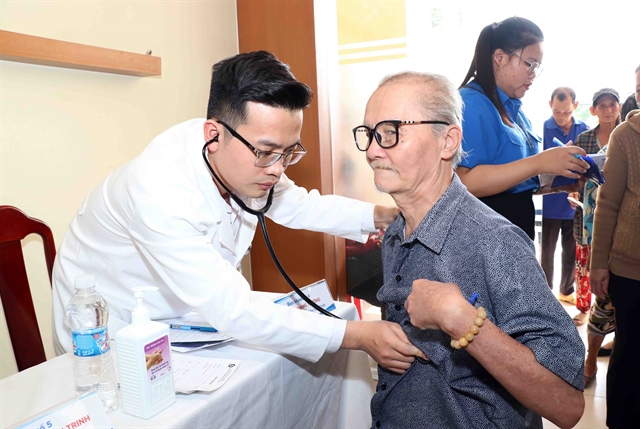 |
| A doctor listens to an elderly patient's chest during a free health checkup at the Gia Định People's Hospital, January 2026. — VNA/VNS Photo |
HÀ NỘI — Free health check-ups have reached more than half of the population, with some provinces and cities topping 90 per cent, a senior Health Ministry official said, as the ministry drops plans for a standard set of tests and leaves those choices to doctors.
Vương Ánh Dương, deputy director of the ministry's Department of Medical Examination and Treatment Management, said 34 provinces and cities have submitted full reports to the ministry. Early results suggest the rollout is going well, he said.
The ministry initially planned to require a standard set of basic lab tests but changed course after getting feedback from local authorities, medical specialties and experts, Dương said.
Instead, the examining doctor will decide which tests a patient needs, depending on their health and what the exam shows.
The ministry also will not impose a single check-up package nationwide. Provincial governments can choose their own basic exams and tests and add others that suit local needs, provided costs stay in check, he said.
Check-ups must take place at facilities with doctors in all the main specialties, including surgery, dentistry, eye care and obstetrics.
To avoid unnecessary, duplicate testing, particularly for people already on treatment for chronic conditions such as high blood pressure and diabetes, as well as for those returning in future years, the health ministry has told doctors to draw on existing records wherever possible.
They can look up patients' histories through the social insurance database, the national ID app VNeID and digital health records, and can rely on earlier results that are still valid rather than reorder them, Dương said.
"The core purpose of these check-ups is to detect illness and risk factors early," he said.
Patients who show signs of disease or elevated risk are referred to hospitals or clinics for diagnosis and treatment, while the results feed into records meant to follow each person's health across their lifetime.
The ministry is tallying how many people have been examined, how many digital health records have been created and how many results have been uploaded, as part of a Politburo resolution on public health issued in September 2025.
Once that work is done, the ministry plans to issue new guidance based on disease patterns by age and region, including screening protocols for specific groups of illnesses. — VNS
Society
 Society
 Society
 Society
 Society
 Society
 Society
 Society
 Society
 Society
 Society
 Society
 Society
 Society
 Society