 Society

Goat meat offers a feast of choice for every diner
1.
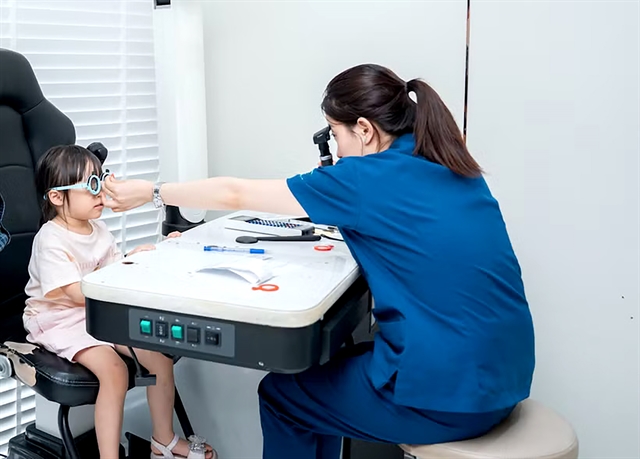 |
| A doctor examines a child's eyes and monitors their vision. VNA/VNS Photo |
HCM CITY — When Trương Vĩnh Thành, 34, took his four-year-old daughter for an eye examination at the HCM City Eye Hospital, he was surprised to learn that she had myopia of 0.75 dioptres.
Before the examination, Thành had only noticed that his daughter often squinted and complained of tired eyes after watching cartoons on a tablet.
The family became even more concerned when they realised that her nine-year-old sister had also been short-sighted for more than two years and was already wearing glasses with a prescription of 3.5 dioptres.
She has her eyes examined every six months to monitor changes in her vision. On some occasions, her prescription increased by only 0.25 dioptres, but at her most recent examination, it had risen by more than one dioptre.
Neither parent has a refractive error, and they have always reminded their children to maintain a proper sitting posture while studying. However, the children have recently been spending more time using smartphones and tablets.
By the time the family realised that both children had developed myopia, the condition had already progressed.
Myopia is the medical term for nearsightedness, a common vision condition where you can see close objects clearly, but distant objects appear blurry.
A similar situation was reported by Nguyễn Thị Minh Thư, 36, who took her 11-year-old son for an eye examination after the summer break because he had repeatedly complained that he could not see the blackboard clearly.
The examination found that the boy was short-sighted and would need regular monitoring.
Nguyễn Huỳnh Yến Nhi, an ophthalmologist and head of the Myopia Control Centre at Sài Gòn Eye Hospital, said the hospital had treated many children whose myopia had progressed rapidly over a short period.
Some children had seen their prescriptions increase by more than one dioptre in a single year without receiving appropriate myopia-control interventions, she said.
According to Ministry of Health statistics, Việt Nam currently has about five million children with refractive errors, equivalent to 30-40 per cent of school-age children, with myopia accounting for the largest proportion.
A survey by the National Eye Hospital found that 26.6 per cent of secondary school students in urban areas had myopia, compared with about 14.2-16.3 per cent in rural areas. In one classroom in HCM City, as many as 75.6 per cent of children were found to have refractive errors, including 52.7 per cent with myopia.
Beyond simply changing glasses
The growing number of children with refractive errors, together with the increasingly young age at which myopia develops, has become a concern for school-age eye health.
Doctors warn that simply replacing a child's glasses when their vision becomes blurred, without monitoring the rate at which myopia is progressing, may leave children at greater risk of developing high myopia and associated eye complications later in life.
Nhi said childhood myopia could result from a combination of factors, including genetics, daily habits and lifestyle.
Many children spend much of their time studying, reading or using smartphones and tablets, while the amount of time they spend playing and exercising outdoors is declining.
Prolonged near work, an inappropriate reading distance, poor sitting posture and inadequate lighting conditions may also increase children's risk of developing myopia, she said.
Myopia can affect children's ability to study. If it progresses rapidly, doctors say, it can lead to high myopia, which is associated with structural changes in the eyeball and an increased risk of serious eye complications that can affect vision in the long term.
Nhi suggested parents should not simply buy glasses based on a child's previous prescription or allow children to use someone else's glasses, doctors recommend. Eye examinations should be performed at specialised medical facilities, particularly for young children and those whose prescriptions are changing rapidly.
According to Dr Trần Đình Minh Huy from the Refractive Surgery Department of the HCM City Eye Hospital, every additional dioptre of myopia is associated with a higher risk of serious eye diseases.
The higher the degree of myopia, the more the eyeball elongates, potentially increasing the risk of retinal damage, retinal degeneration and retinal detachment, as well as other complications that can result in severe vision loss or blindness.
According to Huy, each additional dioptre of myopia may increase the risk of blindness-causing eye diseases by 67 per cent, while controlling each dioptre of myopia progression may reduce the risk of serious complications later in life by about 40 per cent.
The key, therefore, is not simply to correct children's vision with glasses, but to slow the progression of myopia as early as possible.
Myopia management should begin during the pre-myopia stage, before a child's prescription begins to increase significantly, through early screening, regular monitoring and timely intervention, doctors say.
"Parents should not wait until children complain that they cannot see clearly before taking them for an eye examination. Children may adapt to reduced vision and may not actively tell their parents about it," Nhi said.
"Regular eye examinations can help detect refractive errors early, monitor changes in myopia and determine an appropriate intervention."
Dr Huỳnh Minh Chín, Deputy Director of the HCM City Department of Health, said the health sector was implementing periodic health examinations for residents, with students at general education institutions among the groups receiving examinations, consultations and advice aimed at maintaining good vision throughout their school years and reducing the risk of high myopia later in life.
The city's health sector had also called on the education sector to pay greater attention to classroom lighting conditions.
Schools should look beyond simply checking whether light bulbs are working, Chín said. They should also assess the actual light levels at students' desks, the uniformity of lighting and any glare or reflections on blackboards, screens and desktop surfaces.
The arrangement of desks and chairs should also take students' height and physical development into account, helping children maintain an appropriate viewing distance while studying. — VNS
Society
 Society
 Society
 Society
 Society
 Society
 Society
 Society
 Society
 Society
 Society
 Society
 Society
 Society
 Society