 Society

Real estate bond interest rates hit 13 per cent per annum
1.
|
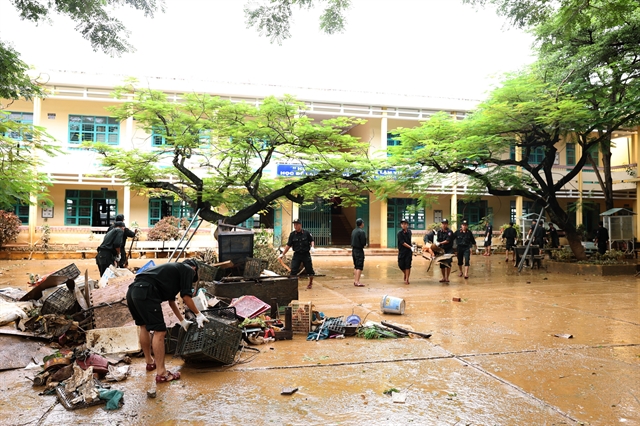
| Mobile police forces in the central city of Đà Nẵng help clean up Nguyễn Duy Hiệu High School on October 31, 2025 after continuous heavy rainfall caused historic flooding across the city. Storms and floods are the major climate hazards causing school disruption across Việt Nam in 2025. — VNA/VNS Photo Anh Dũng |
HÀ NỘI — The United Nations International Children's Emergency Fund (UNICEF) has called on governments, including Việt Nam, to increase efforts to protect children’s education from impacts of climate hazards, based on findings of a new analysis released on Thursday.
Analysing data from 106 countries or territories, the report 'Learning Interrupted: Global Snapshot of Climate-Related School Disruptions in 2025' found that 171 million – or roughly 1 in 10 – students had their schooling disrupted by climate hazards in 2025 globally, with their age groups ranging from pre-primary (three to six) to upper secondary (15-18).
In Việt Nam, the hazards disrupted the schooling of 3,098,500 students.
The climate hazards include storms, floods, heatwaves, droughts and wildfires, which led to suspended classes, damaged schools and a shift to remote learning.
They also led to shortened instructional times, reduced school attendance and increased risk of dropout for millions of students worldwide.
Storms were the most common cause of school disruptions, affecting 109 million students globally.
Floods affected at least 70 million students, while heatwaves disrupted schooling for approximately 50 million.
Storms and floods were also the major climate hazards causing school disruption across Việt Nam in 2025, and the country is among those increasingly exposed to recurring climate shocks.
"The climate crisis is increasingly becoming a learning crisis for children in Việt Nam," said Silvia Danailov, UNICEF Representative in Việt Nam.
"When schools close because of floods or storms, the consequences extend far beyond missed lessons. The most vulnerable children lose valuable learning time, face disruptions to their daily routines, and may be separated from the safe and supportive environment that schools provide.
“We must act now to ensure every school is safe, resilient and prepared for a changing climate."
According to the report, learning losses and higher school dropout rates can reduce workforce productivity, slow economic growth and make it harder for countries to reduce poverty.
Inaction could result in a potential loss of at least US$200 billion in lifetime earnings for students who experienced climate-related school disruptions.
Girls are at greater risk of dropping out when climate hazards disrupt or close schools as facility damage, displacement and lost family income can place additional caregiving and water-collection responsibilities on them.
These pressures can also increase the risk of child marriage, making it more difficult for girls to return to class when schools reopen.
UNICEF called on governments and its partner organisations to scale up efforts to protect children’s education from the impacts of climate hazards.
“Climate hazards threaten children’s lives and futures,” said UNICEF Executive Director Catherine Russell.
“To protect education for children today and for future generations, we must invest in schools and education systems that are built to withstand climate shocks.”
Practical solutions suggested by the report include integrating climate resilience into national education planning, strengthening school infrastructure and ensuring learning continuity during and after disruptions.
Climate education should be embedded into curricula to equip children and young people with the skills needed to build resilience, drive climate action and adapt to a changing world, the report says. — VNS
Society
 Society
 Society
 Society
 Society
 Society
 Society
 Society
 Society
 Society
 Society
 Society
 Society
 Society
 Society