 Society

Lotte, Phát Đạt combine strengths in Thu Thiem project
1.
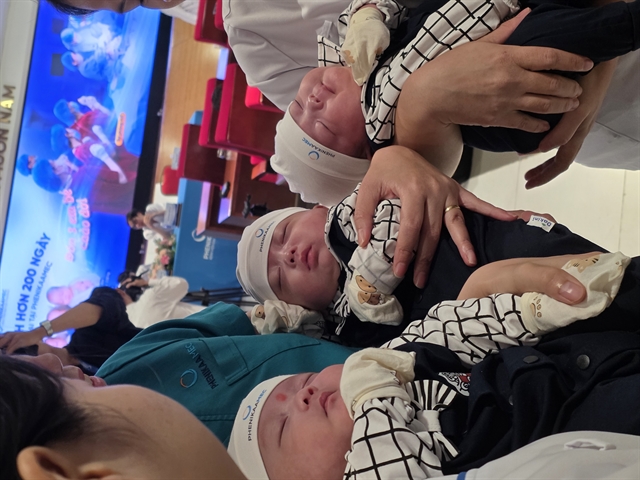 |
| On Friday, Minh Đức, Minh Vũ and Minh Khôi returned to PhenikaaMec to meet the doctors and medical staff who had cared for them from before birth. — VNS Photo |
By Thu Trà
HÀ NỘI — At 9.50am on June 11, a 900-gram baby boy was delivered prematurely at a Hà Nội hospital.
For his mother, Phạm Hồng Nhung, the birth should have marked the beginning of a triplet delivery.
Instead, doctors attempted something unusual: keeping her two other babies inside the womb.
The first baby, Nguyễn Minh Đức, had been delivered at 27 weeks and six days after his amniotic sac ruptured. He was immediately transferred to the neonatal intensive care unit.
But doctors did not deliver his siblings. Instead, they used a strategy known as delayed interval delivery, in which doctors prolonged a multiple pregnancy after one fetus has been delivered, allowing the remaining fetuses to continue developing in the womb.
For the following 36 hours, doctors at Phenikaa University Hospital closely monitored Nhung and the two remaining fetuses, balancing the potential benefits of additional time in the womb against the risks of continuing the pregnancy.
They were prepared to abandon the strategy and deliver the remaining babies if the mother's or fetuses' condition deteriorated.
At 11.40pm on June 12, the situation changed. Nhung developed strong contractions, her membranes ruptured and one of the remaining babies was in a transverse position.
At 11.48pm, Nguyễn Minh Vũ was born weighing 950 grams. Two minutes later, his brother Nguyễn Minh Khôi was delivered at 1,000 grams. Three babies who had shared one pregnancy had now been born - but not at the same time.
A difficult choice
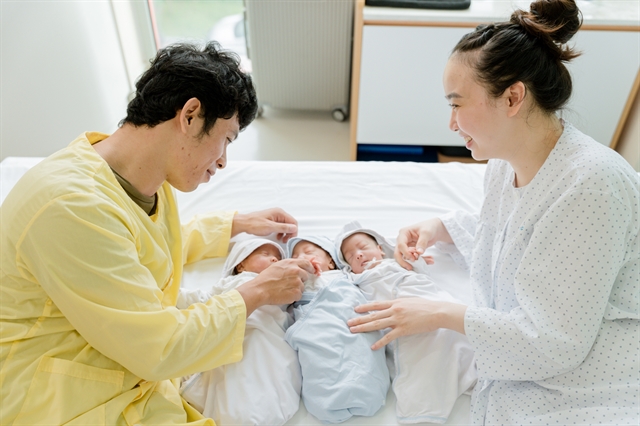 |
| Three healthy babies after spending 200 days in hospital. — Photo provided by the hospital |
Nhung, born in 1997, was a first-time mother who had undergone IVF after being diagnosed with polycystic ovary syndrome.
Although two embryos were transferred, the pregnancy developed into triplets, with three amniotic sacs and two placentas. Nhung and her family were counselled about the possibility of terminating the two fetuses sharing one placenta.
But after years of infertility treatment and IVF, Nhung wanted to know whether there was a medically feasible way to keep all three babies.
They turned to the Phenikaa University Hospital for a second opinion.
“The couple faced a series of agonising decisions, with tears and uncertainty along the way, as they navigated a high-risk triplet pregnancy marked by numerous complications and the risk of premature delivery,” said Nguyễn Thị Sim, deputy director of Phenikaa University Hospital.
Dr Sim said each follow-up examination brought new risks to light, requiring the medical team to adjust the treatment plan accordingly.
Nhung suffered from a hypercoagulable state, requiring medication and regular monitoring. By mid-pregnancy, she developed polyhydramnios and gestational diabetes, posing significant challenges for the medical team.
Amid the difficulties, Nhung remained steadfast and optimistic, working closely alongside the medical team, Dr Sim said.
“The situation was incredibly tense, but we encouraged each other, telling ourselves that since the children had come to us, they would surely do everything in their power to stay - so we had to fight for them,” Nhung said.
A new challenge
At 27 weeks, despite receiving injections to promote fetal lung maturity, Nhung's membranes ruptured around one fetus, leading to the vaginal delivery of the first baby.
“The challenge was to deliver one baby while safely keeping the other two in the womb,” Dr Sim said.
“For extremely premature infants, every hour in the womb is precious,” she said. “However, prolonging the pregnancy also means the mother and the remaining fetuses face additional risks.
“The goal is not to ‘hold on at all costs’, but to extend the pregnancy only as long as conditions remain safe.”
After a vaginal delivery, Minh Đức was immediately taken into neonatal care for respiratory support, while his two siblings remained in the womb.
By 11.40pm on June 12, Nhung had developed strong uterine contractions and her waters had broken. With the remaining fetuses in a transverse lie, Dr Sim decided to perform an emergency C-section.
Four medical teams were mobilised that night. The anaesthesia and resuscitation team cared for the mother while the obstetrics team performed the surgery. Two separate neonatal teams stood by to receive and resuscitate the two extremely premature babies simultaneously.
The long road after birth
All three babies were extremely premature and developed respiratory distress, requiring intensive neonatal care and respiratory support.
Their care progressed gradually from intravenous nutrition and respiratory support to tube feeding, then sucking and eventually bottle- and breastfeeding. After about two months, all three were breathing independently.
They were discharged on September 14, weighing 3.58kg for Minh Khôi, 3.57kg for Minh Vũ and 3.70kg for Minh Đức.
The hospital said they were feeding well, showed no signs of respiratory distress, had strong neonatal reflexes and displayed normal motor function.
“The outcome was beyond our expectations. At the beginning, we could not have imagined how this case would turn out,” Dr Sim said.
The Phenikaa Foundation For Children will provide the three babies with a vaccination package worth VNĐ50 million (US$1,900), according to the hospital. — VNS
Society
 Society
 Society
 Society
 Society
 Society
 Society
 Society
 Society
 Society
 Society
 Society
 Society
 Society
 Society