 Society

Việt Nam fosters comprehensive cooperation with Uruguay
1.
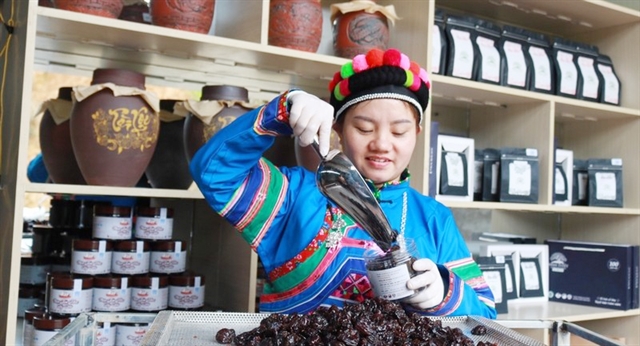 |
| Sải Thị Bích Huế, a member of the Phù Lá ethnic group and head of the Quang Tôm Cooperative in Lào Cai's Bảo Hà Commune, is an exemplary local entrepreneur. — Photo courtesy of the Lào Cai Provincial Women’s Union |
Thu Trang
LÀO CAI — Over the past few years, several organisations and State management agencies have been working together to support ethnic women and young people in developing livelihoods and starting businesses.
In Lào Cai, a mountainous province with a large population of ethnic groups, creating more opportunities for women and young people to access vocational skills, markets and new business methods is especially meaningful.
Former Deputy Chairwoman of the Lào Cai Provincial Women’s Union Vũ Thị Tân said that over the past few years, women’s unions at different levels across the province have focused on carrying out national target programmes and provincial and central Government projects, while also mobilising resources from non-governmental organisations.
She said a key focus was Project 939, which supports women’s entrepreneurship through 2030.
“The most notable outcome has been the strengthened entrepreneurial spirit and economic capacity of women through start-up competitions organised by women’s union branches at all levels,” Tân said.
Over the past year, the Lào Cai Provincial Women’s Union has also changed its approach beyond just providing small-scale livelihood support, as it had done in the past, she added.
The union has worked to help women, young women, students and pupils receive comprehensive career guidance and support for business start-ups, including business management, brand building, digital transformation and e-commerce.
“That is the goal linked to the demands for innovation in today’s era,” she said.
As a result, numerous business models, cooperative groups, production associations, household businesses and small and medium-sized enterprises across the province have gradually developed in a sustainable manner.
“What has mattered most to our women’s union branches over the past year is not just having more products and more examples. What we value most is quality,” Tân said.
Women and young people who start businesses or engage in commercial activities should have the confidence to advance, take charge of their economic lives and become self-reliant in digital transformation and e-commerce applications, she said.
“Our guiding principle and key direction is not merely to ensure that women participate, but to improve their capacity so that they can genuinely take charge of their economic lives. This is precisely the goal we pursue in gender equality, as well as in economic development, labour, employment and women’s entrepreneurship,” Tân said.
Women taking the lead
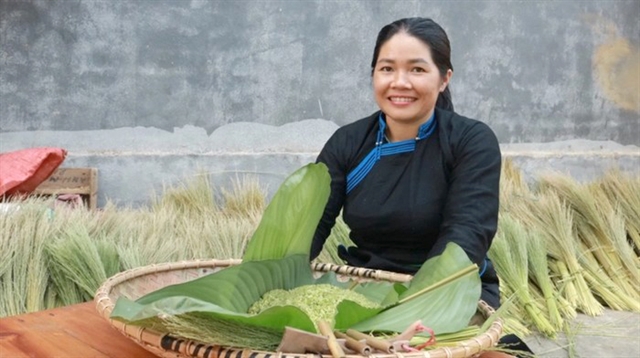 |
| Lù Thị Tươi, a member of the Tày ethnic group, achieves success with products made from young green rice in Bắc Hà Commune. — Photo courtesy of the Lào Cai Provincial Women’s Union |
Trần Thị Hiền, director of the Việt Nam Brocade Production, Trading and Services Company, has received substantial support from local authorities.
Hiền, a member of the Tày ethnic group, was born and raised in Sa Pa, Lào Cai Province.
“When I started my business, I faced a lot of pressure in terms of finance and how to run an enterprise. During the process, we also encountered many difficulties relating to capital, technology and personnel. I was always determined to find a way to combine the preservation of traditional crafts with economic development,” Hiền said.
With management training provided locally, Hiền has expanded her business and created jobs for 12 women, all of whom are from ethnic communities.
Đinh Minh Hà, chairwoman of the Lào Cai Provincial Women’s Union, said that many women and young people who have received support gained more knowledge, skills, confidence and opportunities to develop their careers and gradually take control of their own economic activities.
“What we value most is not only effective models or tangible outcomes, but also people’s creativity, confidence and willingness to change their thinking and working methods, as well as each individual’s efforts and belief in their ability to progress,” Hà said.
She noted that the Provincial Women’s Union would continue to work with and create favourable conditions for women and young people, supporting them in applying technology, expanding markets and adapting to the new demands of digital transformation and integration.
Cooperation between Lào Cai and domestic and international partners will continue to be fostered through new initiatives, programmes and partnership opportunities, towards a shared goal: providing more opportunities for women and young people to realise their potential, become self-reliant and make positive contributions to their communities and society.
“I believe these models will continue to be replicated on a large scale, so that every entrepreneurial idea from Lào Cai women can become a catalyst for positive energy and the aspiration to contribute,” Hà said.
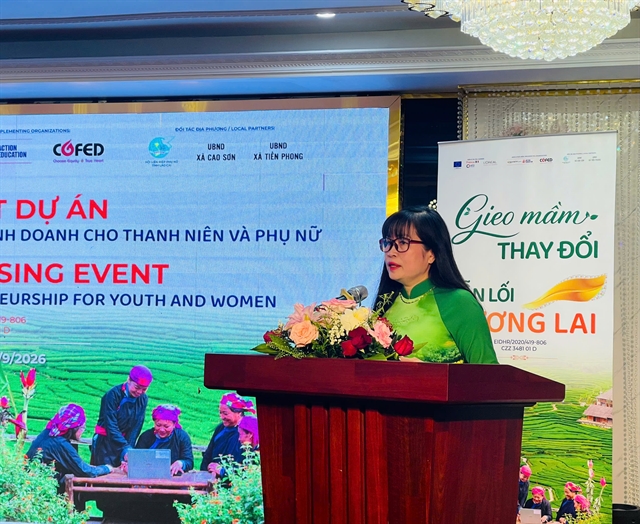 |
| Đinh Minh Hà, chairwoman of the Lào Cai Provincial Women’s Union, says that the union will work with and support women in applying technology and expanding markets. — VNS Photo Thu Trang |
Development policies
Đặng Tiến Hùng, deputy director-general and deputy chief of the National Office for Ethnic Groups and Mountainous Areas under the Ministry of Ethnic Affairs and Religion, said that Việt Nam has a system of policies supporting ethnic women and young people in starting businesses and developing their livelihoods.
These include the Law on Youth, the Law on Employment and the Law on Gender Equality.
Based on those laws, relevant agencies have introduced important policies and initiatives, such as the Việt Nam Youth Development Strategy, the Scheme to Support Women’s Entrepreneurship for the 2026–2035 period, and the National Target Programme on Socio-economic Development in Ethnic Groups and Mountainous Areas for 2021–2025.
“That programme includes a wide range of support activities, from value chain development and medicinal-herb initiatives to start-up support, cultural preservation combined with tourism, and the development of electronic marketplaces to promote products made by ethnic and mountainous communities,” Hùng said.
At present, under the National Assembly’s Resolutions 257 and 46, policies are being integrated and refined in a more coherent and inclusive manner. The groups eligible for support have also been expanded. Previously, policies focused largely on poor and near-poor households; they now extend to ethnic households more broadly.
Nguyễn Thị Tú, country representative of Aide et Action (AEA) Việt Nam, said that the labour market and employment needs have changed significantly since the COVID-19 pandemic.
“Many women and young people, particularly those in rural and ethnic community areas, have had to seek new jobs, including employment far from home," Tú said.
"We therefore not only help them acquire additional vocational skills and equip them with skills that match market demand, but also provide information on occupational safety, workers’ rights and entitlements, and the risks they should consider when working away from home.
"This helps them prepare more effectively and make safe, appropriate and well-informed employment choices."
Behind every person undertaking vocational training is a new opportunity: for a better job, a higher income, the confidence to enter a new working environment and, most importantly, a greater ability to shape their own future.
“This is also how we prepare young people not only with the skills they need today, but also with the capacity to adapt to future changes in the labour market and business environment,” Tú said.
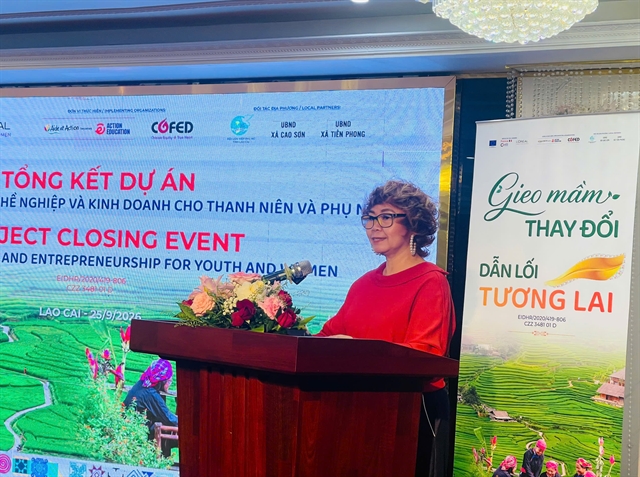 |
| Nguyễn Thị Tú, country representative of Aide et Action Việt Nam, emphasised the need to prepare young people not only with skills, but also with the capacity to adapt to future changes. — VNS Photo Thu Trang |
Trần Bích Hạnh, deputy director of the Phú Thọ Provincial Centre for Science, Technology, Innovation and Digital Transformation, said: “The current direction pursued by all start-up businesses is knowledge and technology. We must use knowledge – from ways of thinking to the acquisition of expertise – to establish production processes, transform production methods and mindsets, apply technology and commercialise products.”
“The artificial intelligence revolution has brought us many benefits, not just for State management agencies but also for entrepreneurs themselves,” she said.
In particular, Resolution 57, issued on December 22, 2024, has helped drive the entire administrative system towards growth and breakthroughs through the application of science and technology in production and business.
Experts said that these resolutions and policies reflect the view that innovation is no longer an option, but a driver of growth for enterprises and individuals, especially ethnic women and young people. — VNS
Society
 Society
 Society
 Society
 Society
 Society
 Society
 Society
 Society
 Society
 Society
 Society
 Society
 Society
 Society