 Society
Sơn La applies science and technology to coffee production
1.
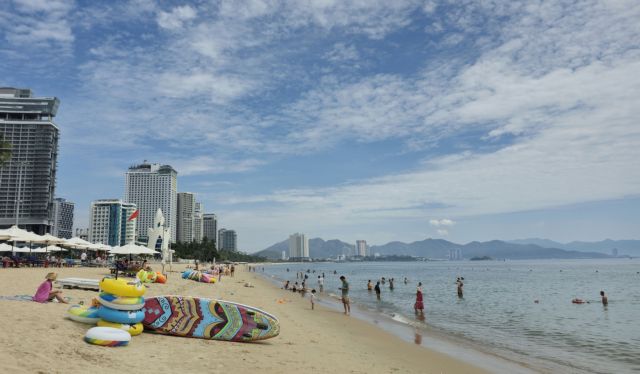 |
| A section of Nha Trang Beach in Khánh Hòa Province attracts visitors. — VNA/VNS Photo Phan Sáu |
KHÁNH HÒA — As international tourism continues to surge, the central coastal province of Khánh Hòa is stepping up efforts to effectively manage the growing number of foreign visitors while maintaining a safe, welcoming environment that supports its ambition of becoming a leading international seaside destination.
Applying the '12-hour rule'
At peak periods, Khánh Hòa has recorded as many as 85,000 foreign nationals staying in the province, most of whom entered Việt Nam for tourism, investment or work.
To ensure compliance with immigration regulations, officers from the Immigration Management Division under the provincial Police Department have intensified inspections and provided guidance to accommodation providers on registering temporary residence for foreign nationals in accordance with the Law on Entry, Exit, Transit and Residence of Foreigners in Việt Nam.
Đào Trung Kiên, head of the front office at Mường Thanh Hotel, said the hotel welcomes around 400–500 foreign guests each day, mainly from Russia, South Korea, Japan and China.
Guests are required to present valid passports upon check-in so reception staff can complete their temporary residence registration. Most visitors cooperate fully, while those with incomplete or invalid documents are assisted in resolving the issues in accordance with Vietnamese law.
The registration process is carried out electronically through the national public service portal, making it as convenient as the procedure for domestic guests.
The Ministry of Public Security has issued regulations governing the submission and processing of temporary residence declarations for foreign nationals.
The regulations apply to foreigners residing in Việt Nam, accommodation establishments hosting overnight foreign guests, authorities responsible for managing foreigners' residence, and other relevant organisations and individuals.
Khánh Hòa Police encourage accommodation providers to submit declarations online. The procedure may be completed either by the foreign guest or by the homeowner, landlord or designated staff member responsible for registering temporary residence on behalf of an organisation or business.
 |
| Foreign tourists purchase local products at an OCOP (One Commune One Product) promotion and exhibition organised by Khánh Hòa Province. — VNA/VNS Photo Nguyễn Thành |
Colonel Tô Bích Ngọc, head of the Immigration Management Division, stressed that accommodation providers must check valid passports and visas as soon as guests arrive and strictly follow the ‘12-hour rule’.
Under the rule, accommodation providers must complete online temporary residence registration within 12 hours of a guest's arrival. In remote or mountainous areas, the deadline is extended to 24 hours, but registration must never be delayed overnight.
If a guest leaves to travel elsewhere and later returns to the same accommodation, a new temporary residence declaration must be submitted rather than relying on the previous one. Overseas Vietnamese entering the country with foreign passports are also required to complete temporary residence registration under the same regulations as other foreign nationals.
Building an attractive and friendly destination
Khánh Hòa has identified tourism as its spearhead economic sector and one of the four key drivers for achieving double-digit economic growth during the 2025–30 period.
The province is focusing on expanding international markets including South Korea, China, Russia, Japan, Malaysia, Uzbekistan, Kazakhstan, North America, Europe, the Asia-Pacific, the Middle East and other promising markets.
In 2026, Khánh Hòa aims to welcome 18.8 million visitors, including 6.3 million international arrivals, as it works towards becoming an internationally recognised marine tourism hub.
Provincial authorities stress that effective management of foreign visitors is intended not to create barriers, but to ensure a safe, orderly and appealing tourism environment for both visitors and local communities.
Sergey Ivanov, a tourist from Russia who has visited Nha Trang three times with his family, described Khánh Hòa as a friendly and secure destination with beautiful landscapes and hospitable people.
During each visit, his family receives clear information at both the airport and the hotel about the regulations they are expected to follow during their stay.
"The guidance is straightforward and easy to understand," he said.
"It not only helps make our trip safer but also shows respect for the local community."
Beyond promoting scenic attractions and tourism products, travel businesses and tour guides also play an important role in helping international visitors understand and comply with Vietnamese laws.
Dương Ngọc Ánh, a tour guide in Nha Trang, regularly accompanies international tour groups. In addition to introducing local attractions and culture, she always spends time explaining the basic rules visitors should observe while staying in Việt Nam.
According to Ánh, many foreign tourists are unfamiliar with Vietnamese traffic regulations, the conditions for using international driving permits, temporary residence registration procedures and appropriate public behaviour.
Providing such information at the beginning of a trip helps visitors avoid unintentional violations, she said.
The provincial Department of Culture, Sports and Tourism has called on tourism businesses to strengthen multilingual public awareness campaigns at airports, hotels, beaches and popular tourist attractions.
The messages should be concise and easy to understand, focusing on regulations that visitors are most likely to overlook, such as residence registration requirements, the prohibition on drink-driving, the use of valid driving licences and appropriate conduct in public spaces.
Authorities believe that effective management of foreign visitors not only helps maintain public security and social order but also supports the development of a safe, professional and welcoming tourism environment.
These efforts are expected to lay a solid foundation for Khánh Hòa's long-term goal of being globally recognised by 2045 as one of Asia's premier seaside tourism destinations. — VNS
Society
 Society
 Society
 Society
 Society
 Society
 Society
 Society
 Society
 Society
 Society
 Society
 Society
 Society
 Society