 Life & Style

Hà Nội aims to turn traditional crafts into drivers of economic growth
1.
 |
| A museum – library – park complex in Lâm Đồng Province. VNA/VNS Photos |
HÀ NỘI — Six months after the Politburo issued Resolution No. 80-NQ/TW on Vietnamese culture development, Việt Nam has added a law on cultural industries development to its legislative agenda.
The second meeting of the Central Steering Committee for the Development of Vietnamese Culture identified turning cultural industries into a new growth driver as a key priority. The Ministry of Culture, Sports and Tourism (MoCST) and other agencies have been ordered to finalse the bill for submission to the National Assembly’s October session under fast-track procedures.
Vietnam boasts a rich cultural heritage, a young creative workforce, a market of over 100 million people and rapidly developing digital infrastructure – all favourable conditions for cultural industries to scale up.
MoCST statistics show cultural industries’ average annual production value hit nearly VNĐ1.06 quadrillion Vietnamese (US$44 billion) between 2018 and 2022. The number of companies in these industries grew 7.2 per cent a year to 70,321 in 2022. The workforce expanded 7.4 per cent annually.
The numbers show a solid market foundation and pooled resources, but potential remains untapped. A major bottleneck lies in policy and legal frameworks. Current laws manage individual fields but don’t link resources into integrated value chains.
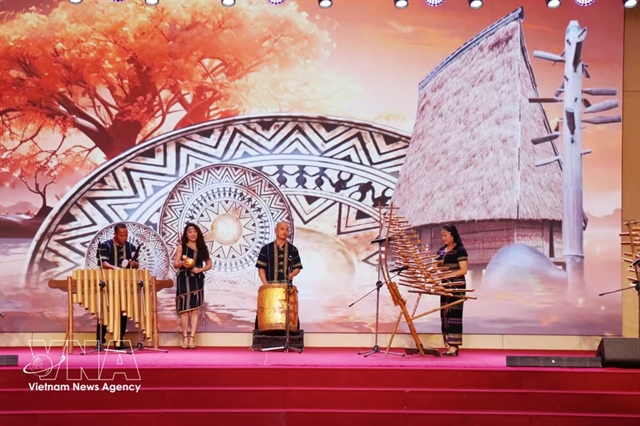 |
| A traditional musical instrument performance at a tourism networking event hosted by the Lâm Đồng provincial Department of Culture, Sports and Tourism. |
That leaves cultural industries fragmented. Many creative firms, especially in video games and animation, mainly do outsourcing for international markets and haven’t built their own intellectual property (IP) assets under domestic brands.
Global experience shows that cultural industry competitiveness hinges on how fast institutional frameworks develop. Many countries have prioritised the sector.
The draft law will focus on key areas, including the cultural industries ecosystem, cultural IP assets, infrastructure, workforce and trading platforms.
A long-term legal framework that unlocks resources while staying flexible to technology and market changes will turn Vietnam’s cultural potential into national competitiveness and pave the way for cultural industries to become a new driver of national development. — VNA/VNS
Life & Style
 Life & Style
 Life & Style
 Life & Style
 Life & Style
 Life & Style
 Life & Style
 Life & Style
 Life & Style
 Life & Style
 Life & Style
 Life & Style
.png) Life & Style
Life & Style
 Life & Style
 Life & Style