 Society

ECO Expo Asia opens at Hong Kong AsiaWorld-Expo in late October
1.
|
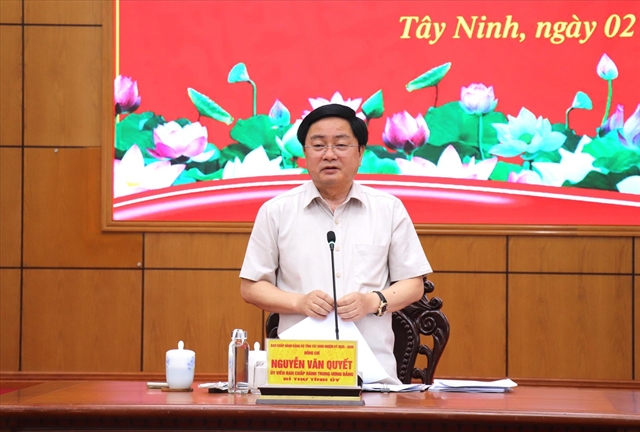
| Nguyễn Văn Quyết, Secretary of Tây Ninh Province’s Party Committee, speaks at the August 6 conference, urging local agencies to shift decisively from study to concrete action in implementing the Politburo’s Resolution No. 57-NQ/TW. — VNA/VNS Photos Đức Hạnh |
TÂY NINH — The southern province of Tây Ninh is taking decisive steps to eliminate data bottlenecks and expedite digital transformation to ensure the full completion of goals outlined in Resolution No 57-NQ/TW.
The Politburo’s Resolution No 57-NQ/TW serves as a strategic policy directive aimed at driving national digital transformation, fostering scientific research, developing high-tech capacity, and building an autonomous digital economy.
The province’s targets were emphasised during a conference held on August 6 by the province’s Steering Committee for the resolution to review implementation outcomes for the first half of 2026.
Speaking at the conference, Nguyễn Văn Quyết, member of the Party Central Committee, the province’s Party Secretary, and head of the province’s Steering Committee, demanded an immediate shift from study and dissemination to concrete action that produces tangible, measurable results.
“Tasks marked as completed must be backed by specific results, verifiable outputs, and supporting documentation, overcoming the practice of vague reporting lacking data and evaluation criteria,” Quyết said.
He asked heads of Party committees, local authorities, and agencies to directly lead, inspect, and take full accountability for task progress and quality, warning against delegating responsibilities solely to specialised divisions or issuing plans without concrete outcomes.
He also asked relevant departments to review and resolve administrative procedures on the National Public Service Portal, fix data synchronisation and online payment issues, accelerate security certification for all local information systems, and permanently resolve remaining data bottlenecks across the province.
Significant progress in key digital metrics
Reporting on the progress made over the past seven months, Senior Colonel Lê Trung Ái, deputy director of the province’s Police, said the province has achieved positive results across multiple indicators, with no tasks suffering from delays.
To date, the province has completed 169 out of 274 tasks assigned by the Central Government (62 per cent) and 41 out of 150 tasks set under the province’s Party Committee’s plan.
The province is transitioning from merely applying technology to building core technological capacity, taking strategic tech, data, and innovation as key drivers for development.

|
| Delegates review the progress of digital transformation and tech capacity building under the Politburo’s Resolution No. 57-NQ/TW at a conference held in Tây Ninh Province on August 6. |
It has identified six major challenges for focused implementation, including increasing the digital economy's share in GRDP, developing a carbon credit market linked to green growth, facilitating deeper integration into global value chains, expanding renewable energy, and establishing ecosystems for startup innovation and autonomous artificial intelligence (AI).
Specifically, AI and unmanned aerial vehicles (UAV) have been designated as strategic priority sectors.
The province has drafted a UAV Ecosystem Development Strategy for 2026-30 with a vision to 2035, while holding four thematic AI seminars attracting over 4,900 participants to promote AI application in governance.
Regarding digital infrastructure, the specialised data transmission network now connects 100 per cent of provincial departments and commune-level people’s committees.
5G coverage extends to all communes and wards via more than 1,250 5G base stations out of a total 5,076 mobile stations, reaching a population coverage rate of 91 per cent.
Meanwhile, 96.3 per cent of local households are connected to fiber-optic internet.
Data clean-up and database construction have also yielded impressive milestones.
The province has completed 100 per cent standardisation of Party member data and digitised over 3.7 million civil status records.
Furthermore, 99.7 per cent of social, health, and unemployment insurance records have been verified.
The province is currently completing 45 digital platforms and 159 specialised databases.
Alongside tech infrastructure, the province continues to invest in human capital. Through its popular digital literacy platform, it has trained over 12,000 officials, civil servants, workers, and members of community digital technology teams in digital skills, AI, and information security. — VNS
Society
 Society
 Society
 Society
 Society
 Society
 Society
 Society
 Society
 Society
 Society
 Society
 Society
 Society
 Society