 Society

Sơn La holds second coffee festival, targeting stronger businesses in future
1.
|
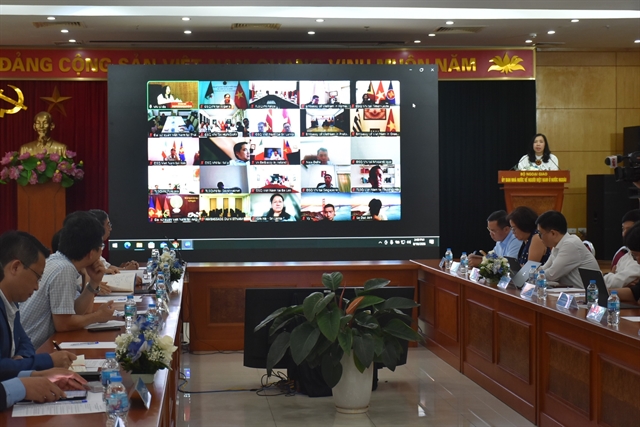
| Deputy Foreign Minister Lê Thị Thu Hằng speaks at the seminar on overseas Vietnamese intellectuals this week. — VNA/VNS Photo |
HÀ NỘI — Việt Nam is moving to tap its global diaspora of intellectuals more systematically, unveiling plans for a digital platform and a national 'bank of challenges' to match overseas Vietnamese experts with projects back home, officials said at a seminar this week.
The event, hosted by the State Committee for Overseas Vietnamese under the Foreign Ministry, brought together researchers and policymakers to discuss how to build and strengthen networks of Vietnamese experts working in strategic technology fields.
Deputy Foreign Minister Lê Thị Thu Hằng told the gathering that the Politburo's Resolution 23 on overseas Vietnamese affairs issued on August 2 marks a turning point in how Việt Nam views its overseas population, which numbers roughly 6.5 million people spread across more than 130 countries and territories.
The policy, she said, casts the diaspora not merely as an inseparable part of the nation but as a strategic resource in its own right – a bridge between Việt Nam and the world, and a direct participant in the country's development and defence.
The official described the shift as moving from a mindset of 'mobilising, rallying and caring for' overseas Vietnamese to one of 'accompanying and creating mechanisms' that give them a more direct stake in national development.
Under the new resolution, she said, it falls to the Party, the State and related agencies to build the space, environment and conditions needed for overseas Vietnamese to take part directly in that process.
Of the diaspora's 6.5 million people, about 650,000 hold a university degree or higher, according to Hằng. In recent years, that talent has begun coalescing into formal networks: nearly 2,000 experts now belong to innovation and specialist networks spanning artificial intelligence, semiconductors, quantum technology, cybersecurity, and aerospace, alongside roughly 50 professional associations of Vietnamese intellectuals scattered across different countries.
Even so, the diplomat acknowledged that this talent pool remains significantly underused. What's missing, she said, is the space, environment and conditions for these experts to contribute meaningfully.
She asked researchers at the seminar to take stock of how existing networks and associations are functioning, to identify effective and innovative practices, and to flag the obstacles, root causes and lessons learned so far.
The diplomat pointed to the gap between overseas expertise and domestic demand. While many diaspora associations have already established ties with ministries, universities, research institutes and local governments, the results have fallen short of expectations, and Việt Nam needs to do a better job matching supply with demand, Hằng said.
She called for clearer coordination mechanisms between the Foreign Ministry and other ministries, local authorities, associations, institutes and universities, to ensure their efforts complement rather than duplicate one another.
Hằng also called for a platform to connect overseas expert resources with domestic demand. Việt Nam is already building a greater database on its overseas citizens, she said, and could roll out a database of experts and intellectuals as a first step, while officials work out the name, organisational model and operating method for the platform.
Delegates at the workshop broadly echoed the assessment, agreeing that the diaspora represents a strategic resource for boosting national strength and that the new resolution reflects a genuine shift in official thinking, from courting overseas talent to building an environment where it can contribute directly.
But many noted that the innovation and expert networks now in place, though active in fields like AI, semiconductors, cybersecurity and aerospace, remain modest in scale relative to the diaspora's potential.
Participants pointed to a shortage of avenues for meaningful contribution, poor coordination between supply and demand, and bureaucratic red tape as the main obstacles holding the networks back.
To address that, participants proposed a shift in strategy – from trying to lure experts back to Việt Nam permanently toward mobilising what several called 'global Vietnamese intellect,' engaging experts on specific projects and problems wherever they happen to be based.
That would involve building a national 'bank of challenges', paired with interoperable digital platforms that connect businesses and local governments directly with expert networks abroad.
One proposal that drew particular interest was a 'Technology Train' model, envisioned as a five-step pipeline: identifying needs, matching them with available resources, forming a project, carrying it out, and then evaluating the results with an eye toward scaling successful efforts more broadly.
Delegates also pushed for a stronger legal and institutional framework, including fair compensation for sensitive work involving data security and intellectual property, and a more transparent, equitable working environment – steps they said were necessary to sustain overseas experts' motivation to keep contributing to Việt Nam's development. — VNS
Society
 Society
 Society
 Society
 Society
 Society
 Society
 Society
 Society
 Society
 Society
 Society
 Society
 Society
 Society