 Society
Vietnamese Prime Minister meets Cambodian National Assembly President
1.
|
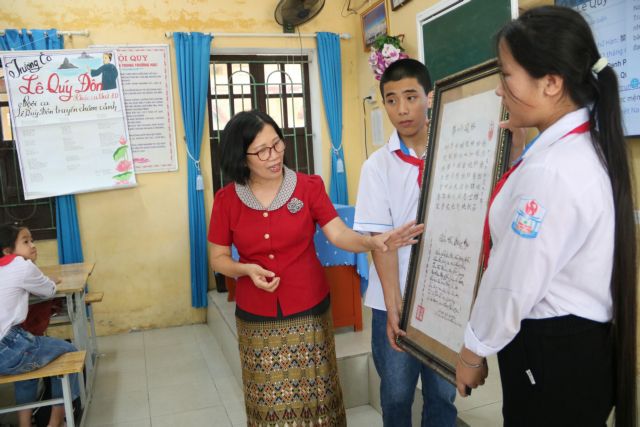
| A literature lesson taught by Nguyễn Thị Phương at Lê Quý Đôn Primary and Secondary School in Lê Quý Đôn Commune, Hưng Yên Province, engages students through a lively and interactive approach. — VNA/VNS Photo Thu Hoài |
HƯNG YÊN — Over nearly three decades in the classroom, Nguyễn Thị Phương, a literature teacher at Lê Quý Đôn Primary and Secondary School in the northern province of Hưng Yên, has developed numerous initiatives to bring the legacy of renowned Vietnamese cultural figure and scholar Lê Quý Đôn into the classroom.
Through lessons, educational programmes and poems she has written about the scholar, Phương has inspired a love of literature among her students, nurtured the local tradition of learning and helped pass on valuable cultural values to successive generations.
From a love of literature to preserving heritage
Phương's literature classes at Lê Quý Đôn school are seen as lively and engaging.
Rather than simply listening to a conventional lecture, students are divided into groups to read, discuss and explore poems written by their teacher about scholar Lê Quý Đôn's life, family background, achievements, teachings and ideas.
Each group focuses on a different aspect, from the scholar's childhood as a prodigy and his years of dedicated study to his major contributions to the nation.
This approach not only helps students understand Lê Quý Đôn and the moral and intellectual values embodied in his legacy, but also encourages them to appreciate the beauty of poetry and develop a genuine interest in literature.
For Phương, this is one of the ways she has persistently brought Lê Quý Đôn's cultural legacy closer to students through her love of literature and creativity in teaching.
After graduating from the Department of Literature at Thái Bình Teachers' College in 1992, Phương began working at Độc Lập (Independence)Secondary School, the predecessor of today's Lê Quý Đôn Primary and Secondary School.
Driven by her passion for teaching Vietnamese, she travelled to the Lao People's Democratic Republic in late 2012 to work as an education expert, teaching Vietnamese to local people. She returned home in 2018 and resumed teaching at the school named after the renowned scholar.
As a teacher working at a school bearing the name of one of the nation's greatest scholars, Phương has long reflected on how to ensure that Lê Quý Đôn's cultural and intellectual legacy does not remain confined to textbooks and history lessons, but becomes a living part of students' understanding.
She said her love for her hometown's cultural heritage and admiration for one of the nation's outstanding intellectuals have continually motivated her to research Lê Quý Đôn and find ways to present his life and legacy to students in the clearest and most memorable manner.
Driven by that belief, Phương led a provincial-level educational programme in 2023 titled ‘Teaching through Cultural Heritage: Focusing on the Scholar Lê Quý Đôn’. The programme made a strong impression on the local education sector by combining academic learning with cultural and historical experiences.
To help students better understand and remember the scholar's life and achievements, she spent considerable time researching and composing 13 poetic cantos recounting his background, life, contributions and legacy.
Through her writing, historical stories became vivid and accessible. Lê Quý Đôn emerged as a more relatable figure, making it easier for students to connect with his story. The poems were later compiled into a collection titled ‘The Epic of Lê Quý Đôn’, providing useful learning material for teachers and students.
Her work did not stop there. In 2025, she undertook a research project examining the system of inscriptions and written materials at the Lê Quý Đôn Memorial Site.
The work has required considerable time and effort to study, compare and verify historical materials. For Phương, however, it is another way of preserving and promoting the cultural values handed down by earlier generations.
Planting a love of literature in young minds
Principal Nguyễn Đình Anh of Lê Quý Đôn Primary and Secondary School said the programme led by Phương had generated a positive response not only among students but also among teachers.
One of its most distinctive features was the creation of an immersive cultural experience in which more than 80 students took on the roles of historical figures and recreated Lê Quý Đôn's life, achievements and teachings through theatrical performances.
|
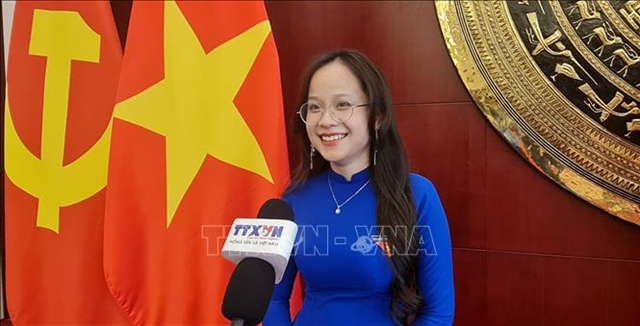
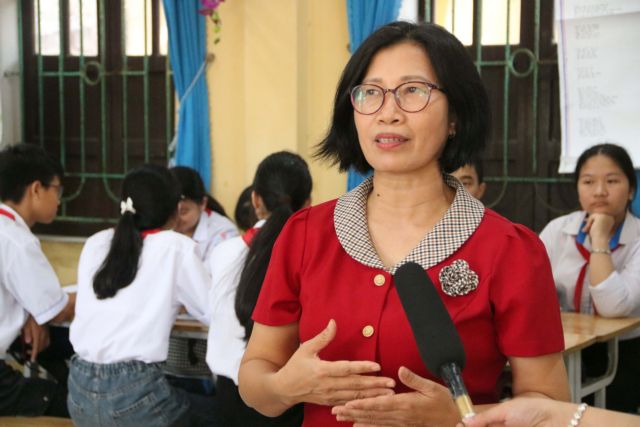
| Nguyễn Thị Phương, literature teacher at Lê Quý Đôn Primary and Secondary School in Hưng Yên Province in an interview with the Vietnam News Agency. VNA/VNS Photo Thu Hoài |
This approach has helped students gain a deeper understanding of history while appreciating the beauty of literature and poetry and the profound humanistic values contained in the scholar's legacy.
Phương's passion for literature is not limited to educational programmes or teaching initiatives.
In every lesson, she looks for ways to make literature more engaging through real-life stories, poems, songs and familiar connections to students' everyday experiences.
Lê Phương Hậu, an eighth-grade student at the school, said Phương's classes are always varied, lively and engaging because of her approachable and emotional teaching style and enthusiasm for every lesson.
"Her teaching has helped me develop a greater love for literature, feel proud of my hometown's tradition of learning and find more motivation to work hard in my studies," Hậu said.
Beyond the classroom, Phương regularly encourages students to develop a habit of reading. For years, she has made a point of finding and borrowing books, newspapers and magazines to recommend additional reading to her students.
To her, every book that reaches a student's hands represents another opportunity for them to explore the world and develop as individuals.
Speaking about his colleague, Principal Nguyễn Đình Anh said that after nearly 30 years devoted to teaching, Phương continues to sow the seeds of a love for literature.
In addition to achieving strong results in teaching and coaching students for literature competitions, she has received the title of outstanding teacher and provincial-level emulation champion for many consecutive years.
She was also presented with certificates of merit by the Lao People's Democratic Republic and the Vietnamese Embassy in Laos in recognition of her contributions to strengthening the friendship between the two countries.
As the school year ends and students begin their summer break, Phương has stepped away from lesson plans but not from her research.
She continues to study inscriptions, parallel sentences, horizontal lacquered boards and other historical materials related to Lê Quý Đôn's life and achievements.
Each ancient inscription she deciphers and every historical document she compares and verifies offers new perspectives on the scholar's legacy.
For Phương, this work is more than academic research. It is also a way of expressing her gratitude to a great predecessor whose intellectual legacy was born and continues to be cherished in her own homeland. — VNS
Society
 Society
 Society
 Society
 Society
 Society
 Society
 Society
 Society
 Society
.jfif) Society
Society
 Society
.jfif) Society
Society
.jfif) Society
Society
 Society