 Society
Hà Nội adorned in red ahead of Liberation Day
1.
Lê Hương
Every morning, before the heat settles over the mountains of Phú Thọ Province, Lường Thị Thơ walks into her chayote field.
Just two years ago, the same plot produced little more than maize and barely enough income to support her family.
Today, its thriving green vines tell a different story — one that is being repeated across many ethnic minority communities as women embrace climate-resilient farming to build stronger livelihoods.
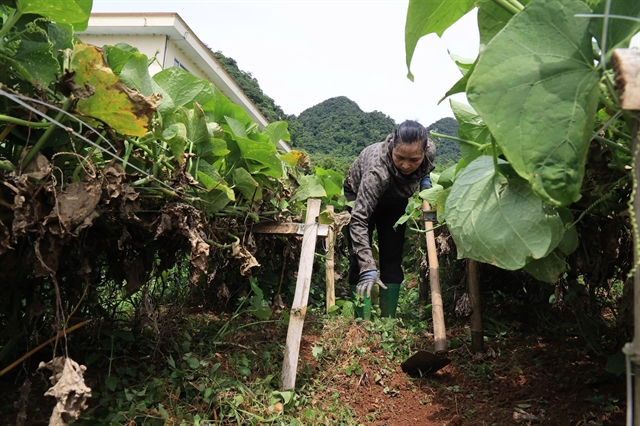 |
| Lường Thị Thơ tends her chayote field in Phú Thọ Province. The crop has transformed a once low-yield plot into a reliable source of income for her family. — VNS Photo Hải Anh |
Like many ethnic minority households living in the mountainous district, Thơ's family depended on small-scale farming on fragmented plots of land, constantly vulnerable to fluctuating weather, poor soil conditions and unstable markets.
Today, the same land tells a different story. Thơ is one of hundreds of ethnic minority women in Phú Thọ benefiting from the Resilience First Programme, funded by the Irish Government and implemented by CARE International in Vietnam, Plan International Vietnam and the Centre for Research on Community Development Initiatives.
The programme combines access to low-interest loans with practical training in climate-resilient agriculture, livestock production and community organisation, helping women become drivers of economic change rather than passive recipients of assistance. Her results speak for themselves.
“Before receiving support from CARE, we didn't grow chayote on this plot of land,” she told Việt Nam News.
“We earned only about VNĐ3 million (US$114) a year from it. Now, our annual income has increased to around VNĐ30 million. Chayote is well suited to the local climate, and it has proven to be a much more profitable crop, generating about ten times more income than other crops we used to grow.”
Thơ's success reflects a broader shift in how vulnerable communities are adapting to climate change, improving household incomes and strengthening resilience against increasingly unpredictable conditions.
Building resilience
Across northern and central Việt Nam, climate change is reshaping rural livelihoods. Mountain communities face increasingly erratic rainfall, landslides, drought and animal diseases, while limited infrastructure and small-scale production leave many households especially vulnerable.
Recognising that resilience means more than disaster preparedness alone, the Resilience First Programme was launched in 2022 with support from the Government of Ireland.
Running until 2028, the programme covers 15 communities across Phú Thọ, Tuyên Quang and Quảng Trị provinces, combining climate adaptation with women's economic empowerment, safer schools, community infrastructure and inclusive local governance.
Rather than imposing ready-made solutions, the programme follows a community-driven approach. Local people first identify their climate risks through Climate Vulnerability and Capacity Assessments before jointly developing action plans.
Investments are then directed towards locally identified priorities, from livelihood models and infrastructure to disaster preparedness, ensuring that communities themselves shape their own development.
Since 2022, the initiative has reached more than 50,000 people. More than 2,100 members, over 82 per cent of them women and nearly 97 per cent from ethnic minority communities, have joined 122 livelihood groups that support sustainable agriculture, savings schemes, market access and community-based tourism.
Thơ's experience is shared by many women across Quy Đức Commune. For Hà Thị Minh, improved farming techniques have dramatically reduced losses in pig farming while giving her family greater financial security.
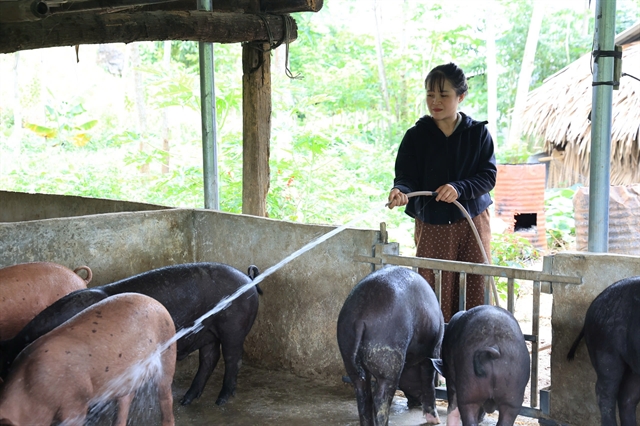 |
| Hà Thị Minh has improved her family's pig farming after receiving training and financial support through the Resilience First Programme. — VNS Photo Hải Anh |
“Before I attended the training, many of our piglets died and the pigs grew slowly,” she said. “Now that I've received training and gained more knowledge, the pigs grow much faster. The project provided my family with a loan so we could invest in pig farming and support our children's education. It also gave us training that equipped us with the knowledge and skills to raise pigs more effectively.”
Beyond farming
Access to affordable credit is only one part of the equation. Equally important is the technical guidance that helps farmers select more suitable crops, improve animal health, adopt biosecure farming methods and respond to changing climate conditions.
The programme encourages participants to learn from one another through producer groups and community savings schemes, reducing the isolation that often characterises farming in remote mountainous areas.
For Sa Thị Quý, the greatest change has been collective.
“Being part of the project has helped me improve my family's income and better cover our daily living expenses,” she said. “I feel that our lives have been changing for the better every day, and our quality of life is much better than it used to be."
"Since joining the CARE Village Savings and Loans Association group, I have become part of a community savings and loan group, where members contribute money to a shared fund and take turns borrowing from it. The living conditions of everyone in the group have improved compared to before," Quý added.
What begins as financial cooperation gradually develops into stronger community networks, an important source of resilience when families face crop failures, disease outbreaks or natural disasters.
Meanwhile, economic empowerment is at the heart of the programme. Women make up more than four-fifths of participants in livelihood groups, reflecting a deliberate effort to strengthen their role in household decision-making and community leadership.
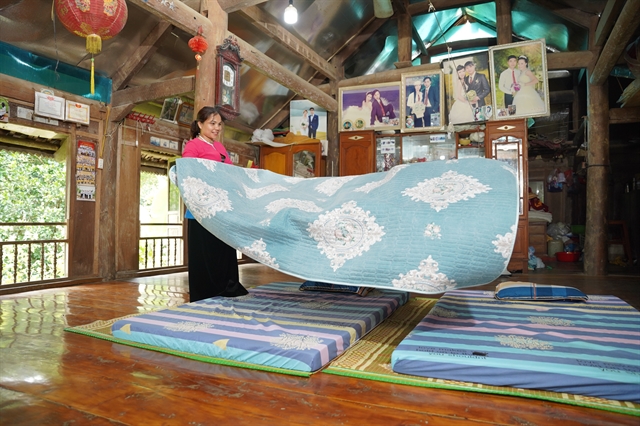 |
| Community-based tourism is creating new livelihood opportunities for women in Phú Thọ Province. — Photo courtesy of CARE International in Vietnam |
In neighbouring Quyết Thắng Commune, that empowerment extends beyond agriculture. Community tourism initiatives are helping women diversify their incomes while preserving Mường cultural traditions. Through cooperative groups, women receive training in hospitality, business skills and tourism services, allowing visitors to experience local farming, traditional music, handicrafts and cuisine.
At the same time, women report becoming more confident in expressing their opinions, managing finances and participating in community affairs. Diversifying livelihoods also reduces dependence on agriculture alone, making communities less vulnerable to weather shocks and market fluctuations.
Lasting impact
Local authorities believe the programme's greatest achievement lies in creating sustainable change rather than short-term assistance.
Lường Văn Vinh, a local official, has seen firsthand how practical support is improving lives.
“The CARE project has played a vital role in improving people's lives,” he said. “It provides hands-on guidance and practical support to every participant. As a result, living standards have risen, and many households have been able to purchase equipment and other essential items to improve their homes and livelihoods.”
He believes the programme is laying the foundations for long-term rural development.
“The project serves as a foundation by providing local people with practical training in modern farming techniques," he said.
"From there, they can continue to expand these models and improve their crop cultivation and livestock production, creating more sustainable livelihoods in the long term.
"We are also working to upgrade the existing producer groups into cooperatives, enabling farmers to bring their products to a wider range of markets and increase their incomes.”
The journey is far from complete. Mountain roads remain vulnerable to landslides, livestock diseases still threaten farmers' investments, and market access continues to be a challenge. Yet communities that once relied on subsistence farming are increasingly building diversified, climate-resilient livelihoods supported by stronger local institutions.
The women themselves are already thinking about the next step, and Thơ hopes loan repayment terms can become more flexible.
“I would suggest that loan repayment be based on a reasonable percentage. If the repayment amount is set too high, it will be difficult for many households to meet their obligations,” Thơ said.
Elsewhere, Minh hopes to continue expanding her family's farm. “I hope the project can support my family in building a biogas pit. If possible, I'd also like to expand our pig shed so we can raise an additional breeding sow,” she said.
Those hopes signal growing confidence that rural women can shape their own futures. Across Phú Thọ and beyond, the Resilience First Programme is demonstrating that resilience is about creating opportunities before crises occur, through stronger livelihoods, stronger communities and women empowered to lead the way. VNS
Society
 Society
 Society
 Society
 Society
 Society
 Society
 Society
 Society
 Society
 Society
 Society
 Society
 Society
 Society