 Society
VN-Index ends lower despite liquidity hit over $1 billion
1.
 |
| A view of Hà Nội from above. — VNA/VNS Photo |
HÀ NỘI — Nguyễn Mạnh Đức has a rule he keeps repeating to his staff: one cannot manage a neighbourhood from behind a desk. Lately, that rule has become less a philosophy than a daily necessity.
Đức runs what's known in Việt Nam as a tổ dân phố – a residential group, the smallest unit of local administration and the layer of government closest to people's front doors.
Until this summer, his patch in central Hà Nội's Cửa Đông area covered around 300 households, a manageable stretch of familiar faces and well-worn habits.
Then, on July 1, Hà Nội folded its wards and communes into a leaner structure as part of a nationwide push toward a two-tier local government model, consolidating the city's 526 commune-level units into just 126.
Đức's neighbourhood group absorbed pieces of three former wards – Cửa Đông, Hàng Bồ and Hàng Mã – and emerged responsible for 1,129 households spread across 11 streets.
The households had multiplied, and so had the territory. Đức, like thousands of neighbourhood officials across the capital, now had to get to know a jurisdiction nearly four times its old size, even as staffing was still catching up to the new scale.
"The workload has at least tripled compared to before July," he said.
These reforms aim to streamline the administrative apparatus, with fewer layers, lower costs and a leaner system built for the long run. Getting there, though, has meant an intense adjustment period at the neighbourhood level, where officials like Đức are doing the practical, on-the-ground work of the transition in real time.
His most immediate task wasn't policy, but simply relearning who lived where. Rebuilding that knowledge meant knocking on doors – thousands of them. His team had to relearn, household by household, who was elderly, who was in school, who was employed and where, who qualified for State assistance, who was quietly struggling.
It was less a bureaucratic exercise than a kind of re-census, conducted on foot.
Adding to the task, the neighbourhood groups now being merged had each kept their records their own way. Some of the old-guard leaders, Đức found, had maintained meticulous files – ID numbers, phone numbers, occupations, even which children in which households were in school.
That level of detail was what had let previous officials respond quickly on everything from welfare cases to matching local labour with local demand, he said. But now his team is essentially relearning that institutional know-how from scratch.
"That's the kind of data that lets you really know your area – for social welfare, for labour supply and demand, for basic population management," he said.
"Right now we're still relearning the methodical approach the old group leaders used to have."
Technology has helped, but only so much. The group runs several chat groups on Zalo, Việt Nam's dominant messaging app, and now asks that at least one member from every household join, so that new policies and notices reach people quickly.
But Đức is careful not to treat a chat app as a substitute for a knock on the door.
"Technology can't replace going to see people in person," he said.
"There are residents who don't use smartphones, who don't check Zalo, who don't engage online at all. If you want to know what people actually need, you still have to go to them."
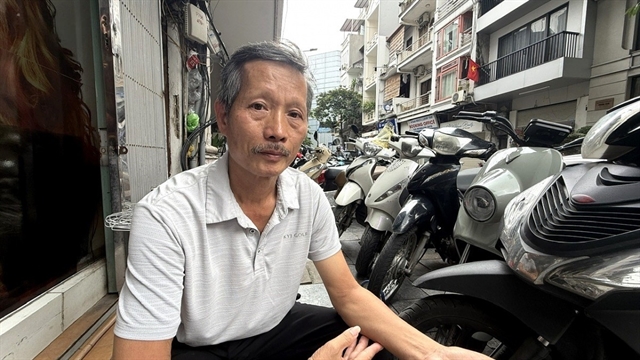 |
| Nguyễn Mạnh Đức, who is in charge of the Cửa Đông 3 Residential Group in Hà Nội's Cửa Đông Ward. — Photo vov.vn |
That same door-to-door process has already started paying off in ways a database alone couldn't. In a single month of house-by-house review, Đức's team identified dozens of households facing serious hardship, including people undergoing dialysis multiple times a week, and others with no stable income.
The group is now flagging those cases for authorities to consider for assistance.
The merger has also thrown up a smaller, more practical wrinkle, one that says a lot about how much has changed in a short time. With so many new households and businesses now inside his group's boundaries, shopkeepers and staff often do not yet recognise the officials showing up at their door.
Đức's first formal request to higher authorities was straightforward: issue his team identification cards, so residents and business owners can tell who they are dealing with.
Across a residential cluster in Tương Mai Ward, Nguyễn Xuân Tùng has been living a version of the same story.
Since the start of July, his neighbourhood group has been handed one assignment after another, including spreading word of new policies, checking clean water access and tallying young men of draft age, plus whatever else lands on the desk in between.
"One task isn't even finished before the next one arrives. I haven't had a single day off since taking this on. It's constant overload," Tùng said.
The scale tells its own story. As deputy group leader before the merger, Tùng shared responsibility for roughly 350 households with his group leader.
Afterward, the combined territory grew to more than 750 households – handled, still, by just one leader and one deputy.
Tùng isn't particularly worried about the learning curve. New software, digital paperwork, unfamiliar procedures – he figures he can pick up those things quickly enough on his own. What weighs on him instead is simpler: there are only so many hours in a day.
Money is the other pressure point, one that sits closer to home. Before the merger, Tùng earned about VNĐ3.7 million (US$141) monthly – modest, but manageable, because he still had time for side work to help support his two school-age children.
His pay has since risen to around VNĐ6.3 million ($240), nearly double. But the job now fills every available hour, leaving no room for the extra work that used to fill the gap.
"The income went up, but it's still not enough, because I've lost the time I used to spend earning more on the side," he said.
"My kids are still in school, and living costs and tuition keep climbing. If the workload stays this intense, it's going to be very hard to keep the family afloat."
Reforms on this scale are, in the end, absorbed first by the people closest to the ground – the neighbourhood officials who take a redrawn map and turn it, street by street, into a working system.
For Đức and Tùng, that has meant the same streets they've always walked, now multiplied several times over, covered with the same small team they started with. — VNS
Society
 Society
 Society
 Society
 Society
 Society
 Society
 Society
 Society
 Society
 Society
 Society
 Society
 Society
 Society