 Politics & Law

Sơn La holds second coffee festival, targeting stronger businesses in future
1.
|
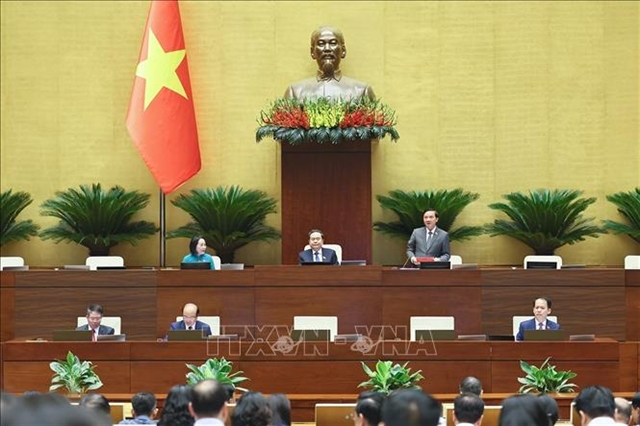
| Vice Chairman of the National Assembly Nguyễn Khắc Định (standing) moderates the NA's discussion of the draft Law on Urban Development in Hà Nội on Tuesday morning. — VNA/VNS Photos Doãn Tấn |
HÀ NỘI — The National Assembly (NA) discussed key issues in the draft Law on Urban Development, including healthcare and social welfare, land use and the marine economy, as their first extraordinary session continued in Hà Nội on Tuesday morning.
The discussion was led by NA Chairman Trần Thanh Mẫn and moderated by NA Vice Chairman Nguyễn Khắc Định.
NA deputies generally agreed on the necessity of the law, as it would establish a long-term legal framework and a foundation for enhancing the efficiency of urban administrations.
They offered opinions on several items, including the development of healthcare systems and social welfare in urban areas, mechanisms for transferring planned land-use quotas in Transit-Oriented Development (TOD) areas, and the development of marine economies within urban settings.
Regarding the development of healthcare systems and social welfare stipulated by Article 27, NA deputy Lê Thị Hoài Chung from Nghệ An Province said the draft law should not consider healthcare only as a social welfare service, but an essential component of urban infrastructure and a crucial factor in ensuring residents' quality of life.
Meanwhile, for Article 10 on city planning, she proposed adding a requirement to plan and distribute healthcare facilities in alignment with each zone’s population scale, density and distribution, its pace of urbanisation and geographical characteristics, and the people’s healthcare needs.
For matters directly concerning the healthcare network, the Ministry of Health should be consulted and included in the policy planning and adjustment processes to ensure consistency between urban planning and healthcare sector planning, she said.
As for Article 12, which outlines principles for urban investment, construction and redevelopment, Chung proposed adding a principle that urban development should be adapted for an ageing population to ensure their access to healthcare services.
“Future urban areas must be friendly to the elderly, persons with disabilities and vulnerable groups, giving them convenient transportation, safe public spaces, suitable housing and accessibility to medical facilities and social services,” she said.
Commenting on the mechanism for transferring land-use quotas within TOD areas, NA deputy Trần Thế Anh from Ninh Bình Province said it would help regulate spatial layout and leverage land value in connection to public transport.
However, to ensure consistent application, quota transferring should not be interpreted merely as a synonym for planning adjustment, Anh said.
Anh proposed that such transfers should be defined as decisions by relevant State authorities to reallocate, in whole or in part, land-use quotas between projects or structures within a TOD area.
“Clearly defining this as an administrative decision by the State will help distinguish it from voluntary civil transactions between private entities,” he said.
Marine economic development
|
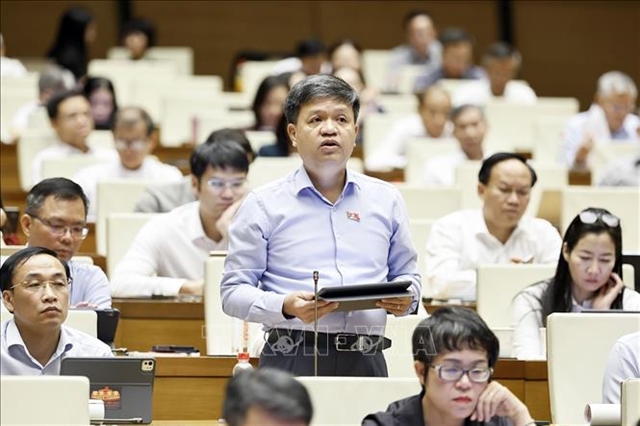
| NA deputy Tạ Đình Thi from Hà Nội comments on the draft law. |
Commenting on the marine economic development provisions in Chapter III, NA deputy Tạ Đình Thi from Hà Nội acknowledged the draft's efforts to actualise the Party's main guidelines on developing a strong maritime nation, and the NA’s National Marine Spatial Plan until 2030.
He proposed that special-class urban areas, such as HCM City, should be explicitly designated as the driving forces for marine economic development, and granted the authority and mechanisms to pioneer new models such as the 'smart coastal city' or 'robust marine economic hub'.
Moreover, exceptional financial and investment incentives should be incorporated to attract strategic investors to emerging marine sectors.
A mechanism to ensure the consistent development of marine infrastructure and related sectors should be developed, Thi added.
Articles 52, 53 and 56 of the draft law opened up new avenues for the development of islands and the resort real estate sector.
“However, more specific regulations are needed to ensure strategic connectivity between urban areas and seaports, and to enhance scientific research capabilities and mastery of marine technology,” he said.
NA deputy Nguyễn Ngọc Sơn from Hải Phòng agreed with the idea to grant greater autonomy to 'special-class' cities, stressing that such autonomy must be accompanied by increased oversight of power.
He proposed that the law clarify procedures for soliciting and addressing the views of the Government or the Prime Minister on matters related to national planning and inter-regional infrastructure, before a city grants its approval.
The law should also clarify the scope of regulations that the municipal People's Committee is authorised to temporarily suspend, Sơn added.
Any deviation from existing laws or NA resolutions must strictly adhere to mechanisms authorised by the NA to avoid creating a grey area between technological experimentation and policy pilots.
"The greater the granted authority, the more essential it is to have three essential requirements in place: the boundaries of power, the accountability of decision-makers and independent oversight mechanisms," said Sơn.
The NA's draft resolution on crime prevention and control was discussed in the afternoon. — VNS
Politics & Law
 Politics & Law
 Politics & Law
 Politics & Law
 Politics & Law
 Politics & Law
 Politics & Law
 Politics & Law
 Politics & Law
 Politics & Law
 Politics & Law
 Politics & Law
 Politics & Law
 Politics & Law
 Politics & Law