 Politics & Law

Sơn La holds second coffee festival, targeting stronger businesses in future
1.
|
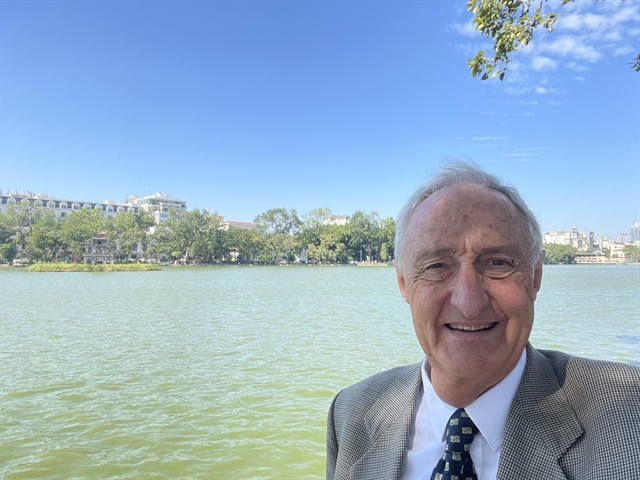
| James Kember by Hoàn Kiếm Lake in Hà Nội in 2025. Photos courtesy of James Kember |
In an interview with Việt Nam News reporter Nguyễn Khánh Chi ahead of the visit by Party General Secretary and President Tô Lâm to New Zealand on August 12-14, former New Zealand Ambassador to Việt Nam James Kember recalled the statement of the then Prime Minister, Bill Rowling, when the bilateral diplomatic relations were established in 1975. PM Rowling said that 'Việt Nam had the capacity to exert a major influence on the future course of events in its region' which emphasises that in a political, and now an economic, sense, this is being proven.
How do you view the significance of the visit?
In any bilateral relationship, an exchange of visits at the highest level serves not only to acknowledge that relationship but also to set the tone and agenda for the future.
I had the pleasure of being involved in the visits both of President Nguyễn Minh Triết in 2007 and of Party Secretary Nông Đức Mạnh in 2009, when our two countries entered a comprehensive partnership. Since then there have been a number of exchanges at the level of Prime Minister as well as many others by relevant ministers.
Under these have been a set of valuable visits by officials, non-governmental organisations and business delegations. The visit by General Secretary and President Tô Lâm will bring additional focus on, and impetus for, the growing bilateral relationship.
Following the elevation of their relationship to a Comprehensive Strategic Partnership (CSP) in 2025, what have been the key areas of progress and cooperation between the two countries?
The establishment of a Comprehensive Strategic Partnership in 2025 was a further sign of a closer relationship along a road that included the 2009 Comprehensive Partnership and its elevation to a strategic partnership in 2020.
At one level, this indicates a growing confidence that both countries have the means to add depth to the political and economic ties and to provide a platform for business and investment to flourish.
'Comprehensive' does not have to mean 'all-encompassing'. Rather it signals that there are areas of cooperation that have the potential to be strengthened. More than that, it implies a level of trust, transparency and openness that allows difference of approach to be aired, and confidence that both governments have invested in a framework for commercial and other activity to operate.
This is all the more important in an uncertain strategic environment, where regional security, climate challenges and supply chain issues are evident.
When diplomatic relations were established in 1975, the then New Zealand Prime Minister, Bill Rowling, said Việt Nam had the capacity to exert a major influence on the future course of events in its region. Both in a political, and now an economic, sense, this is being proven.
New Zealand, and its citizens, are adapting to the reality of Việt Nam becoming a major economy, one that is well-placed to make the most of the very latest technological developments.
Above all, the CSP is evidence that New Zealand has as much to learn from Việt Nam as it in turn has been able to contribute.
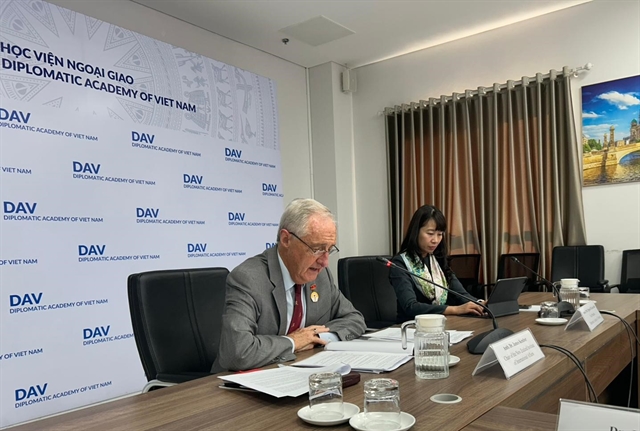
One example was in 2009 when a dialogue was established between the Diplomatic Academy of Việt Nam and the Asia New Zealand Foundation to exchange views on major political and economic trends. With one exception (during COVID), these exchanges have taken place annually, with extremely focused and frank conversations about current political, economic and security challenges.
Having participated in the first of these, as New Zealand Ambassador, in 2009, it was a privilege to be part of the delegation to Hà Nội late in 2025 and to see the confident and frank way in which the two sides addressed the pressing challenges facing our countries and region.
It was no surprise that climate change was a prominent topic, given the mid-year flooding in central Việt Nam: both countries have a great deal more to share on how best to mitigate the impact on our peoples and economies.
|
| James Kember joins the Asia New Zealand Foundation delegation to Hà Nội late in 2025 in the annual dialogue with the Diplomatic Academy of Việt Nam. |
With the relationship now upgraded, strengthening economic and trade ties is a priority, and both nations have set a bilateral trade goal of US$3 billion for 2026. Is this a realistic target and could trade volume triple or even higher by 2030 if the full potential of this partnership is realised?
As an ambassador, I was regularly reminded that a trading relationship had yet to achieve its potential.
Much effort in recent years has gone into easing the rules of doing business, notably through various free trade agreements, so to allow commercial activity to expand and flourish.
When our two Prime Ministers exchanged visits in 2015, two-way trade was around NZ$1.2 billion (equal to the then $840 million), with Việt Nam New Zealand’s 22nd largest trading partner. By 2020, with the Strategic Partnership, it was NZ$2 billion (16th largest trading partner), and by 2024 (another year of Prime Ministerial exchanges) it was NZ$2.7 billion or around $1.6 billion (14th largest trading partner).
By those figures, a goal the two countries set for $3 billion for 2026 is laudable, though still a bit of a leap.
Reducing trade barriers and improving market access are a constant pursuit, but there are wider factors also at play, including the impact on world trade of US tariffs and the war with Iran that were not around when these goals were set.
Providing governments have done their best on creating the best conditions, and there is transparency and openness that gives confidence for commercial activity and investment, there is every reason to be optimistic about the expansion of bilateral trade – as long as the international environment is not adverse.
Beyond economics and trade, in which areas do you think both countries have the most potential to strengthen ties?
Outside the commercial and investment ties, there is scope for education exchanges that relate better to the emerging Việt Nam economy, in providing higher-level exchanges and a possible Centre of Excellence in New Zealand that bolster and take further the training at undergraduate level that has been the cornerstone in the past.
There is scope for more on peace and security cooperation, on science and technology including agri-tech, and on maritime security.
Most of all, dialogue at all levels is vital to create confidence and avoid unwelcome surprises. Exchanges such as the one with the Diplomatic Academy of Việt Nam, previously mentioned, must continue.
Việt Nam views science, technology and innovation as the primary drivers of new development models to accelerate sustainable growth. In this context, how can New Zealand contribute to strengthening cooperation in these sectors and advancing digital transformation in Việt Nam?
Your question about how New Zealand can contribute is only part of a bigger picture.
Of course, New Zealand has certain skills to offer and facilities in which to provide training. But perhaps more important, given the trajectory of the Vietnamese economy is how the two countries can best share expertise and knowledge, to mutual advantage. Perhaps this takes the form of joint research establishments or centres of excellence, or business hubs that apply some of the theoretical learning to current business operations.
Some of these things can grow organically, but they need to be buttressed by the right government-led settings, and the confidence that comes only from developing strong people-to-people relations, notably amongst our younger citizens, as they will be the ones leading the way into the future.
This also means paying good attention to the cultural and sporting links, and exchanges at expert levels so that we can operate as friends.
Even better, as President Nguyễn Minh Triết said to me when I was leaving Việt Nam, New Zealand and Việt Nam are 'good friends', and that provides the platform for trade and other relationship goals to reach their potential. VNS
Politics & Law
 Politics & Law
 Politics & Law
 Politics & Law
 Politics & Law
 Politics & Law
 Politics & Law
 Politics & Law
 Politics & Law
 Politics & Law
 Politics & Law
 Politics & Law
 Politics & Law
 Politics & Law
 Politics & Law