 Life & Style
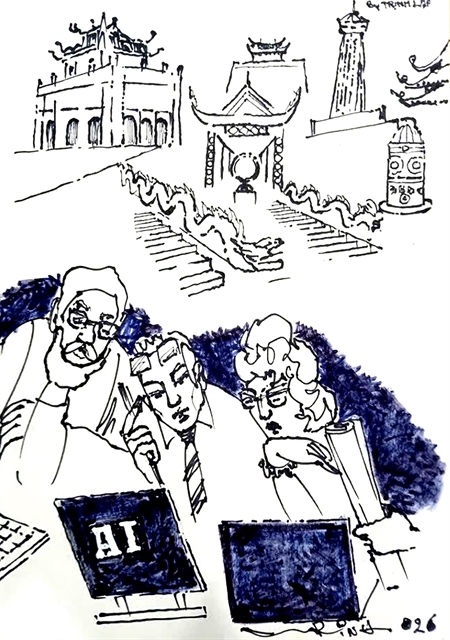
Dream of the visible 1300 years of history in the heart of Hà Nội starts to take shape
1.
.png) |
| Where hearth smoke preserves the seasons, water colour by Giang Lai. |
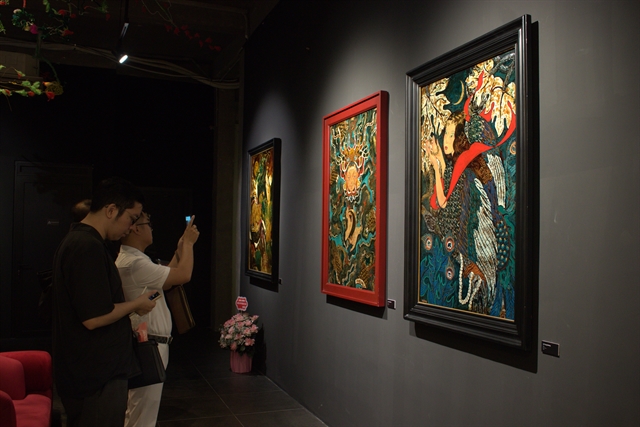
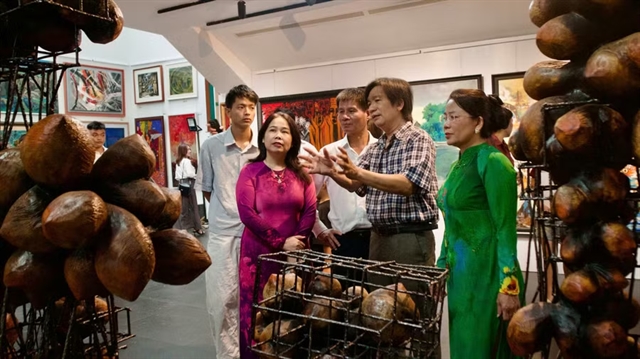
HÀ NỘI — More than 120 artworks by 53 artists are on display at the Thái Học Hall in the Temple of Literature, from August 8 to September 25.
The exhibition brings together artists of different ages and professions, working with a range of materials, including silk, lacquer, dó paper, woodblock printing, watercolour, gouache and experimental media.
Set in the Temple of Literature, a site closely associated with Việt Nam's traditions of learning and scholarship, the exhibition creates a dialogue between heritage from the past and the ways it is viewed today.
One heritage, many perspectives
One of the most notable features of Millennia of Heritage is the absence of a single way of portraying heritage.
The Temple of Literature appears solemn in The Sacred source of national essence by Giang Lai, where light falls across the doctoral stelae. The same site is seen more simply and directly in works by young artists.
Hà Nội also appears in different moods. The Military Central Hospital 108 residential complex by Nguyễn Đặng Phương Dung depicts a peaceful corner of the city; Early morning at Hoàn Kiếm lake by Thanh Thủy, a teacher, captures the city at the start of the day; while Where hearth smoke preserves the seasons by Giang Lai finds memories not in a historic monument but in the warmth of family life.
This diversity reflects the backgrounds of the participants. A child may see heritage with curiosity and imagination. Someone who has lived in Hà Nội for decades may associate it with personal memories. Those without professional art training may approach their subjects without being constrained by established conventions, finding their own ways of expressing them.
Artist Đinh Quang Huy, founder of the Tôi Vẽ (I paint) Club, said the diversity of the works provides a wide range of perspectives on heritage, from architecture, people and nature to culture and everyday life. Each work has its own voice while sharing a common appreciation of heritage.
The participants include civil servants, bank employees, businesspeople, sales staff, teachers and retirees - people whose daily lives revolve around paperwork, figures and work pressures. Some first encountered painting while taking their children to art classes, gradually becoming interested as they waited outside. Others turned to painting as a way of coping with periods of stress or depression, or simply as an opportunity to challenge themselves in a new field.
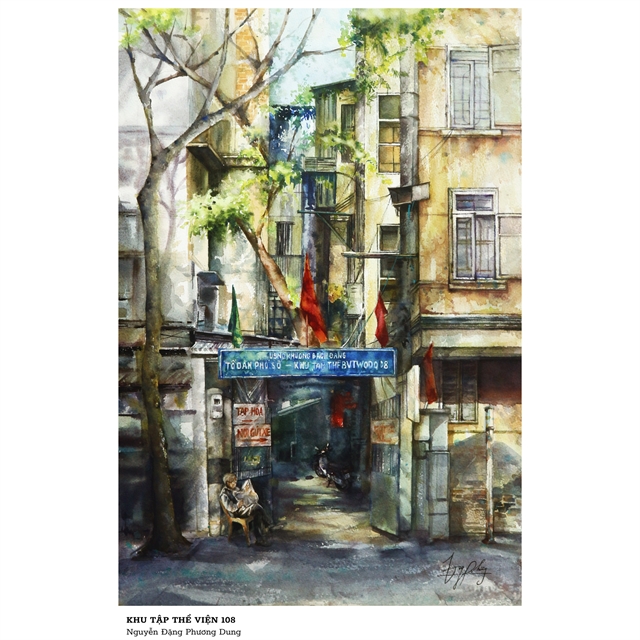 |
| Military Central Hospital 108 residential complex by Nguyễn Đặng Phương Dung |
Among the 53 artists are 15 children, alongside adults from a range of professions. Their fresh perspectives on the Temple of Literature and other Vietnamese cultural symbols create an interesting dialogue between generations.
Diverse materials, diverse expressions
The variety of artists is matched by the range of materials used in the works. On silk, Hà Nội takes on a softer character. A Peaceful window by Bùi Diệu Hương creates a quiet moment, while Hà Nội’s Railway alley and Long Biên in silk by Đặng Thị Kiều Trang depict a city in motion.
Lacquer offers a deeper, more subdued representation of Hà Nội. Images of Hoàn Kiếm Lake, cyclo riders, old streets, flowers and peaceful windows recall familiar aspects of the capital. But the medium is not limited to memories of the past. Works such as Over the mountain by Doãn Chí Minh, Before nightfall by Thùy Dung and The conqueror of the stars by Châu Đinh use traditional lacquer to explore contemporary ideas.
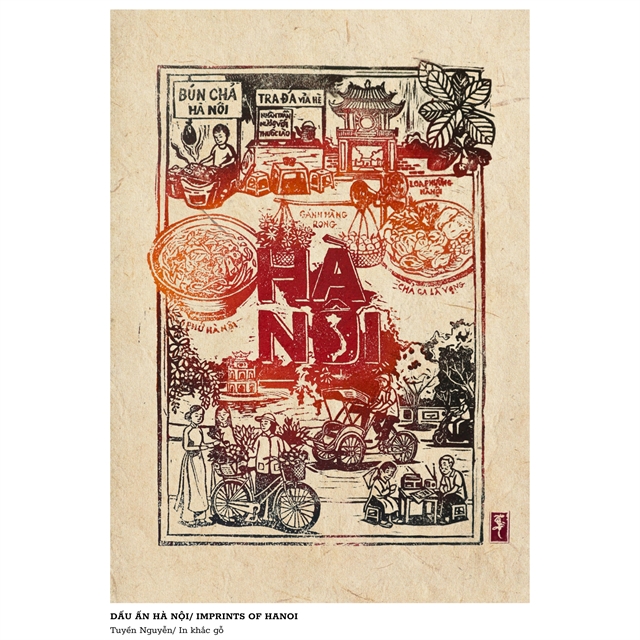 |
| Imprints of Hà Nội, woodblock print by Tuyền Nguyễn |
Dó paper creates a different effect. In An gia by Hoàng Hoài Thương, ink and watercolour are used on dó paper to depict a tea set, Tết sweets, peach blossoms and purple chrysanthemums - simple images associated with Vietnamese cultural memories.
Jose Antonio, a visitor from Spain, said that looking at An gia and the combination of Aqyla and dó paper made him feel 'strangely peaceful'. His response suggests that traditional materials can communicate beyond language and cultural background.
Artist Đinh Huy, meanwhile, experiments with Aqyla, a water-based oil paint, on dó paper, combining a traditional material with a contemporary approach.
Woodblock printing brings another distinctive element to the exhibition. Carved lines made on wooden blocks are printed onto Dó paper in works by Tuyến Nguyễn such as Millennial Imprints, Khuê Văn Các and Imprints of Hà Nội.
Keeping heritage in the conversation
For Lê Xuân Kiêu, Director of the Centre for Scientific and Cultural Activities at the Temple of Literature, Millennia of Heritage is more than an art exhibition. It reflects a love of Hà Nội, appreciation of heritage and a desire to promote Vietnam’s cultural values through art.
Kiêu said: “The Millennia of Heritage exhibition is not only an art event, but also a celebration of the love for Hà Nội, appreciation of heritage and aspiration to promote the nation’s cultural values through art.
"The Temple of Literature and the Tôi Vẽ Club are honoured to organise the event as a tribute to the nation’s history, culture and tradition of learning.”
The approach also continues the Tôi Vẽ Club’s community-based art activities and its belief that 'everyone can paint', following earlier exhibitions including Những Giấc Mơ Màu (Dreams in Colour), Tôi vẽ Hà Nội (I Paint Hà Nội) and Nước Non Ngàn Dặm (Across Mountains and Rivers).
Heritage is not preserved only by keeping existing works or repeating established stories. It is also passed on when a new generation explores traditional materials, tries old techniques, looks at familiar symbols from a different perspective, or simply develops a personal connection with them. That may be how heritage remains alive, not by preserving a single way of telling its story, but by ensuring that there are always people willing to tell it again.
The 'Millennia of Heritage' exhibition runs from August 8 to September 25 at the Thái Học Hall, Temple of Literature, Hà Nội. — OVN/VNS
Life & Style
 Life & Style
 Life & Style
 Life & Style
 Life & Style
 Life & Style
 Life & Style
 Life & Style
 Life & Style
 Life & Style
 Life & Style
 Life & Style
 Life & Style
 Life & Style
 Life & Style