 Society

World Health Summit 2026: Berlin Becomes Global Meeting Point for the Future of Health
1.
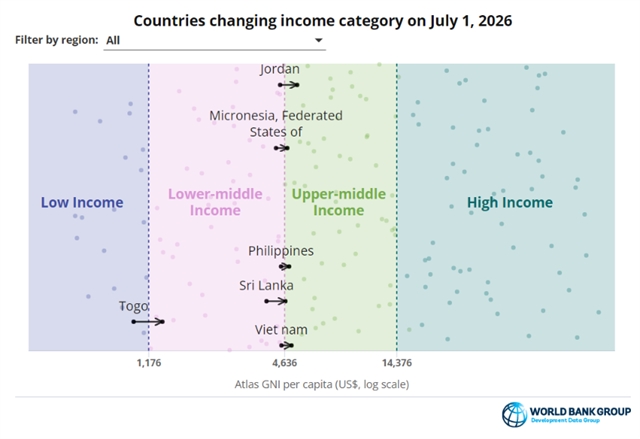 |
| Data from World Bank shows Việt Nam among five countries moving up to the upper-middle income group in its latest country income classifications. Photo courtesy of the World Bank |
HÀ NỘI — The World Bank has moved Việt Nam up from the lower middle-income to upper middle-income group in its latest country income classifications, released on July 1.
The evaluations were made based on each country’s gross national income (GNI) per capita in the previous year, with Việt Nam’s increasing from $4,490 in 2024 to $4,970 in 2025.
This figure exceeded the minimum value for a country to enter the upper middle-income group that the World Bank set for 2025, which was $4,516.
The GNI per capita, measured in US dollars and adjusted for short-term swings in exchange rates, places economies into the four income groups of low, lower-middle, upper-middle, and high.
The thresholds are adjusted for inflation and other factors such as economic and population growth, shifts in national accounts, and revisions to underlying data.
The thresholds that define upper-middle-income countries were set at $4,496-13,935 for this year, and $4,636-14,375 for 2027.
Việt Nam’s upgrade was thanks to its ‘export-led’ economic model, with exports surging by more than 15 per cent in both 2024 and 2025, and GDP growing at 7 and 8 per cent, respectively, according to the World Bank.
The country’s GNI expanded at an average of 10 per cent annually between 2021 and 2025, which the organisation said was “one of the strongest sustained runs in the region”.
Việt Nam is one of the six countries that moved to a higher income status this year, out of 218 countries assessed.
 |
| Quy Nhơn Port, Gia Lai Province. — VNA/VNS Photo |
Four other countries that moved from lower-middle to upper-middle income are Jordan, Micronesia, the Philippines and Sri Lanka, with GNI per capita in 2025 at $5,260, $4,760, $4,850 and $4,670, respectively.
Togo, a West African country, moved from low to lower-middle income, with the figure standing at $1,350.
“The update matters because the classifications inform which countries can access concessional loans and development assistance, and help governments, researchers and a wide range of international organisations track economic progress worldwide,” the World Bank said in its release of the classifications.
However, it does not affect the World Bank's current lending policies as Việt Nam and the Philippines remain in the group borrowing from the International Bank for Reconstruction and Development (IBRD), and Sri Lanka from the International Development Association (IDA), which are two major institutions that make up the World Bank Group.
Việt Nam aims to become an industrialised, upper-middle-income developing country by 2030, and a high-income developed country by 2045.
An economic growth rate of 10 per cent or higher has been set for this year to realise these ambitions. — VNS
Society
 Society
 Society
 Society
 Society
 Society
 Society
 Society
 Society
 Society
 Society
 Society
 Society
 Society
 Society
 Rikkeisoft ký kết MOU với LAC.Co, LTD - thúc đẩy hợp tác kinh doanh toàn diện trong lĩnh vực an ninh mạng.jpg)