 Society

World Health Summit 2026: Berlin Becomes Global Meeting Point for the Future of Health
1.
|
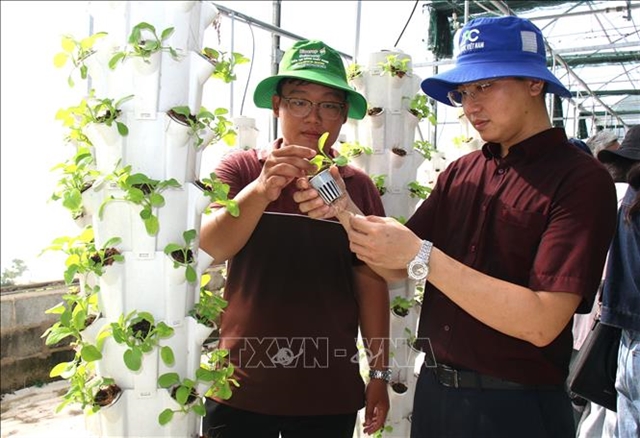
| Vertical hydroponic vegetable farming models are proving highly effective in optimising space, increasing productivity, and boosting yields, making them perfectly suited for urban agriculture in HCM City. — VNA/VNS Photos Hương Giang |
HCM CITY — Over the past half-century, HCM City's agricultural sector has transformed from a manual industry reliant on traditional practices into a high-value urban model driven by tech and innovation.
Facing rapid urbanisation and a shrinking land fund, the southern economic hub chose to develop high-tech, ecological farming.
Automated systems, biotechnology, and digital platforms have drastically boosted the quality and competitiveness of its agricultural products.
Following national reunification in 1975, the city rapidly reclaimed over 70,000 hectares of uncultivated land to meet urgent food demands.
Cultivation areas expanded from 45,000 to 115,000 hectares, pushing annual rice production from 95,000 tonnes in 1975 to 160,000 tonnes by 1976.
Management reforms in the 1980s and 1990s prioritised high-value commodities, sustaining a 5.9 per cent annual growth rate.
By the early 2000s, high-yield urban farming models were generating hundreds of millions of đồng per hectare.
A major shift occurred in July, 2025, when the administrative boundary merger of HCM City, Bình Dương, and Bà Rịa-Vũng Tàu quadrupled the city's available agricultural land.
This expanded territory allowed the sector to phase out low-efficiency activities and focus strictly on high-value supply chains.
By 2025, the sector maintained a 2.5 per cent growth rate.
The expanded hub now boasts over 18,400 hectares of crops, 173 hectares of brackish water shrimp farms, and two high-tech agricultural zones, supplying millions of tissue-culture plantlets, mushroom spawns, and ornamental fish to the market.
Võ Thành Giàu, deputy director of the city Department of Agriculture and Rural Environment, said unlike rural provinces, the city faces intense land competition from industrial and infrastructure projects.
"This presents a unique challenge: the city cannot compete on land mass or output volume. Instead, it must maximise economic value on every single square metre of land."
This pressure accelerated the shift toward specialised, high-tech zones for safe vegetables, flowers, and aquaculture.
In Châu Pha Commune, the Châu Pha Agricultural Production and Service Cooperative manages 55 hectares of clean, VietGAP-compliant vegetables, including 20 hectares for European exports.
The cooperative’s director Nguyễn Viết Tự said tech integration allows them to export three tonnes of aromatic herbs to Europe weekly, with chilli exports to South Korea launching later this year.
"Everything from greenhouses and automated irrigation to production management software is applied to ensure products meet stringent quality and traceability standards required by demanding international markets," he said.
Farming households have successfully pivoted to this quality-first model.
Local farmer Đỗ Thanh Hiền added that adhering to these strict guidelines ensures stable purchase prices, securing his family an annual income of nearly VNĐ300 million (US$11,800).
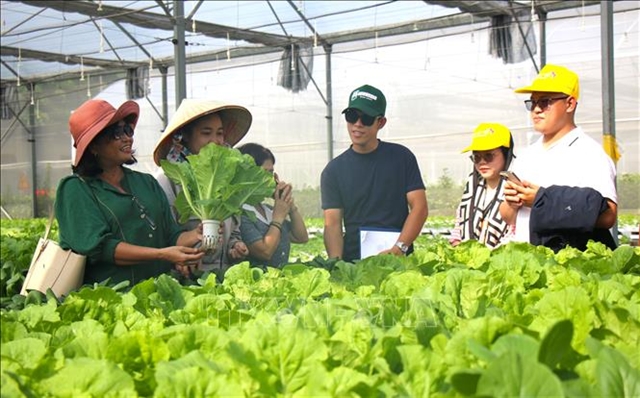
|
| Students visit and study a hydroponic vegetable farming model at the HCM City High-Tech Agricultural Park. |
Urban agricultural economy
Nguyễn Thanh Hiền, deputy head of the HCM City High-Tech Agricultural Park (AHTP) Management Board, said moving from "volume" to "value" remains the city's defining achievement.
The city has progressively transitioned from a traditional agricultural mindset to an 'urban agricultural economy', Hiền said.
“Every square metre of land is optimised through science and technology to yield the highest economic efficiency."
Established in 2004 as Việt Nam's first high-tech farm park, the AHTP has incubated over 60 enterprises and developed 150 transferable technical processes, including smart greenhouses and drip irrigation, now used nationwide.
Dr Nguyễn Hải An, director of the HCM City Biotechnology Centre, said alongside zoning the newly expanded territory, the city must continue investing in human resources, start-ups, and community training.
"These efforts are building a comprehensive high-tech agricultural ecosystem where science is present at every stage, from seed research and farm management to processing and consumption."
Backed by digital transformation tools like blockchain traceability, drones, and environmental sensors, the city’s agricultural sector has effectively turned land constraints into a competitive edge, anchoring its position as a pioneer in smart, green farming. — VNS
Society
 Society
 Society
 Society
 Society
 Society
 Society
 Society
 Society
 Society
 Society
 Society
 Society
 Society
 Society
 Rikkeisoft ký kết MOU với LAC.Co, LTD - thúc đẩy hợp tác kinh doanh toàn diện trong lĩnh vực an ninh mạng.jpg)