 Society
NA President visits Beijing legislative liaison station
1.
|
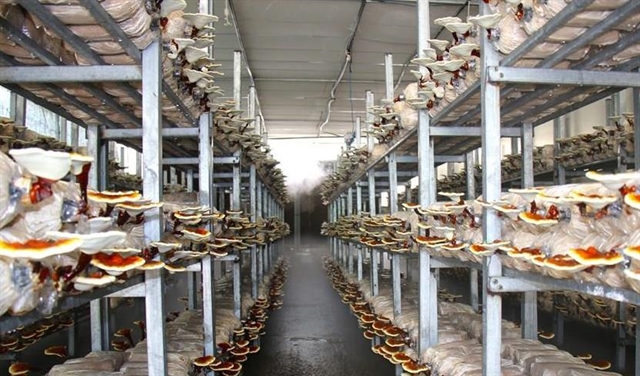
| A linh chi (Ganoderma lucidum) mushroom cultivation model that uses IoT at the HCM City High-Tech Agricultural Park. — VNA/VNS Photos Hương Giang |
HCM CITY — With 50 years of development and a successful transition from traditional production to high-tech farming behind it, HCM City is now building a green, smart, and sustainable agricultural sector with the ambition of becoming a leading innovation hub in Việt Nam and the wider region.
With limited land for physical expansion, the southern economic locomotive is reshaping its agricultural landscape by focusing on biotechnology, artificial intelligence, big data, and the circular economy.
The driving force behind this transformation has shifted from State-backed programmes to pioneering businesses leading agricultural value chains.
Their growing role has fundamentally changed the city’s agricultural mindset, shifting from supply-driven production to market-oriented models that prioritise quality, traceability, and added value.
Trần Nguyễn Khánh Vy, deputy director of Goodlife Company, said the city’s agriculture had evolved from relying on traditional experience and production volume to focusing on food safety and international standards.
Her company exports around 5,000 tonnes of fresh fruit annually to demanding markets such as the US, Australia, New Zealand, Canada, and Europe.
She said: "HCM City has pioneered a favourable environment for businesses to access new technologies and innovate. This has enhanced the competitiveness of Vietnamese agricultural products globally."
Rather than farmers alone driving production, businesses now lead the market by investing in technology, building brands, and connecting the value chain from farm to fork.
This has created a high-tech ecosystem in which businesses, scientists, co-operatives, and farmers co-create value.
With land scarcity a major constraint, local firms are focusing on intensive, specialised production.
Phương Minh Tú, deputy sales director of TPC Pharmaceutical JSC, said his company specialises in biotechnology and extracting active compounds from medicinal herbs such as xáo tam phân (Paramignya trimera), which has anti-cancer properties.
Incubated at the HCM City High-Tech Agricultural Park (AHTP), TPC has supplied more than one million saplings and developed a nearly 100-hectare raw material zone.
Tú said: "Technology is no longer a supporting factor; it is essential to increasing the value of agricultural products. City businesses must compete on technology and seed quality rather than land area."
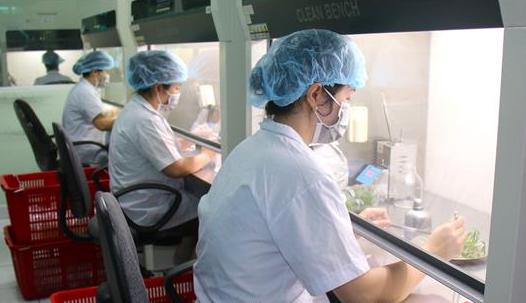
|
| Tissue-cultured saplings from the HCM City High-Tech Agricultural Park’s laboratory ensure uniformity, are disease-free, and deliver high yields and efficiency. |
Paving way for green agriculture
As climate change intensifies, green development and emissions reduction are becoming essential requirements for the sector.
Nguyễn Thanh Hiền, deputy head of the AHTP, said to maintain its role as an innovation leader, the city would focus on three pillars: low-emission ecological agriculture, the circular economy, and faster digital transformation.
The city plans to develop 12 specialised high-tech agricultural zones in future, he said.
“Each zone will serve as an R&D hub, spreading technology and technical processes to production areas while helping build large-scale, high-tech agricultural value chains.”
The city will also step up research into seeds, biotechnology, AI, IoT, blockchain, and big data as it builds a modern digital agriculture platform.
Dr Nguyễn Hải An, director of the HCM City Biotechnology Centre, said the expanded development space created by the integration of Bình Dương and Bà Rịa-Vũng Tàu provinces with HCM City offers a great opportunity to restructure the sector.
“This synergy will connect urban R&D with regional production, logistics, and export hubs.”
Bùi Minh Thạnh, vice chairman of the municipal People's Committee, said global trends meant agriculture could no longer rely on resource exploitation or volume growth alone.
Instead, the city aims to build a next-generation high-tech agricultural ecosystem, he said.
"Innovation must not stop at research; it must be translated into practical products, services, and business models through close collaboration among authorities, research institutes, universities, businesses, and investment funds."
From IoT-enabled greenhouses and biotechnology laboratories to circular economy models and digital farms, a new era of agriculture is taking shape in HCM City.
Driven by data, knowledge, and innovation, the sector is positioning the city as a leading high-tech agricultural innovation hub in Southeast Asia. — VNS
Society
 Society
 Society
 Society
 Society
 Society
 Society
 Society
 Society
 Society
 Society
 Society
 Society
 Society
 Society

 Rikkeisoft ký kết MOU với LAC.Co, LTD - thúc đẩy hợp tác kinh doanh toàn diện trong lĩnh vực an ninh mạng.jpg)