 Society

Data centre market faces energy challenges
1.

|
| Students sit for the 2026 high school graduation exam in the northern province of Phú Thọ on June 12. — VNA/VNS Photo |
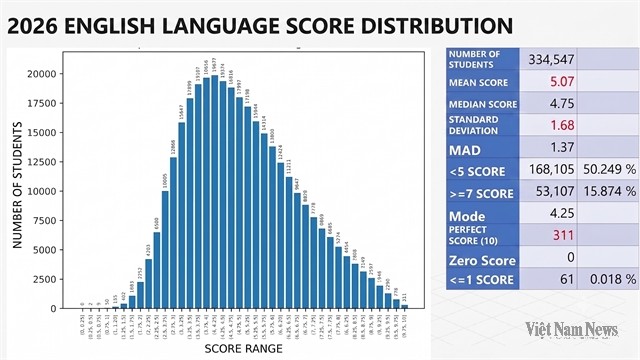
HÀ NỘI — A high proportion of below-average scores in English on this year's high school graduation exam does not signal a decline in teaching quality, education experts have said, instead attributing the results to a shift in the students who sit the subject.
The Ministry of Education and Training released exam results and score distributions on Wednesday, prompting analysis from several senior education officials.
Professor Lê Anh Vinh, director of the National Institute of Educational Sciences, said English is now an elective subject. Students with strong foreign language ability, demonstrated through international certificates such as IELTS or TOEFL, are exempt from the exam or use score conversion instead.
The students who do sit the English exam are largely those with weaker language skills, he said, which lowers the average without indicating a broader drop in teaching standards.
However, both Vinh and Professor Nguyễn Đình Đức from Việt Nam National University Hà Nội agreed that English teaching methods still need continued reform to meet the demands of international integration.
The English results were part of a wider pattern of sharper score differentiation this year, a positive development for a test that both certifies graduation and feeds into university admissions, according to experts.
|
| The English language score distribution. — Photo xaydungchinhsach.chinhphu.vn |
In literature, the share of students scoring a seven or above fell to about 35 per cent, down from a range of 62 to 65 per cent in previous years. Đức called this evidence of a shift towards more substantive assessment.
Geography saw a similar change. The proportion of top scores in that subject dropped to just over 2 per cent, ending what Đức described as a previous pattern of unusually high numbers of perfect or near-perfect scores.
Scores in mathematics, physics, chemistry and biology remained stable while still differentiating between students.
Đức said the narrower spread of high scores across subjects does not reflect declining student ability, but rather a more accurate assessment of it, and described it as a step towards genuine learning and more accurate selection of talented students.
Vinh said the more stable mathematics results reflect greater familiarity among teachers and students with the 2018 general education curriculum.
He said a new rubric-based grading method for literature has improved objectivity and given students more room to express individual thinking, even though the overall shape of the literature score distribution changed little from previous years.
The shift in score patterns is expected to affect admission benchmarks.
Đức forecast that benchmarks at top universities and in high-demand majors are likely to fall by 1–3 points compared to last year, with majors admitting students through the C00 combination – literature, history and geography – facing steeper declines given the shift in those subjects' distributions.
Benchmarks for most other subject combinations are expected to shift by about one point and settle in a range of 15 to 20 points, depending on the school and major, he said.
Đức added that the current score distribution gives universities confidence to rely on the graduation exam for admissions without needing to introduce additional separate entrance exams.
Hà Nội National University of Education rector and Associate Professor Nguyễn Đức Sơn described this year's distribution as well-balanced and well-differentiated, which he said eases pressure on universities to organise their own assessment tests.
He said the results reflect the 2018 curriculum's focus on developing student competencies and character, aided by teacher training in rubric-based assessment methods in recent years.
Sơn also noted a sharp rise in student registration for informatics, technology and economics and law education, which shows that students are increasingly choosing subjects based on interest, ability and career direction rather than solely to meet university admission requirements.
Experts said the score data serves a purpose beyond admissions, providing the ministry with a basis to compare performance across regions and subjects and to adjust teaching methods and assessment policy. — VNS
Society
 Society
 Society
 Society
 Society
 Society
 Society
 Society
 Society
 Society
 Society
 Society
 Society
 Society
 Society