 Society
Sơn La applies science and technology to coffee production
1.
|
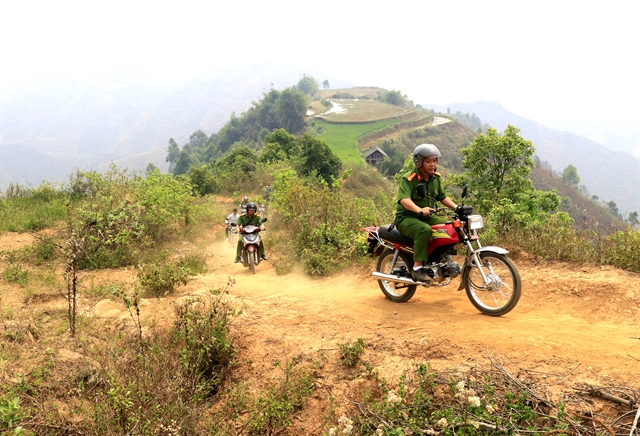
| Police officers on the way to households in remote areas to disseminate information about drug prevention and control in the mountainous northern province of Lào Cai. — VNA/VNS Photo Định Thùy |
HÀ NỘI — Việt Nam's anti-drug crime forces, including the People's Public Security force, are intensifying efforts to prevent narcotics from entering the country.
In late February, nearly 300 officers from the Ministry of Public Security's Drug Crime Investigation Police Department and local police forces simultaneously launched 18 operations across Hà Nội, Hải Phòng, Điện Biên, Sơn La, Nghệ An and Hà Tĩnh.
The investigation aimed to dismantle an entire transnational network involved in transporting chemical precursors used to manufacture synthetic drugs.
After months of painstaking intelligence gathering, verification, financial tracking and close coordination with domestic and international law enforcement agencies, investigators seized a total of 50.7 tonnes of caffeine.
Had the shipment reached Myanmar, the precursor could have been used to produce more than 150 tonnes of methamphetamine tablets, according to authorities.
Lieutenant Nguyễn Trọng Tuấn, deputy head of the department’s Office 2, told the Vietnam News Agency that the global drug trade is highly complex, with criminal groups adopting increasingly sophisticated, technologically advanced and transnational methods.
He said traffickers are not only expanding drug transactions through cyberspace, but are also using encrypted messaging applications, cryptocurrencies, anonymous bank accounts, express delivery services and logistics networks to conceal their criminal activities.
Even more concerning, organised drug syndicates have forged links with other forms of organised crime, including money laundering and smuggling, creating massive criminal networks operating across multiple countries.
Việt Nam is located close to the Golden Triangle and has well-developed road, maritime and air transport infrastructure.
“International criminal organisations are therefore seeking every opportunity to exploit the country as a transit point, storage location and production base for drugs, while introducing new types of narcotics into the domestic market," he said.
This trend is reflected in a 2025 United Nations Office on Drugs and Crime report, which found that seizures of synthetic drugs across East and Southeast Asia and the Pacific rose by 18 per cent compared with the previous year.
The Golden Triangle remains a major supply source for various synthetic narcotics. Meanwhile, that pressure is being felt directly in Việt Nam.
In 2025, drug crime investigation police nationwide uncovered 21,998 drug-related cases, arrested 44,354 suspects and seized 276kg of heroin, 1,280kg of cannabis, 4,396kg of synthetic drugs and more than two million methamphetamine tablets.
During the first quarter of this year alone, authorities uncovered a further 7,424 cases, arrested 14,813 suspects and confiscated large quantities of illegal drugs.
Tuấn said as drug trafficking increasingly shifts to digital platforms, the department is stepping up the use of science, technology and digital transformation in its operations, while expanding international cooperation to exchange intelligence, conduct joint investigations, apprehend suspects and coordinate cross-border investigations from the point of origin.
That determination is reflected in a coordinated anti-drug campaign launched by Việt Nam, China, Laos and Myanmar that will run from mid-June to mid-September this year.
The four countries have agreed to conduct joint investigations, pursue wanted fugitives and expand inquiries to identify and prosecute criminal masterminds while dismantling entire transnational trafficking networks.
|
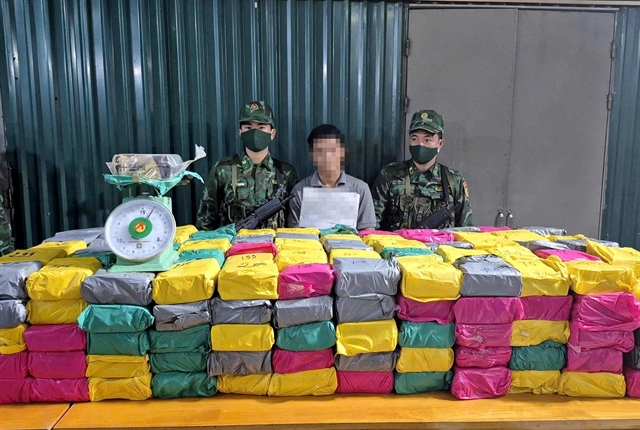
| Border Guard forces successfully cracked a major drug trafficking case, seizing 500kg of various types of drugs in the central province of Quảng Trị. — VNA/VNS Photo |
Cracking down at home
While operations along the border and overseas are designed to cut off supply, an equally intensive battle is being fought within Việt Nam.
The focus is on eliminating venues where illegal drug use is organised or facilitated, cleaning up local communities, reducing domestic demand and tackling drug-related crime at its source.
Police units across the country have dismantled a number of major drug hotspots in the past few months.
Hà Nội police shut down a venue in the city's Đan Phượng Commune where illegal drug use had been organised and facilitated, leading to criminal proceedings against 89 suspects.
Authorities also prosecuted 62 suspects after dismantling illegal drug-use operations at The King Karaoke and Club 71 in the Mekong Delta province of Vĩnh Long.
In HCM City, police raided Phương Lâm Bar and charged 25 suspects, while in the central province of Quảng Ngãi, dozens of people tested positive for drugs during an inspection of Venus Karaoke.
The department said these results demonstrate the rigorous implementation of the ministry’s strategy to reduce domestic drug demand and realise the goal of ensuring that at least half of Việt Nam's communes, wards and special administrative zones are drug-free by 2030.
Behind those successes, however, lies an extremely dangerous struggle.
Tuấn described transnational drug trafficking as one of the most dangerous forms of organised crime.
Criminal groups now operate through tightly compartmentalised networks spanning multiple countries, make extensive use of advanced technology and are prepared to use firearms when confronted by law enforcement.
Officers often spend months or even years conducting surveillance, verification and intelligence gathering to successfully dismantle a major criminal network.
“Every successful operation reflects extraordinary perseverance, professionalism and a deep sense of responsibility. Many officers have been injured, and some have sacrificed their lives in the line of duty," Tuấn said.
He added that combating drug crime is not solely the responsibility of specialist police units, but requires the participation of the entire political system and society as a whole.
Early line of defence
Statistics from the department show that as of April 1, Việt Nam had 299,960 drug addicts, illegal drug users and people under post-rehabilitation supervision, representing a decline of 18.7 per cent compared with April 2025.
However, more than 131,000 drug users remain in the community, representing a substantial source of demand and posing an ongoing risk of drug-related crime and social disorder if not effectively managed.
Meanwhile, drug traffickers are changing their methods of recruitment.
Rather than waiting for young people to seek out drugs, synthetic narcotics disguised as sweets, beverages, electronic cigarettes, vape liquids and other products are increasingly finding their way into parties, bars, karaoke venues and online platforms.
Young people's curiosity, desire for acceptance and academic and social pressures, along with insufficient parental supervision or guidance, create vulnerabilities that criminal groups readily exploit.
Tuấn said the most important priority is to build an early "protective shield" for younger generations.
That shield consists of attentive families, effective school education, active support from youth and community organisations and a healthy social environment.
Drug prevention must remain at the heart of national efforts, with the public as the central actor and young people as the primary target for preventive measures, he said.
Alongside strict law enforcement, police are working with other agencies to provide drug rehabilitation, vocational training, employment opportunities and social welfare support for people recovering from addiction.
Without meaningful opportunities to reintegrate into society, the risk of relapse remains high. — VNS
Society
 Society
 Society
 Society
 Society
 Society
 Society
 Society
 Society
 Society
 Society
 Society
 Society
 Society
 Society