 Society
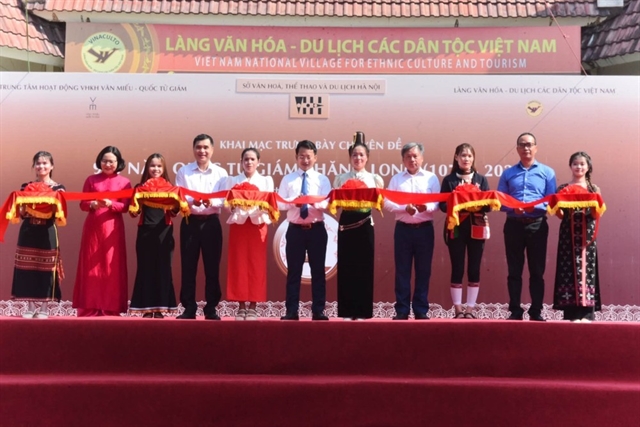
Exhibition marks Temple of Literature's 950th anniversary
1.
|
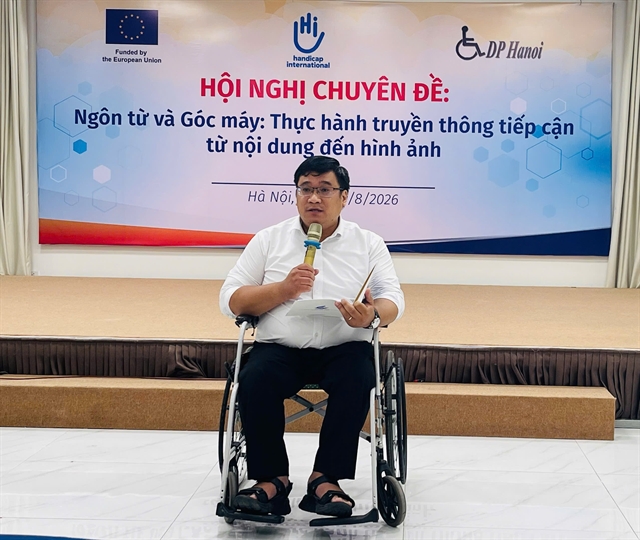
| Phạm Quang Khoát, deputy chairman of the Hà Nội Association of People with Disabilities, speaks at the event. — VNS Photos Thu Trang |
HÀ NỘI — Among the many ways to shift societal perceptions of persons with disabilities, the media is one of the most powerful tools.
That was the message from Phạm Quang Khoát, deputy chairman of the Hà Nội Association of People with Disabilities (DP Hà Nội), speaking at a specialised training programme held in Hà Nội on Wednesday.
The event, themed 'Words and camera angles: Practising inclusive media from content to imagery', was co-organised by the DP Hà Nội and the Humanity & Inclusion (HI).
It is a part of the project 'Making inclusion campaign by persons with disabilities', conducted by the DP Hà Nội, in partnership with the HI and with fund from the European Union.
“A single article can change how thousands, even millions, of people perceive persons with disabilities," Khoát said.
"A single photograph can lead readers to see a person with full capabilities, aspirations and social roles, or, conversely, inadvertently reduce them to an object of pity. And sometimes, just one seemingly small word can create a vast distance.
"People still frequently see articles with headlines such as ‘The indomitable spirit of a disabled person vows’, ‘Success and happiness of a disabled girl’, or ‘A disabled girl performs a miracle’.
“I believe that most of those who write such articles do not intend to hurt persons with disabilities. They may simply wish to tell a compelling story or share an inspiring example of resilience. But the issue lies here: from whose perspective are we telling that story?”
He pointed out that often there are misconceptions like if a wheelchair user graduates from university, we must call it a ‘miracle’, or if a woman with a disability has a good job, builds a family and lives happily, that is a ‘fairy tale’? Or it is simply an ordinary life that any person has the right to choose and pursue.
“We are talking about a broader shift: a change in mindset. From an approach based on pity and charity, to one grounded in human rights, equality and inclusion,” Khoát added.
He called for a shift in attitude from seeing persons with disabilities as people who ‘need help’, to recognising them as citizens with rights, capabilities, voices and the ability to contribute to society.
A truly modern media landscape is not one defined solely by advanced technology or beautiful imagery, he said, adding that there must be a media landscape that respects people, reflects societal diversity, and ensures that everyone is seen, heard, and able to tell their own story fairly.
“I believe that, with the support of press agencies, journalists and especially young media practitioners, we can absolutely create a new way of telling stories about persons with disabilities,” said Khoát.
The way is, according to Khoát, without pity, without turning disability into a miracle, but by telling their stories as ordinary people with extraordinary lives, in a very human way: with dreams, capabilities, successes, failures, joys, difficulties, and above all, with the right to live a life of their own choosing.
“Every word we choose, every frame we create, can either build a barrier, or open a door to inclusion,” Khoát said.
|
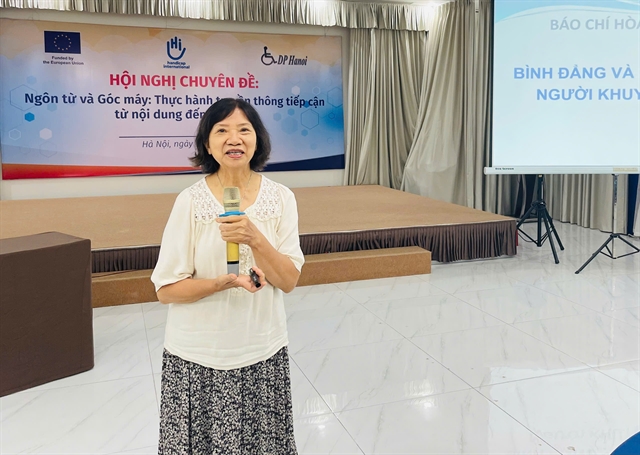
| Dương Thị Vân, director of the Inclusion Consulting and Capacity Support Centre, shares her points of view. |
Dương Thị Vân, director of the Inclusion Consulting and Capacity Support Centre (ICC) and former chairwoman of the DP Hà Nội, also shared the view that, alongside improving accessibility in infrastructure and services, changing community perceptions was also a crucial factor in advancing inclusion.
Experiences
|
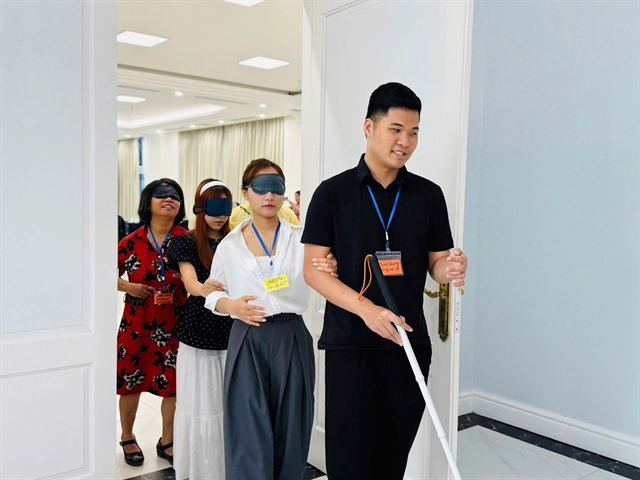
| Participants join experiential groups focusing on mobility impairments, visual impairments and hearing impairments. |
As a part of the programme, participants were divided into three experiential groups focusing on mobility impairments, visual impairments and hearing impairments.
Nguyễn Thùy Dương, a student at the Academy of Journalism and Communication, said: “This is my first time experiencing the use of a wheelchair.
"I found getting around outside much more difficult, especially when unable to get down stairs independently. Accessing toilets was also a challenge, as not all spaces are designed to accommodate wheelchair users.”
Nguyễn Thị Thục Hạnh, former editor-in-chief of the Việt Nam Women’s Newspaper and former member of the Việt Nam Journalists’ Association Executive Committee, shared key considerations for media coverage of persons with disabilities.
“An article about persons with disabilities does not need to make readers feel sorry for the person, nor does it need to force the person to be inspirational," she said.
"Media coverage of persons with disabilities should shift from a humanitarian angle to a mainstream social topic.”
|
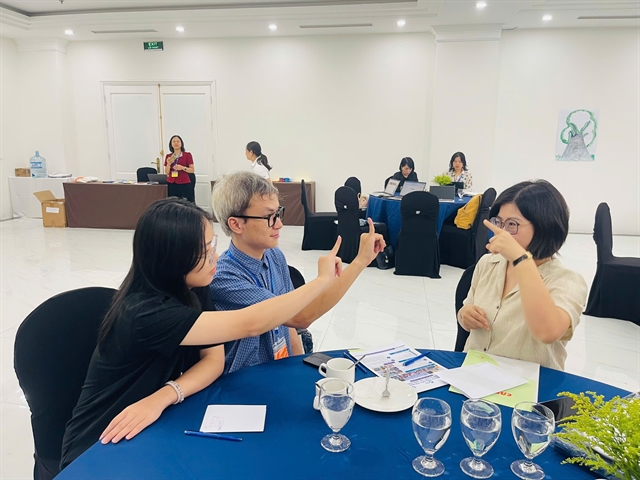
| People exchange their opinions at the programme. |
Through experiential activities and discussions, the programme helped media practitioners gain a clearer understanding of the barriers faced by persons with disabilities, thereby enabling more appropriate choices of language, imagery and approach.
Participants agreed that media coverage of persons with disabilities should not stop at recounting stories of overcoming hardship, but must reflect them as equal people with capabilities, needs, aspirations and the right to choose, thereby contributing to building an inclusive society free from stigma and discrimination against persons with disabilities. — VNS
Society
 Society
 Society
 Society
 Society
 Society
 Society
 Society
 Society
 Society
 Society
 Society
 Society
 Society
 Society
.jpg)